

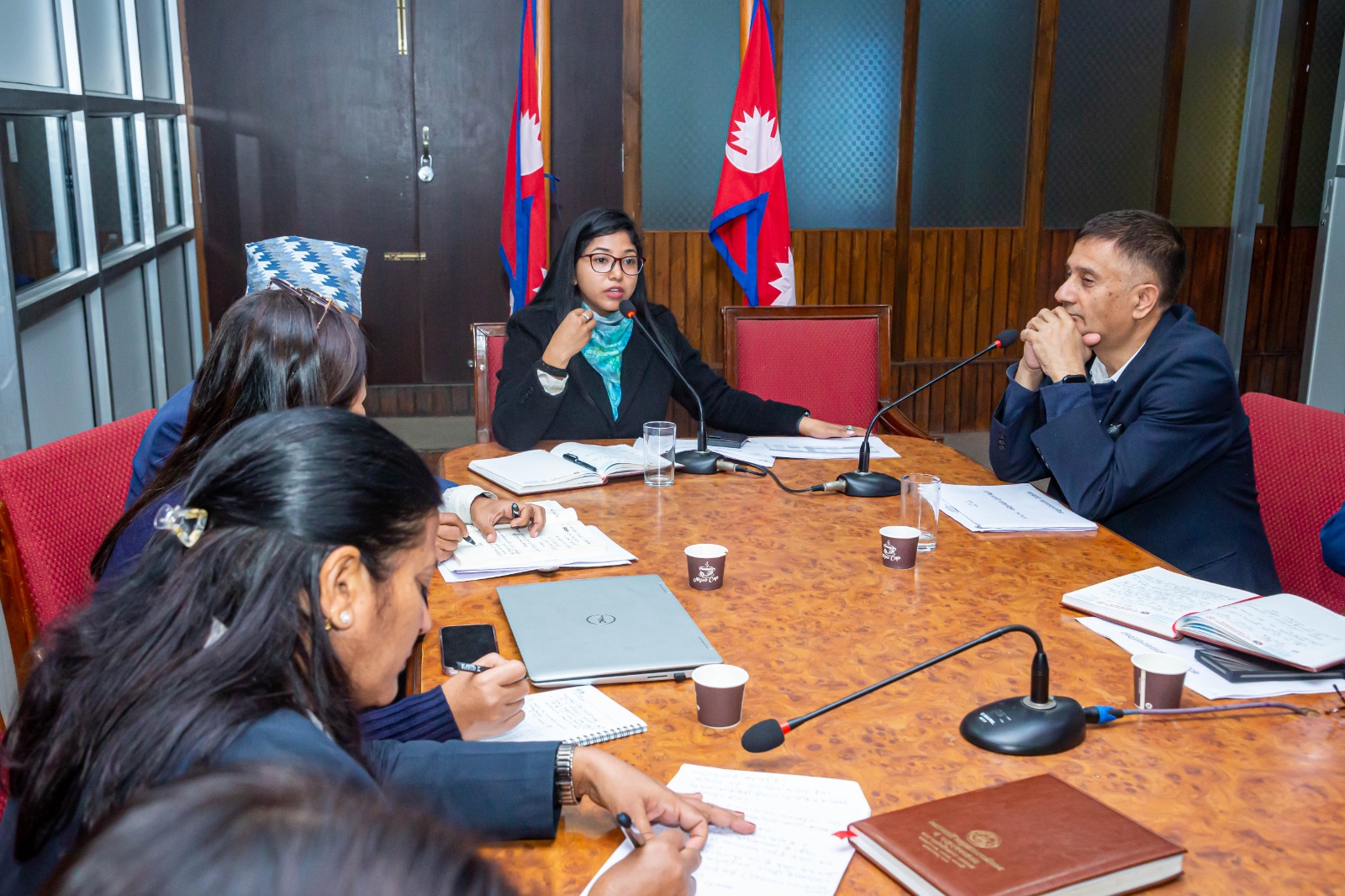
Kathmandu. Kathmandu Metropolitan City (KMC) has achieved 52.23 percent result in expenditure and 74.15 percent in internal income in the fiscal year 2081/82. This information was shared at a departmental annual review program organized by the Project Monitoring and Evaluation Unit at Kathmandu Plaza.
After the progress analysis presented by Deputy Director of the unit Gangadhar Gautam in the review, Deputy Mayor Sunita Dangol urged the departmental chiefs to realize that the present efforts could not yield results due to lack of internal and external coordination and communication. “The review will not be done only by holding a formal meeting. Departmental and sectoral problems and possibilities can always be reviewed in any formal or informal way. Mutual dialogue and discussion can be done. This will be beneficial in terms of mutual progress,” he said, adding, “It has been a long time since we talked about integrated and sustainable urban infrastructure. Now, we should start with drawing, designing and mapping, not talking. ’
Giving the example of floods in the city and water recharge to the ground, he said, “Let us make water recharge system mandatory while constructing roads and walkways. It has positive results in many areas, including human settlement, urban management and the environment. ’
On the presentation, Chief Administrative Officer Saroj Guragain stressed on the need of enhancing spending capacity by institutionalizing good practices such as effective monitoring system, complaint management, sustainable journey towards digital governance, recovery of fines and protection of public land.
Presenting the details received from the departments, Deputy Director Gautam said that Rs 13.03 billion or 52.12 per cent of the Rs 25.86 billion allocated for the current fiscal year has been spent. Out of this, Rs 6.22 billion was current expenditure, Rs 6.73 billion was capital expenditure and Rs 70 million was financial expenditure.
According to Bikash Chitrakar, acting chief of the Finance Department, 37.67 per cent of the budget has been spent on economic development, 47.91 per cent in social development, 52.52 per cent in infrastructure development, 28.88 per cent in good governance and inter-related sectors and 77.02 per cent in office operation and administrative sector. In the last fiscal year (FY 2080/81), 38.11 percent, 60.34 percent, 46.35 percent, 31.61 percent and 73.13 percent of the expenditure was incurred in these sectors respectively. This year, the total expenditure was 51.03 percent.
Chief of the Department of Administration Dhruba Kumar Kafle said the expenses have increased as KMC was expanding its service areas and it was not possible to completely abandon the traditional process with the practice of e-governance system.
This year, 49.48 per cent of the Rs 23.31 billion allocated was spent while 88.70 per cent of the Rs 1.69 billion received from conditional grants was spent. Of the Rs 4.73 billion allocated for ward levels, 60.38 per cent was spent. The average expenditure of the departments was 46.7 percent.
The inland revenue collection target for the current fiscal year was Rs 8.03 billion. Of this, 74.15 percent i.e. Rs 5.95 billion was collected. This is 1.55 less than the previous year. On the issue of decline in internal income, Chief of the Department of Revenue, Dipak Adhikari, said that it was difficult to meet the target as the institutional restoration tax was deposited at the Inland Revenue Office due to the policy-level ambiguity in the restoration tax.
This year, Rs 2,35,14,96,000 was received from the allotment. This is 93.96 percent of the target. Rs 2,433,38,60,000 was received from internal grants. This is 102.79 percent of the target. This year, the government collected 66.71 percent property tax, 84.88 percent rent tax, 41 percent map pass fee and 87.45 percent recommendation fee against the target.
This year, the goals of vibrant cities, safe habitats, civilized society and sustainable development were set. The main programmes included infrastructure development, zero emission goal in waste management, protection and promotion of cultural heritage, urban greenery and investment in disaster management.
Sectoral goals and progress
This year, the Public Works Department had a budget of Rs 5.49 billion. Of this, 52.12 percent i.e. Rs 2.86 billion was spent. Out of 243 schemes under the department, 148 were implemented. The department achieved 52.12 per cent financial progress and 57.50 per cent physical progress.
A total of Rs 2.41 billion was allocated for 401 programmes in the heritage and tourism sector. There were 276 tangible heritage events and 125 intangible heritage events. The Department of Heritage and Tourism spent 39 per cent of the allocated budget i.e. Rs 923.1 million 25,380.
A total of 48 projects, including 8 temples, 8 patis, sattals, 2 wahawahi and monasteries, 28 stone spharas and hiti, 17 projects including Guthighar, Dyochhe, etc., were completed with the amount spent. A total of 61 projects initiated by consumers are in the implementation phase. A total of 21 projects including Bhadrakali, Mahankal, Ikhapokhari and Nawadeg are under construction through tender contract. A total of 15 projects are in the process of being purchased.
Detailed project reports and mapping of 131 projects were done. 4 plans were disputed.
The government had allocated Rs 905.15 million for the health sector. Out of this, Rs 78 crore 21 lakh 8 thousand 800 was received from internal sources, Rs 9 crore 38 lakh 68 thousand 500 from the government of Nepal and Rs 2 crore 91 lakh 80 thousand from the provincial government. Of the allocated amount, 55.64 per cent financial progress has been achieved towards internal resources and 76 per cent has been made towards physical progress. The financial progress of the amount received from the government has been 93.26 percent and the physical progress has been 100 percent. The financial progress of the amount received from the state government has been 96.51 per cent and the physical progress has been 100 per cent.
The financial progress of the total allocated amount has been 65.86 percent.
This year, 30 health institutions were registered and renewed. A total of 120 health institutions were monitored. A total of 1,087 people were recommended for treatment. Under the free treatment of the destitute, the destitute and the destitute, 210 people were provided free treatment. A total of 26,019 people were screened under the Non-Communicable Disease Screening Mega Campaign. In the adolescent anaemia screening program, 2,300 adolescent girls were screened. A total of 1,222 pints of free blood and blood components were provided.
A total of Rs 1.08 billion was allocated for environment management. Out of this, Rs 48.75 crore was spent. This resulted in 53.42 per cent physical progress and 47.57 per cent financial progress. The department had earned Rs 3.86 crore.
Rs 7,54,10,000 was spent in the information technology and communication sector. A total of Rs 54.20 crore has been allocated for this sector. The Department of Information Technology (DoIT) has achieved 13.91 per cent financial progress and 62 per cent physical progress of the allocated amount. Recommendations and e-office system, software development and operation action plan approved, drone survey under household survey, DGPS survey, layer digitization and mapping are the important achievements of the Department.
This year, the Department of Urban Management saw the lowest financial progress of 3 percent. Senior Division Engineer Harishchandra Lamichhane, who heads the department, said that Rs 800 million was allocated to work for the Federal Capital Urban Area Public Transport Council and the Federal Capital Urban Area Public Transport Authority. The progress has been slow as the amount has not been spent due to lack of inter-government coordination. Other works are being done regularly.
The Department of Disaster Management spent 25.1 per cent or Rs 49.11 million of the allocated Rs 195.6 million. It managed 152 fire incidents, 143 vulnerable trees and 130 water-borne disasters. A fire dryer system of 2,896 meters was installed.
The Urban Planning Commission spent 38.52 per cent or Rs 5.46 crore of the allocated amount of Rs 14.18 crore annually. Detailed Project Reports (DPRs) of 164 projects to be implemented by wards and departments were prepared.
A total of 251 projects, including 11 projects worth more than Rs 100 million, 74 projects worth Rs 100 million, 88 projects of goods and 78 projects of wards were procured through the bidding process. The estimated cost of these projects was Rs 6,33,58,59,246.
The metropolis saved Rs 1,28,64,15,997 by purchasing these schemes for Rs 5,04,94,43,249.












प्रतिक्रिया दिनुहोस्