

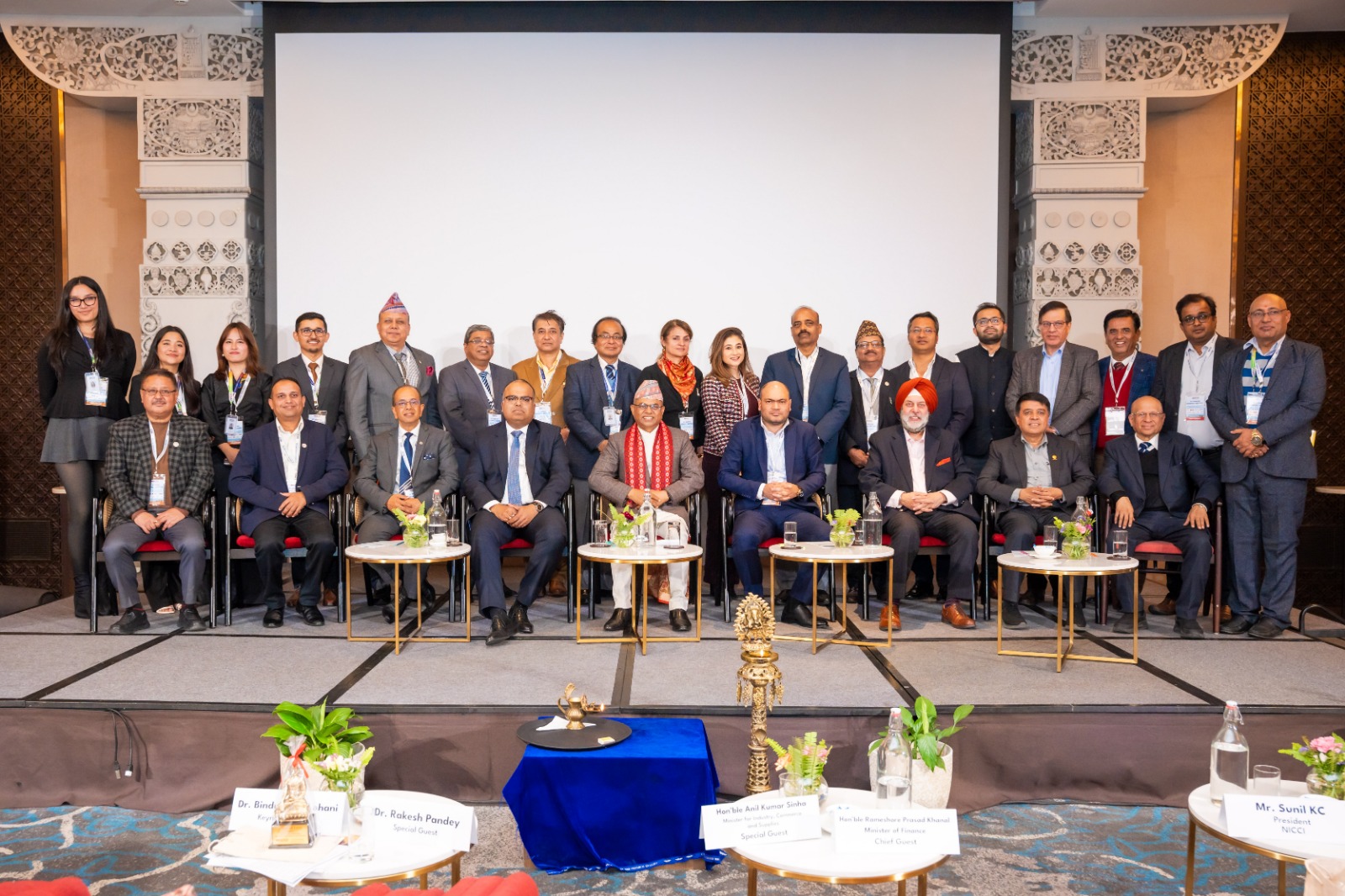
Kathmandu. Uncertain transition, fragmentation of regulatory structure, involvement of many government bodies, duplicity among the local governments, lack of clear accountability and weakness in the implementation of the agreement are major obstacles to attract investment in Nepal, said Dr Lohani, Chancellor of the University.
Addressing the 31st Annual General Meeting of Nepal-India Chamber of Commerce and Industry (NICCI) as a keynote speaker on ‘Systemic reforms for expanding Indian investment in Nepal’, former Vice-President of Asian Development Bank Dr. Lohani mentioned six major barriers to investment in Nepal and urged the Nepal government to work as a partner instead of a doorkeeper to stop investment.
“The government should act as a partner and not a gatekeeper to move from approval to facilitation,” he said, stressing that a change in mindset was necessary for the same.
Clearly recommending the government for policy assurance, quick work and credibility, he said, “Otherwise, the investment will be diverted from us due to uncertainty.” ”
Dr. Lohani also advised Nikki to help the government with structural reforms.
Similarly, a panel session on ‘Investment and Private Sector Collaboration in Cross-Border Power Trade’ facilitated by Engineer Lal Krishna KC was also held, where the participants discussed the possibilities of electricity trade by the Nepali private sector.
Neha Agrawal, Managing Director, Arunachal Pradesh Power Corporation shared her experience of power trade within India and between countries.
Similarly, Chairman of the Electricity Regulatory Commission, Dr Ram Prasad Dhital shed light on the provisions related to electricity trade and the latest developments in the Act.
On the occasion, managing director of Nepal Electricity Authority (NEA) Hitendra Dev Shakya welcomed the private sector for electricity trade.
First Secretary (Commerce) at the Embassy of India, Suman Shekhar, highlighted the focus of Indian investment in Nepal, especially in the hydropower sector. He also invited Nepali power producers to participate in the India Energy Week to be held in India in January.
Former Indian ambassador to Nepal, Manjeev Singh Puri, urged Nepal to identify the market and said that Nepal is a country with huge potential, and now there is a need to develop new private sector players.
On the occasion, Deputy Chief of Mission at the Embassy of India, Dr. Rakesh Pandey briefed about the initiatives taken by the Embassy to strengthen the economic relations between Nepal and India.
Uttam Blonne Lama, executive member of Nikki Limited and vice-president of the Independent Power Producers’ Association, said, “Nepal is the most hydropower active country. After the success in hydropower generation, the private sector now wants to focus on the transmission line. ”
Inaugurating the session, Finance Minister Rameshwor Prasad Khanal suggested the private sector to expand market access by understanding how the market operates. “Nikki can lay the foundation for better relations between Nepali and Indian investors,” he added.
On the occasion, Finance Minister Khanal also presented a letter of felicitation to the highest tax-paying members of Nikkei Company including Bhotekoshi Hydropower, Soaltee Hotel, Unilever Nepal and Dabur Nepal as well as to Raj Bahadur Shah, the highest tax-paying member and the highest individual taxpayer.
The Finance Minister also released a baseline survey report titled ‘Local Skill Transfer, Prospects of Commercialization and Women Empowerment’. The report highlights the export potential of the Titaura and recommends measures to the government to promote women-led businesses under medium, small and micro industries.
In his concluding remarks, Minister for Industry, Commerce and Supplies Anil Sinha said FDI has increased in various sectors.
Welcoming the guests to the AGM, Mr. Sunil KC, Chairman of NICC briefed about the activities of Nikki in the past one year and plans for the coming year.











प्रतिक्रिया दिनुहोस्