

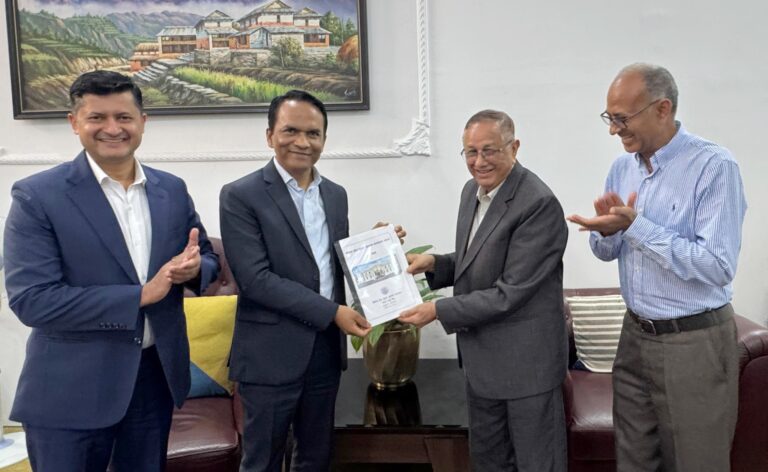
Kathmandu. KATHMANDU: Nepal Rastra Bank (NRB) has submitted its report to the task force formed to resolve the complex problems seen in the banking sector due to sluggish economy, high liquidity, growing non-performing loans and non-banking assets.
The Board of Directors of Nepal Rastra Bank (NRB) was held on June 15, 2082. The task force formed under the leadership of Rewat Bahadur Karki had given priority to banking policy, regulation, credit flow, rural economy, merger, grey-list and capital market reforms.
The taskforce has drawn the conclusion that structural reform is inevitable in the context of the economy not being fully revitalized, investment flow to the banking sector is weak and liquidity is accumulating in a state of stagnation.
The report said that banking policy regulation should be liberalized but prudent and risk-based supervision should be given high priority.
It has suggested that separate directives should be implemented by categorizing the banks and financial institutions into three categories on the basis of criteria. The report has suggested to increase the flow of loans to education, health, transport and green sectors by reviewing the directive loan policy, and to develop an integrated mechanism to compare the cost and interest rate of banking services.
According to the taskforce, a separate regulatory body like Bangladesh is necessary as the nature of microfinance institutions is different. The report states that a separate regulatory structure is needed for non-banking institutions such as Employees Provident Fund, Citizen Investment Trust and Social Security Fund due to the increase in their turnover.
The task force has suggested restructuring of loans, immediate operation of concessional loan programme and provision of additional loans to revive closed or small-scale businesses without undermining the interest of depositors.
Similarly, business loans up to Rs 5 lakh in rural areas and Rs 1 million in urban areas should be easily available, limit of group and collateral-based entrepreneurial loan should be increased through microfinance and loans should be encouraged to youth-targeted start-ups and IT businesses.
The task force has suggested starting the ‘Rastra Bank’ program in rural areas. It has been said that the Governor himself should visit different geographical areas every month to understand the demand for loan, possibilities and problems and make policy revisions.
The report has also suggested that a financial master team comprising entrepreneurs, NRNs and bankers should be mobilized to identify potential industries outside the traditional agriculture.
Stating that mergers and acquisitions should be proceeded with utmost caution, the task force has said that the performance of many institutions that have not gone for merger has been good. The report warns that without complete integration of human resources, technology and operations, the merger will not be successful in the long run.
The report stresses that the central bank should play a more active role in removing Nepal from the grey list. The task force has pointed out the need for a time-bound action plan to complete the necessary corrective activities within the next two years.
The agenda of the capital market includes recalling representatives of the central bank from NEPSE, adopting global practice on margin loans, facilitating NRNs in the secondary market and coordinating with the Securities Board of Nepal for the development of bond market including green bonds.
The task force’s report has clearly indicated that the reform of the banking sector will be decisive not only for financial stability but also for reviving the overall economy.


















प्रतिक्रिया दिनुहोस्