

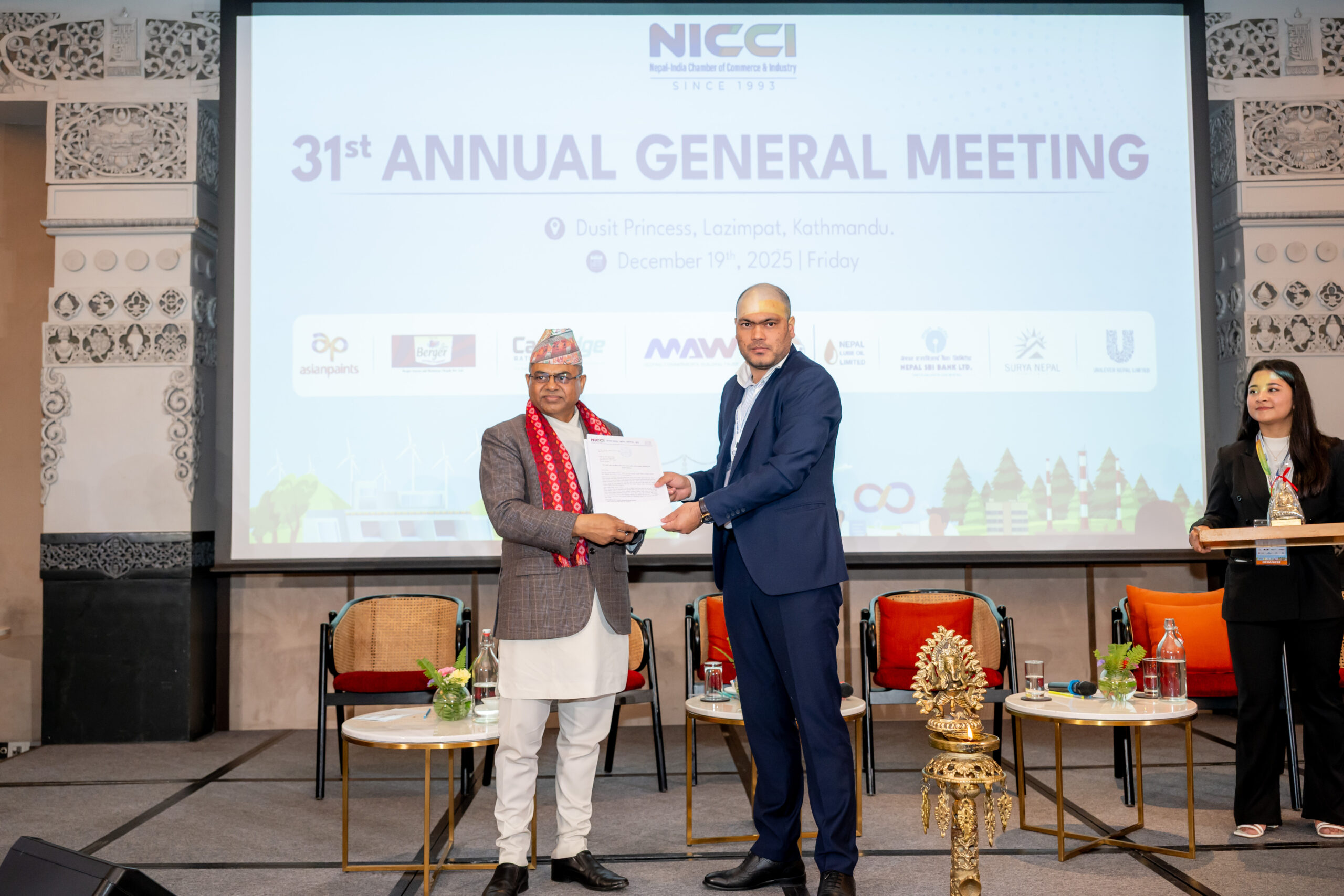
Kathmandu. KATHMANDU: Nepal-India Chamber of Commerce and Industry (Nikki) has urged the government to reform the government to resolve the policy and procedural hurdles that have been operating in Nepal for a long time.
According to the association, although there was an initial expansion of foreign investment in Nepal after the 1990s due to the Nepal-India Commerce Treaty, there has been no large number of foreign investment in the last three decades.
According to the statistics, although about one-third of the total foreign investment in Nepal has come from India, the inflow of new multinational investment has been limited despite geographical, cultural and linguistic proximity with neighboring countries.
In this context, Nikkei has urged the Ministry of Industry, Commerce and Supplies to make public the practical difficulties and solution proposals experienced by the foreign investment industries operating in Nepal for the past three decades and make improvements in coordination with the concerned ministries and agencies.
The letter, submitted by Sunil KC, chairman of Nikkei to Minister for Industry, Commerce and Supplies, Anil Kumar Sinha, has also suggested 11 major policy reform proposals, especially strengthening trademark and intellectual property protection, making trademark royalty and technical service charge affordable for tax purposes, simplifying and time-bound foreign payment process.
Trademark and Intellectual Property Protection Promotion: Although Nepal is a party to various international treaties on global intellectual property, multinational brands are not adequately protected due to lack of compatible laws and regulations. This has created confusion in the investment climate. It has called for making the trademark registration process flexible, making strict legal provisions against counterfeit and counterfeit goods and developing a mechanism for settling cases quickly.
Multinational companies have been affected by the rejection of royalty and technical service charges paid under the agreement approved under the Foreign Investment and Technology Transfer Act as expenses for tax purposes. Businesses need clarity between the Act, the Directive and the International Tax Agreement, Nikkei said.
Pointing out the problem of delays in making payments in foreign currency for import of services and technical services due to approvals from many bodies, Nikkei has also suggested to make arrangements to make payments directly through banking channels up to a certain limit by adopting a risk-based audit system through Nepal Rastra Bank.
To make the Single Stop Service Center practically effective: The demand has been made to make the process truly ‘single’, saying that despite the concept of Single Stop Service Center, the industrialists are compelled to visit different agencies.
Ending the duplicate process of self-declaration of imported goods: Nikkei has stated that it is unnecessary to ask for a separate self-declaration for foreign currency payment in the context of the price and details already verified through the customs declaration.
In the current context of global supply network, some provisions of the Nepal-India Treaty of Commerce are not in line with today’s reality, so it has requested the government to allow the import of essential raw materials, medicines, machinery parts, and other goods from the regional storage center in India.
Industrialists argue that technology transfer, market development and expansion of production in the country will increase if there is a provision to import the goods that are not produced in Nepal but are allowed to import the goods required for the market in limited quantity.
Stating that the food industries have been severely affected due to the ban imposed on the import of raw materials not produced in Nepal such as whey (protein) powder, it has been requested not to impose ban without necessary research and alternative arrangements.
Timely and full implementation of export incentive subsidies: Nikkei has also demanded a clear timeline and continuity, saying the delay in the distribution of export incentive subsidies announced by the government, partial approvals and procedural ambiguities have discouraged export-oriented industries.
Duty drawback process should be started immediately: Stating that the duty drawback has had a serious impact on the working capital of the industry due to the non-publication of the customs duty refund rate, it has been urged to immediately make the rate public and start the refund process.
Accepting business social responsibility expenditure for tax purposes: Industrialists have demanded that the business social responsibility expenditure made mandatory by the Industrial Enterprise Act, 2076 should be recognized as expenditure for income tax purposes as well.
Nikkei believes that the implementation of these reforms will improve the investment-friendly environment in Nepal, attract new foreign investment, increase employment, provide quality products to consumers and contribute positively to revenue in the long run.
KC also urged the government to address these suggestions at the earliest for the promotion of domestic and foreign investment.














प्रतिक्रिया दिनुहोस्