

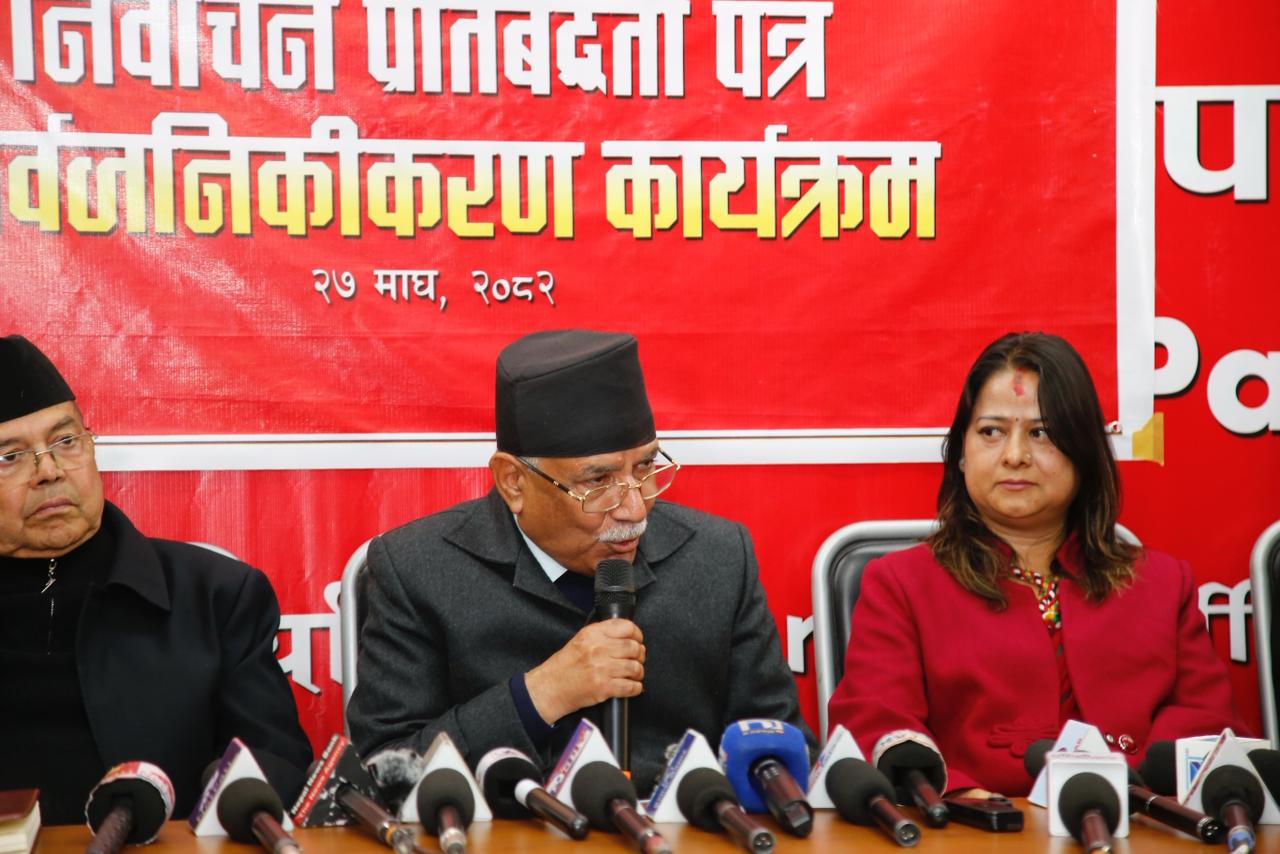
Kathmandu. KATHMANDU: The Communist Party of Nepal (CPN) has announced the upcoming decade as the ‘Agriculture Investment Decade’ and pledged to increase investment with the participation of the government, private, cooperative and donor agencies. The commitment paper unveiled at a programme organised at the party office in Parisdanda today has set a target to achieve complete self-sufficiency in rice, wheat, vegetables, fruits, milk, meat and fish within two years.
The commitment paper also aims to declare the next decade as the decade of agriculture investment and distribute the identity cards to all the farmers within the next one year. Likewise, the manifesto has pledged to ensure farmers’ rights within a year by formulating an integrated agriculture act.
The party’s manifesto has a plan to provide relief to the people by setting up the National Agricultural Disaster Fund and to implement the digital farmers’ database after conducting regular agricultural census. Stating that the agricultural and rural economies are about transformation and farmers’ rights, it has been mentioned that the following reforms will be made:
1. Investment in Agriculture, Institutional Reforms and Farmers’ Rights
· Integrated Agriculture Act and Farmers’ Rights Act will be formulated and implemented within a year.
· Investment will be increased with the participation of government, private, cooperative and donor agencies by declaring the next decade as ‘Agriculture Investment Decade’.
· Identity cards will be distributed to all farmers within a year by classifying farmers on the basis of production and ownership.
· The National Farmers Commission will be strengthened to ensure farmers’ direct participation in policy making.
· The Ministry of Agriculture and its subordinate bodies will be restructured and brought in line with the federal structure.
· The long-term agriculture strategy will be rewritten and implemented with farmer participation.
· The federal level will hand over research, seed development, human resource management and technical services to the provinces and local levels and encouragement, grants and assistance will be provided to run integrated programs.
· Integrated Agriculture Service Centre and laboratory will be set up at all local levels and at least one agro and livestock technician will be stationed in every ward.
· Minimum wages, social security and insurance will be made effective for agricultural workers.
· A National Agricultural Disaster Fund will be set up to protect against risks such as floods, droughts, hailstorms and epidemics.
· A digital farmers’ database will be created by conducting a regular agricultural census.
· Subsidy, insurance, minimum support price and market information system will be made digital, transparent and accountable. Strict action will be taken against those who misuse the grant.
· Legal provisions will be implemented to protect the rights of tillers and contract farmers.
· The Nepal Agricultural Research Council will be restructured giving priority to innovation, climate adaptation and farmer-centric research.
· Lumpy skin vaccine will be produced and distributed in the country by giving priority to livestock vaccine research.
· Rabies and measles will be eradicated by vaccination and tagging of pets and stray livestock.
2. Self-sufficiency and production growth
Land use plan and production programme will be implemented by collecting data on the demand and supply of basic food items at the local level.
· Self-sufficiency in paddy, wheat, maize, vegetables, fruits, sugarcane, milk, meat and fish will be achieved within 2 years. Other areas will be expanded within 5 years.
· Resource centers will be established and expanded to produce seeds, improved breeds, feed, vaccines and medicines in the country.
· Concessional loans, grants and technical assistance will be provided for conservation of arable land, barren utilization, pooling, collective/contractual/cooperative farming.
· The Prime Minister Agriculture Modernization Project will be restructured and programmes based on farmers’ demand, production potential and market will be implemented.
· Self-sufficiency in sugar will be maintained by promoting sugarcane farming; The payment and grant will be made available within 1 month.
Dairy Development Board will be formed in all seven provinces and milk will be sold and subsidized within a month.
A special program will be conducted with grants for the production of domestic fish and brown and for market promotion.
· Community seed banks will be established at every local level to protect and promote indigenous seeds.
Priority will be given to indigenous improved seed production, processing, packaging and marketing.
· The subsidy will be provided for electricity used in cold storage, milk chilling centers, fisheries and hatcheries.
3. Area specific and infrastructure development
}
· Aromatic rice, onion, oilseeds, milk and meat production and export will be promoted in the Terai.
· The “Himal Samriddhi Programme” will be implemented for sheep, goats, mountain goats and yak farming, apple, walnut and herb farming in the hilly and mountainous regions.
· Lease will be provided to the community forest by promoting commercial cultivation, processing and export of medicinal herbs.
· Legal provisions will be made after studying the feasibility of controlled production of marijuana for medicinal purposes.
· Commercial agro-food processing corridor would be developed along the Postal Highway and the Mid-Hill Highway.
Production, processing, research and skill development centers would be established in all seven provinces through the establishment of agro-industrial parks.
· Model farms and learning centers will be set up in partnership with youth farmers at ward levels.
4. Markets, Prices, and Marketing
· The Minimum Support Price (MSP) will be fixed before the start of production and the advance purchase agreement will be implemented; Arrangements will be made for the farmers to fix the market price.
· The products will be collected and purchased from the farm through the digital app.
At least one cold store and multi-level agro wholesale market will be constructed in each of the seven provinces.
· The scope of pesticide test on imported food÷vegetables would be expanded by expanding the market information system.
· Long-term purchase and supply agreement will be signed for the industries to produce the required raw materials within the country.
5. Fertilizer, Soil, Irrigation and Technology
}
· The organic fertilizer production programme would be implemented at the province÷local level after carrying out feasibility study of chemical fertilizer factories.
· Soil health cards will be distributed to every farmer and technical services will be provided.
• An indigenous agricultural implements/machinery production and repair center will be established.
• Irrigation will be expanded to all arable land and traditional canal conservation and solar/lift irrigation will be promoted.
6. Agricultural Insurance, Farmers’ Facilities and Social Security
}
· Contribution-based farmers’ pension and felicitation programme will be implemented.
The interests of small, poor, landless Dalits, landless squatters and family farmers will be given priority and the interests will be protected.
· Only genuine farmers will be provided with subsidies, loans, services, facilities and social security on the basis of farmers’ identity cards.
· Agriculture, livestock and fisheries insurance will be expanded based on information technology; Action will be taken against companies that refuse insurance in rural/low-profit areas.
· Insurance premium subsidies will be made timely; The state will bear the premium of landless Dalits, landless squatters and poor farmers.
7. Food Sovereignty, Nutrition and Hunger-Free Nepal
The right to food and food sovereignty of all citizens shall be ensured.
· Nepal will be declared hunger-free within two years.
· Food shortage, malnutrition or undernourishment will be eliminated.
· Nutrition security will be enhanced by linking the school lunch program with local production.
· Nutrition programmes targeting pregnant women, new mothers, children and the elderly will be made effective.
8. Environmental, Organic, and Climate Resilient Agriculture
· Organic, environment-friendly and climate-resilient agriculture systems based on biodiversity will be given national priority.
· The country will be declared an organic country along with the increase in production.
· Harmful















प्रतिक्रिया दिनुहोस्