

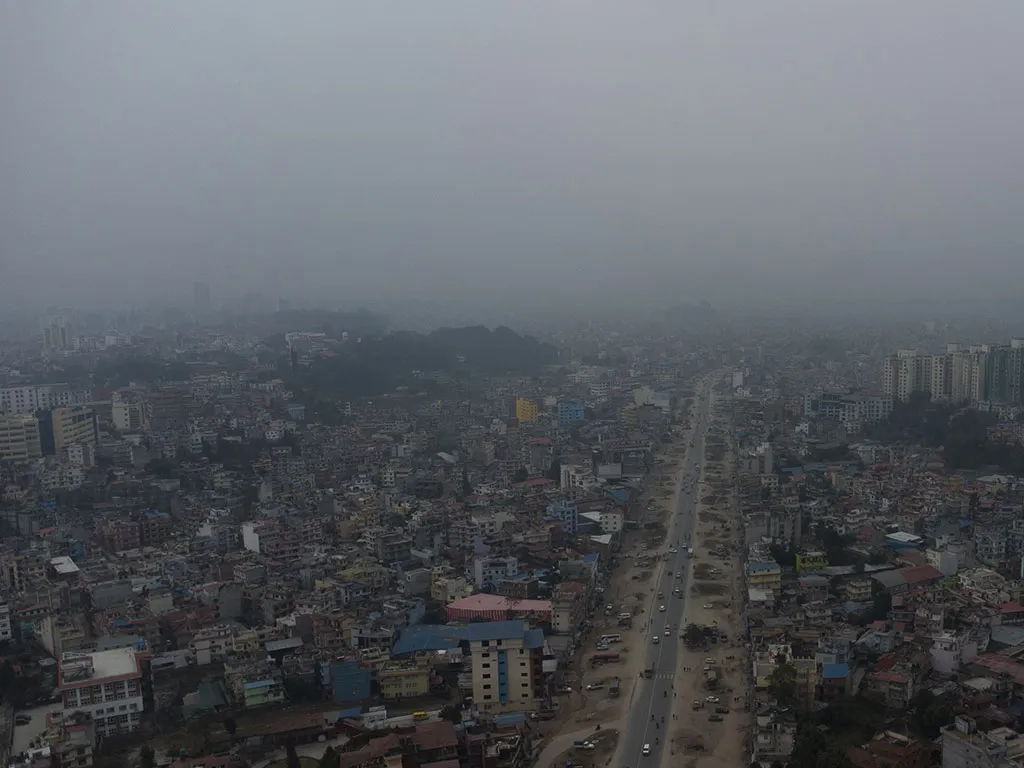
Kathmandu. Air pollution has increased in the Kathmandu Valley. The air quality index (AQI) was 178 on Monday and it was 191 by noon today. This category falls under the category of “unhealthy for all”, particularly affecting children, the elderly, and those with respiratory and heart conditions.
With this, the air pollution in the Kathmandu Valley has reached an unhealthy level today. Kathmandu has been listed as the third most polluted city in the world according to the Air Quality Index (AQI). India’s Delhi has been ranked first with 229 AQI and Pakistan’s Lahore has been ranked second with 203 AQI.
Director General of the Department of Environment, Gyan Raj Subedi, said that pollution could increase in the coming days if there is no rain. According to him, the level of pollution is high during the long dry season as rainfall helps the dust and particulate matter in the air to fall to the ground. Director General Subedi said that the bodies concerned have been advised to implement sustainable and environment-friendly development measures in an effective manner.
According to environmental campaigner Barsha Parajuli, the rapid increase in the number of vehicles, smoke emitted from diesel and petrol, dust from under-construction roads and infrastructure projects, forest fires and prolonged dry weather have contributed to the air pollution.
“The situation could worsen if control measures are not taken in time,” he said.
Parajuli also urged the people to be aware in time saying pollution could increase if it remains dry. According to the data of the index, 50 AQI is considered good (green signal) and 51 to 100 is considered a cautionary signal (yellow signal). Similarly, an AQI of 101 to 150 is considered unhealthy, which affects patients with respiratory and heart disease. An AQI of 151 to 200 is considered unhealthy for all, an AQI of 201 to 300 is very unhealthy and an AQI above 300 is considered very dangerous.
According to the Air Quality Management Action Plan for the Kathmandu Valley, 2076, the government has declared the AQI of more than 300 as a disaster. The action plan also includes stopping the burning of garbage, increasing the use of ‘broomers’ and ‘vacuums’ for road cleaning and issuing public notices to children, senior citizens and the sick to adopt special precautions.
According to the National Environment Policy, 2076 BS, the government has a strategy to prepare and implement national standards related to the prevention of water, air, soil, sound, electromagnetic waves, radioactive radiation and hazardous chemical pollution. Similarly, quality monitoring stations would be set up in major cities, industrial areas and places where there is a risk of pollution, and the quality of air, water and sound would be monitored.















प्रतिक्रिया दिनुहोस्