

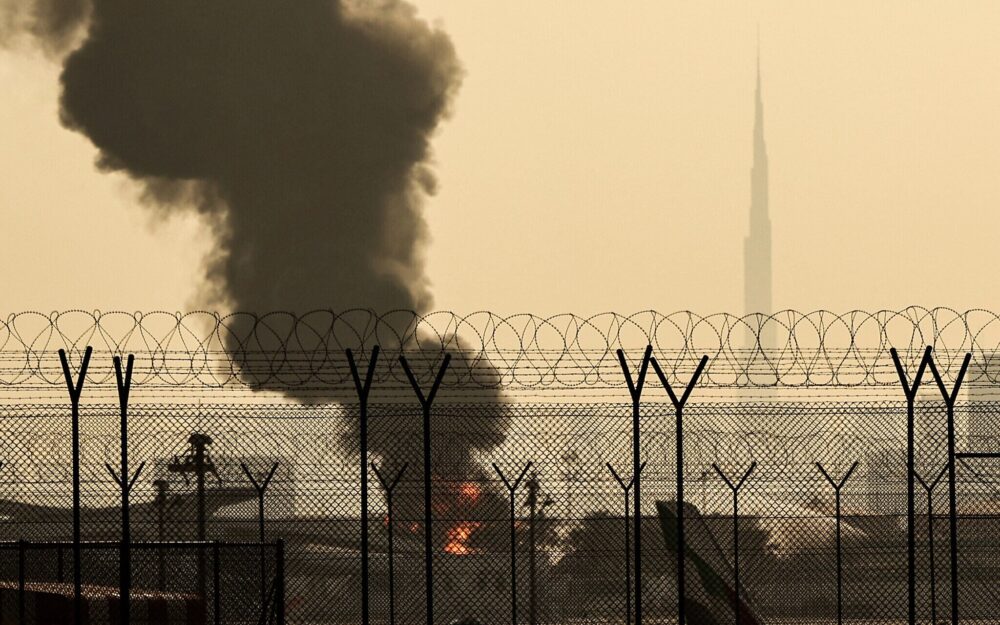
The conflict between the United States, Israel and Iran has entered its fourth week.TAG_OPEN_p_28 Its direct impact is clearly visible in the Gulf region. At first, Iran’s war strategy appeared to be aimed exclusively at Israel. But within a few days, it turned its attention to Gulf Cooperation Council member states. The United Arab Emirates (UAE) was one of the worst-hit countries. This has plunged not only the UAE but the entire Gulf region into an extraordinary security risk.
Iran had announced early in the conflict that the U.S. military structure would be the main target. But the reality was different: Thousands of Iranian drone and missile launches were diverted to the Gulf. In the first 11 days of the war, there were 433 attacks on Israel, during which time there were about 3,100 strikes in the Gulf countries. This indicates that Iran is expanding its strategic objectives by multi-dimensionalizing the war.
According to Mohammed Baharun, head of the Dubai Public Policy Research Centre, Iran sees the UAE as the “easiest target”.TAG_OPEN_p_26 According to his analysis, the UAE’s continued attacks automatically put other countries in the Gulf — Saudi Arabia, Qatar, Oman, Kuwait and Bahrain — under pressure. This “chain effect” is central to Iran’s strategic thinking, they argue. “If the first stone shakes, the rest of the stones fall on their own,” the Iranian leadership believes. ’
Since the start of the war, Iran has targeted several key infrastructure in the UAE, according to several Gulf security personnel.TAG_OPEN_p_25 Prominent among them are the Habshan gas refinery, the Bab oil field, the Al-Dhafra air base, the port of Fujairah, the oil storage facilities and Dubai International Airport. The UAE consulate in Erbil, located in Iraq’s Kurdistan region, was also the target of drone strikes.
Iran has also issued a public warning to UAE civilians to stay away from “ports, warehouses, US military installations and crowded places”.TAG_OPEN_p_24 Iran claims that targeting US military installations in the UAE is a “legitimate right of self-defense”. However, the UAE denies that its territory has been used for US attacks.
The UAE’s image as a ‘safe, stable and open hub’, which has long been a mainstay for trade, investment and tourism, is now under serious challenge.TAG_OPEN_p_23 Abu Dhabi’s main stock index fell 11.42% in the month, a direct impact of war risks. Such a sharp decline is rare in a large investment center like the UAE.
Aircraft and tourism, where the UAE is known as the world’s leading transit hub, became the first victim of the conflict.TAG_OPEN_p_22 In the first week of the war, six airports in the Gulf suffered about $400 million, of which the UAE alone suffered about 95 million dollars. Canceled flights, route changes, reduced passenger arrivals and airspace closures have tarnished the UAE’s image as an international “safe aviation hub” in its tenth year.
The oil and energy sectors have been similarly affected.TAG_OPEN_p_21 The closure of the Strait of Hormuz has reduced the UAE’s daily oil production by less than half, according to international news agencies. The Gulf of Hormuz is one of the most sensitive points of global trade and energy supply, where disruptions shake not just the UAE, but the entire international market.
Relations between the UAE and Iran have been gradually improving since 2021.TAG_OPEN_p_20 The China-brokered Iran-Saudi deal of 2023 brought some positivity to the Gulf region. But the current conflict has completely reversed those diplomatic efforts. The UAE has closed its embassy in Tehran and recalled all diplomatic staff. Accusations and counter-accusations between the two countries have intensified.
According to regional sources, both the UAE and Saudi Arabia appear to be gradually leaning towards military preparations against Iran if necessary.TAG_OPEN_p_19 Experts say that if such a step goes ahead, the possibility of a return to normalcy in UAE-Iran relations will end in the near future.
In the midst of the war, the UAE government is constantly trying to send a message to the general public that “everything is under control”.TAG_OPEN_p_18 President Mohamed bin Zayed has tried to boost people’s morale by saying the kingdom is “capable of meeting every challenge”. On the other hand, the federal attorney general has issued strict instructions against posting photos and videos related to the war on social media. Some foreign nationals have been arrested for violating this directive, which carries a jail term of up to one year. The government’s strategy is clear — to ensure that a weak image does not go out.
According to analysts, the current war is not only about reshaping the balance of power in the Gulf region, but also the long-term economic and security architecture.TAG_OPEN_p_17 And the UAE is at the center of this change. Due to its close cooperation with the US, formal relations with Israel, its pivotal position in the global aviation and trade routes, digitization and investment-friendly policies, the UAE has become highly sensitive to regional politics and security equations.
The UAE’s so-called “safe hub” image is now under the biggest test in history.TAG_OPEN_p_16 Economic indicators have fallen, with aviation, tourism, oil production and trade having a major impact. But the real challenge now lies in how to rebuild credibility once the war is over. Stability is the first foundation for investors.
On the contrary, the UAE still has strong diplomatic reach, international partnerships, economic capacity and security infrastructure, on the basis of which analysts believe it can rebuild its image.TAG_OPEN_p_15
Still, the current reality stands firm: as long as the war continues, the UAE’s security environment, economic reputation and identity as a ‘safe hub’ will continue to be at risk.TAG_OPEN_p_14 With the help of various international media









प्रतिक्रिया दिनुहोस्