

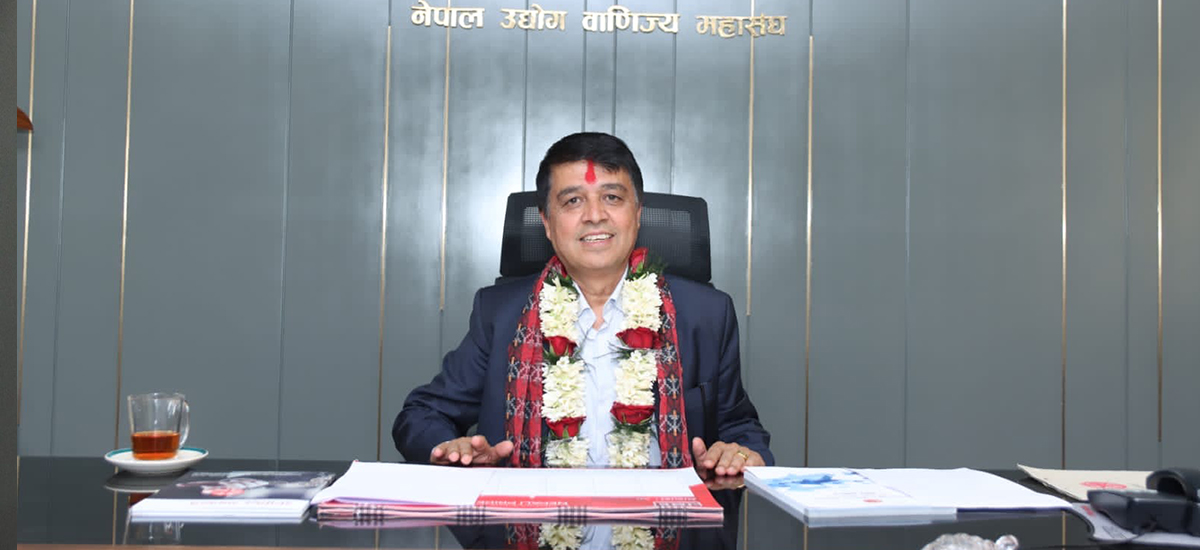
. KATHMANDU: Chandra Prasad Dhakal, president of the Federation of Nepalese Chambers of Commerce and Industry (FNCCI), is set to expire for three years on April 14. During his three years at the helm of the FNCCI, Dhakal has established his tenure as a result-oriented work that is directly linked to the country’s economic structure, investment climate, government-private sector collaboration and institutional empowerment.
Under his leadership, the FNCCI has prioritized policy and legal reforms to create investment-friendly environment, promote domestic and external investment, strengthen the role of the private sector among the state regulatory bodies and plant a new concept in the society that ‘private sector is a partner of national development’.TAG_OPEN_p_45
Leadership journey amidst challenging economic and political conditions
}
When Dhakal took over as the chairman, the country’s economic situation was very weak.TAG_OPEN_p_43 The Covid-19 pandemic, the Russia-Ukraine war, rising interest rates, liquidity shortages, investor disappointment and a series of government changes — all of these factors put the economy under severe pressure. In such a situation, his initial challenge was to maintain the morale of the private sector, reassure investors and make business activities vibrant.
TAG_OPEN_p_42 From the very beginning, Dhakal prioritized ‘implementation over announcement’. He tried to find solutions to the problems of the private sector, government’s compulsion and international economic context through dialogue, keeping them in a single frame. As a result, the gap between the private sector and the government narrowed significantly.
Policy Interventions and Reforms: Key Highlights of the Tenure
Under Dhakal’s leadership, the FNJ changed its long-standing traditional role of ‘demanding’ and started the practice of directly influencing the policy-making process.TAG_OPEN_p_40
The third executive committee meeting of the FNJ held in Dhorpatan, Baglung was an important turning point for this.TAG_OPEN_p_39 The meeting decided to organize a national economic debate to address the economic problems of the day—which, for the first time, brought the government, political parties, regulators and the private sector on one platform.
On the basis of this debate, the government set up a high-level economic reform advisory commission.TAG_OPEN_p_38 Dhakal himself was a member of the commission. The commission recommended more than 30 laws and laid a long-term basis for the construction of investment-friendly structures.
It brought issues that had been complex legal hurdles to the agenda for decades, accelerating regulatory reform.
Redefinition of state–private sector relationship
The most well-known and influential aspect of Dhakal’s tenure has been the initiative to shift government-private sector relations from confrontation to cooperation.TAG_OPEN_p_35
When the proposal to bring the private sector under the purview of authority was forwarded, it caused widespread concern in the business community as a whole.TAG_OPEN_p_34 Dhakal addressed this issue not emotionally or adversely, but through institutional dialogue with logical answers.
From the prime minister to the ministers, the chief secretary, the secretary, the constitutional bodies, the parliament—he was able to convince everyone. As a result, this provision was suspended, which is believed to have played a decisive role in preserving the investment climate.
Internal Capital Mobilization and New Model of Large Projects
At a time when the negative perception of ‘nothing can happen’ was growing in Nepal, Dhakal established Nepal Development Public Limited with a capital of Rs 10 billion.TAG_OPEN_p_31
This model provided a practical example of how domestic capital can be invested in large infrastructure, manufacturing industries, and startups.
He has also set in motion the campaign to attract foreign investment through investment forums, bilateral conferences and international business networks in different countries.TAG_OPEN_p_29
Institutional Transformation and Transparency in Leadership
The amendment of the FNCCI’s statute is another important achievement during his tenure. Dhakal unanimously amended the FNJ statute which had been a subject of controversy and debate for a long time. The system of electing the chairman through direct election was implemented by abolishing the system of automatic appointment of senior vice-president. This has made the leadership selection process more competitive, responsive and timely.
This change has created a new balance of power structure within the federation. The new statute will make the chairperson more accountable, responsible and result-oriented towards the members as it will come through a competitive method through the then representatives. In addition, the statute has made provision for two district vice-chairpersons keeping in mind the 50 percent weightage of the district municipality. Women Vice-President and many other positive provisions have been amended in the statute to encourage women’s participation.
Overall, Chandra Prasad Dhakal’s tenure has prepared the ground for transforming the private sector from a ‘pressure group’ to a ‘development partner’. It is clear that the collaboration, policy reforms and institutional transformation initiatives initiated by him would have a long-term positive impact on Nepal’s economic development and investment climate if we could be continued.













प्रतिक्रिया दिनुहोस्