

Nepal is a country rich in resources, possibilities and goodwill.TAG_OPEN_p_23 But due to the lack of positive winds, right thinking, determination and governing virtue, those possibilities could not be realized. Nepal went through several stages of political transformation, but it did not complete the institutional transformation of the non-political structure as expected.
The country could not move forward at the required pace due to deep social discrimination, weak governance and governance uncertainty. As a result, discontent, resentment and resentment turned into irrepressible rebellion as the great opportunity provided by the demographic dividend was limited.
Now there is a need to build a new thinking on the basis of a situation like rebellion. We should be determined to rise again with a common determination. Today’s priority is to advance the positive social capital of the Nepali people towards prosperity through the right purpose, policy formulation and implementation. The Falgun 21, 2002 election has handed over the responsibility to a change-changing government with massive mandate, realizing this priority.
The root cause of Nepal’s non-political crisis lies in a distorted incentive structure. Expensive elections, opaque fundraising, and cumbersome party structures made politics a profession and a means of investment, not a service. As a result, policy-level corruption, a culture of give-and-take, and access-based capitalism flourished.
Collection under the guise of licenses, contracts and regulations became a feature of state-market relations where entrepreneurship, competition and innovation were supposed to grow. This discouraged potential entrepreneurs and new entrants, and the economy moved towards an access-based structure.
There was a perpetual ideological confusion about the role of the state and the market. Sometimes the socialist state was blamed, and sometimes it was a mistrust of the market-oriented approach—there was policy instability between the two sides. The lack of proper regulation of the market failed to strengthen the necessary institutional structures such as competition policies, consumer protection, environmental regulation, and social protection.
TAG_OPEN_p_17 On the other hand, distrust of the business sector and distribution-oriented policy tilt did not give the expected priority to production, investment and productivity. As a result, neither the market nor the state structure could be held accountable. The state’s failure to ensure an enabling business environment—credibility, contract enforcement, and policy stability—failed to attract investment and plunged the economy into an unproductive cycle.
Similarly, as social protection programs or distribution-oriented schemes expanded without an assessment of long-term financial responsibility, the challenges of intergenerational obligations increased.TAG_OPEN_p_16 Efforts without effective implementation in the name of ensuring convenience neither reduced inequality nor increased production capacity. Foreign employment, remittance-dependence, and limited domestic employment became the basis of the economy due to the lack of effective utilization of the demographic dividend. The tendency to view development from a cost-centric perspective does not provide adequate accountability to the fundamental question of “what, for whom and how?” As a result, Nepal’s main challenge is not just lack of resources — conceptual confusion, institutional weakness and poor implementation culture. The main obstacle is not the lack of business entrepreneurship—but the policy and institutional structures that stifle entrepreneurship itself.
The economy cannot be taken forward by liberalizing the status quo alone. What is needed now is sweeping structural reform—one that promotes competition, encourages innovation and technological assimilation, allows new entrepreneurs to enter, and transforms the economy from a “rent-seeking structure” to advanced employment-focused sustainable growth.
The country’TAG_OPEN_p_14 s economy has entered a phase of restructuring and steady growth. As the economic and political scenario of Nepal takes a new turn, high priority has been given to policy reforms, quality transformation of public services, necessary transparency and good governance. We will move ahead with determination to build a strong, inclusive and creative society by addressing the structural weaknesses seen for decades.
In this context, this strategic document has been prepared with the objective of helping to set the guidelines for moving forward by presenting a realistic picture of the upcoming economic, social and governance situation.TAG_OPEN_p_13 It is expected to provide the basis for policy reforms, strengthening good governance and determining the necessary course of action for sustainable economic transformation by clearly identifying the current opportunities and challenges.
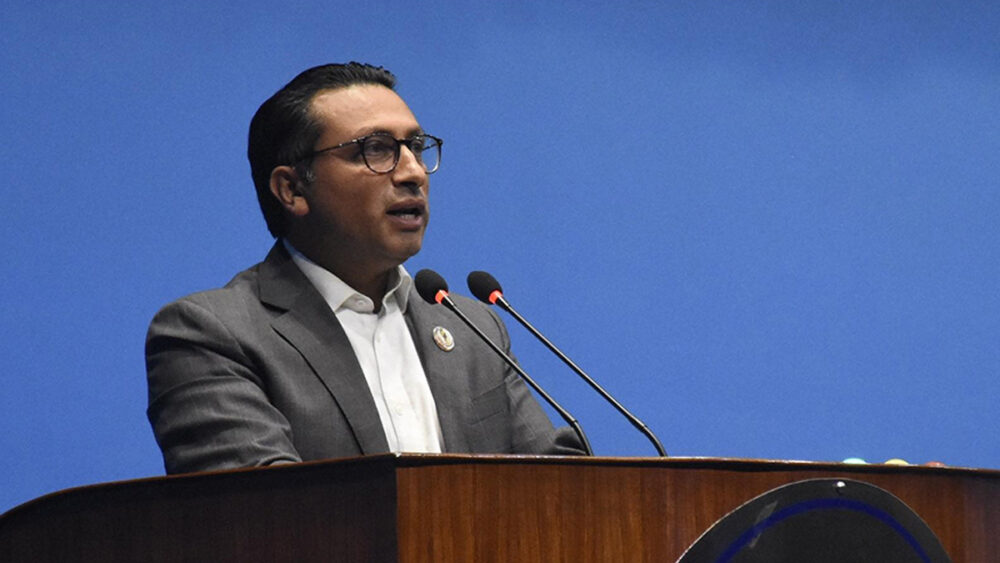
The white paper released by the Ministry of Finance is courtesy of the foreword written by Finance Minister Dr. Swarnim Wagle










प्रतिक्रिया दिनुहोस्