



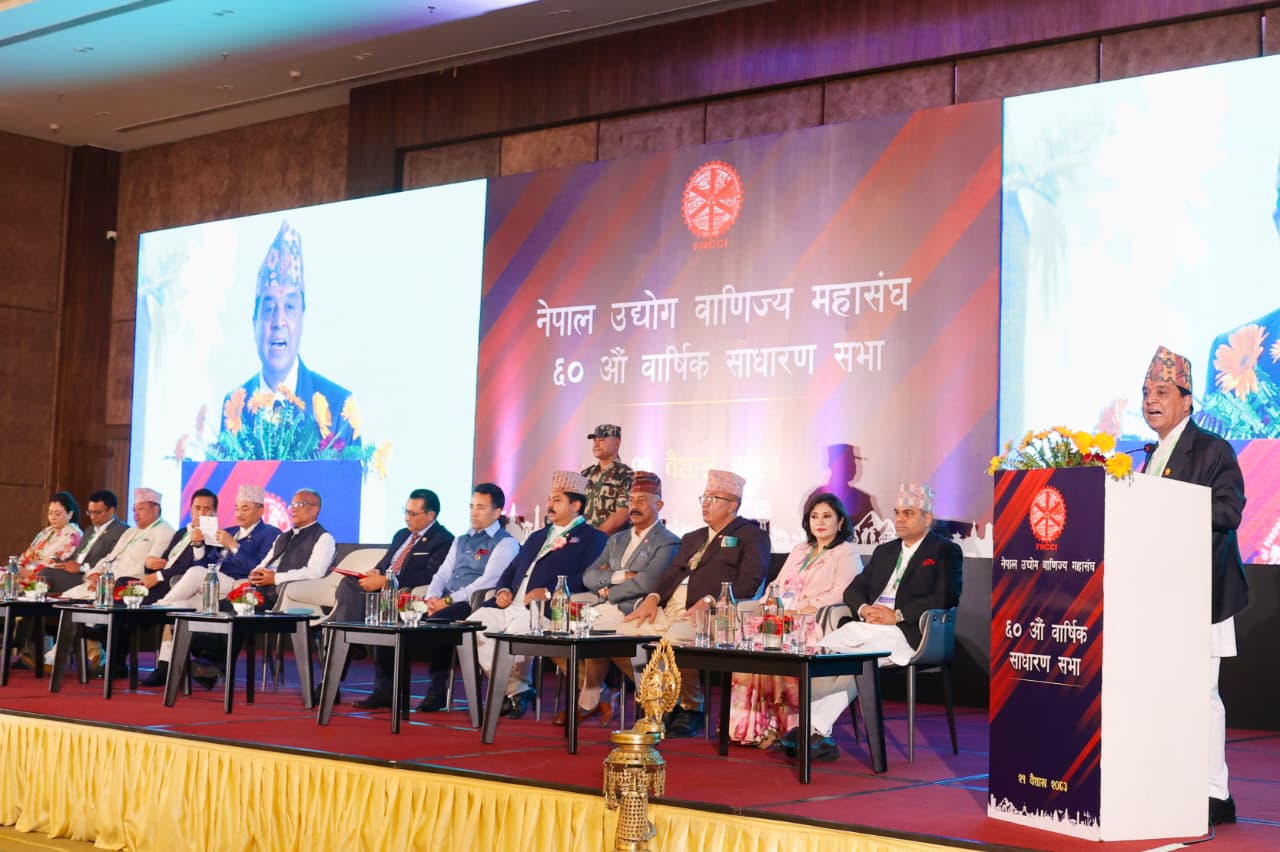
The 60 years of the FNCCI are not only a countdown of years, it is also a golden brick of determination, struggle and partnership that is being added one by one in the economic history of the country. Through this, it has contributed to the construction of the golden house of national prosperity by strengthening the economic backbone of the country.
This umbrella organization of businessmen from all over the country has been working tirelessly to create an environment for industry, trade and investment by strengthening the voice of the private sector. The FNCCI has never allowed its role to weaken despite the difficult circumstances of the past, political instability from time to time, and economic challenges arising due to natural calamities and internal and external circumstances. Rather, it has emerged as a strong leader to further accelerate the country’s economic momentum by turning every challenge into an opportunity.
The 60-year history of FNCCI is not only a symbol of national entrepreneurship but also a centre of hope and guide of economic transformation. It has paved the way for realizing the dream of collective prosperity by uniting small, medium and big entrepreneurs on a single platform. The journey of 60 years of the Federation is not only a memory of the past but also an inspiration for the future generations. The bricks that are being added every year have further strengthened the foundation of a stronger, self-reliant and prosperous Nepal.
During this period, we tried to convert various challenges into opportunities. We looked for new opportunities. We also tried to overcome the despair. We have been successful in many cases. A stable government with nearly two-thirds majority has also been formed after the March 4 election. The first Cabinet meeting of the new government has decided to immediately implement the Private Sector Promotion and Protection Strategy (PSPP) as per the request of the Federation of Nepalese Chambers of Commerce and Industry (FNCCI).
This was necessary to boost the morale of the private sector in the context of the private sector being affected in most of the movements after 2046 BS and the attack on the private sector in the last movement as well. This will ensure the safety of private enterprises and businesses. Not only physical security but also policy security will be guaranteed under this strategy.
The federation will collaborate with the government for its implementation. The Finance Minister also accepted the recommendations presented by the High-Level Economic Reform Suggestions Commission formed for the second phase of economic reform at the request of the FNCCI for policy reforms.
The third executive committee meeting of the FNJ held in Dhorpatan of Baglung district had decided to urge the government to form a high-level economic reform advisory commission to prepare a roadmap for the second phase of economic reforms. The federation had urged for the amendment, amendment and repeal of the laws through the National Economic Transformation 2030. We are confident that the PSPP will work as a mechanism to implement the recommendations of the Commission.
Now an unprecedented opportunity has come before the country. At a time when we are looking for an all-party consensus for policy stability and not a stable government, the presence of a single party in the parliament is a remarkable opportunity. We urge the government to utilize this stability as an opportunity for the country’s development and to provide stability in all sectors.
Because, in the past, we have many examples of such possibilities being turned into opportunities to achieve progress. But if we work, if we acknowledge each other’s importance and presence, and if the private sector can do business with respect, we believe that we have more opportunities to grow than in other countries of the world. The median age of Nepalis is 25 years. Our neighbours India and China have a lot of market. Since we have access to duty-free market in developed countries, our products will be competitive in the world market.
To fulfill the aspirations of our youth, we need to create jobs and self-employment opportunities in practice. Unless we create decent and high-wage employment opportunities in the country, despair cannot be turned into hope. The August agitation is the result of that.
The government has limitations in providing employment. But even Nepal’s private sector does not have the capacity to provide employment to about five lakh youths entering the labour market every year. About 7 lakh youths go abroad every year in search of work, both old and new.
In 1960, Nepal’s per capita income was $50 while that of South Korea was about $100. Currently, the per capita income of Korea is around $ 40,000 while that of Nepal is $ 1400. We made progress but not as much as we should have.
Globalization not only increased the needs and desires of the citizens, but also opened up the whole world to get work according to their capacity. That’s why we’re going to get jobs in a big economy. But we could not make our economy bigger.
Nepal’s economy has grown by an average of 4 percent in the last three decades. Foreign investment has not been able to cut one percent of the GDP annually. After 2048, there was an unprecedented change in the economy. Our economy is still running on the basis of the policies of that time.
This opportunity came even after 2072. The economy grew by seven percent. After that, there was no stability. The COVID-19 pandemic crippled the economy. After COVID-19, there was about 6 percent economic growth. There was ample scope for improvement. However, the policy decisions adopted to control the demand of the market have not allowed the market to remain active.
The current crisis in the Middle East has made it more important to make our economy bigger. The tourism industry has been affected by the crisis. The huge increase in fuel prices is driving up the cost. If it goes on for a long time, it will affect remittances and the economy will be in crisis.
There is an unprecedented opportunity to make the economy self-reliant to a large extent. Let’s create a safe and dignified working environment for the private sector to create high-wage jobs, because 86 percent of the jobs are still provided by the private sector.
The main objective of all the organs of the government should be to create an environment conducive for investment. However, this has not happened due to excessive regulation. Our concern now is the ease of living of the citizens. Earning income is the first condition for the development of the country. To earn money, you have to invest your intellect and wisdom. Before that, it is necessary to invest money. This will demand labor and skills later in production.
The government and the private sector are the two main agencies that invest money. The government will get money for investment mainly from revenue. Revenue is collected from entrepreneurs, businessmen and citizens.
First of all, I urge all stakeholders to understand the importance of the private sector. The country which has realized this has made rapid progress. Bangladesh, Rwanda, Cambodia, Vietnam, Laos, which were like us, are now surpassing us on the path of progress.
It is possible that poverty in India is decreasing at the rate of one and a half percent per year due to the advent of the private sector. In 20 years, about 500 million people have risen above the poverty line. Foreign Direct Investment (FDI) in Cambodia, which is a member of the World Trade Organization (WTO), is ten times higher than Nepal. If these countries can’t, why can’t we?
I also raised the issue that it is time for a new phase of economic reforms. At the request of the Federation, the then government formed the commission by adopting the issue of new phase reforms. There are suggestions for this. The honorable finance minister has already started the implementation. I hope that the reforms will move forward by making full use of the potential of all sectors of Nepal (energy, agriculture, tourism, minerals) through legal stability, promotion of good conduct, and maximum use of technology.
Our main goal should be to increase investment. The meeting of Dhorpatan in Baglung had decided to establish an investment company with a paid-up capital of Rs 10 billion to facilitate the FNCCI. Nepal Development Public Limited Company, established to raise domestic capital and invest in Nepal, has already started its work. If 10 billion capital is considered as equity, then big projects of about 40 to 50 billion can also be started. In fact, it will dispel the narrative that nothing happens in Nepal and it will give a message that big projects can be run with domestic capital.
In terms of FDI, we have organized business summits in India, China, UAE, Qatar, Spain, Thailand and many other countries in the last three years. Many foreign investors participated in each program. They want to invest in Nepal.
Good governance is also a pre-condition for FDI in Nepal. The main theme of our Annual General Meeting last year was Good Governance. We had raised this issue as the survey conducted by us had shown that lack of good governance was the main obstacle to development.
This was also the main theme of the youth movement last August. The present government is working on it, which is welcome. There are two ways that can be taken for sustainable governance. The first is the maximum use of technology. Artificial intelligence is now developing to change the face of the world. We are demanding general reform. We want to be able to do everything from business registration to citizen app. The government should take the initiative in this regard.
It also has the support of the private sector and donors. The second task for good governance is to promote virtue. FNJ has always believed in integrity and transparency. It has been working accordingly. We urge the government to do the same. We have examples of corrupt laws that have increased mistrust.
It is necessary to bring the policy, program and budget for the coming fiscal year as the starting point for reform. We can do a lot. I think the private sector should now lead the economic recovery. I had also said last year that we should not look to the government for resources. Let’s come up with a plan, let’s discuss how we can work together. Look for opportunities to collaborate with local and state governments.
The presence of donor agencies will not be the same as before. I urge all to spread the slogan of respect and prosperity of the private sector everywhere. We need to be aware and responsible towards consumers and other stakeholders. I would also like to urge the members of the federation to make efforts from all levels for the new phase of reform. The federation will provide necessary support.
I am a person who seeks adversity. I have come here in my professional life by finding opportunities through many challenges. So I don’t want despair, I want to sow hope. In the past, I have always been with the businessmen on many issues in the private sector. And I still will.
The coronavirus pandemic has taken a toll on us and our economy. At that time, I myself was ill, but I encouraged all the businessmen of the country to get involved in the field of work by applying marks that a golden morning will come after the dark night. A decade ago, it was not so easy to recover the business sector that was hit by the earthquake. We vowed to get up, shaking the dust, and we did.
We have patience, patience and the resilience to withstand many rains and clouds. We have continued these efforts and efforts. That is why we are stronger today than yesterday and our situation is improving now. I am confident that tomorrow will be even more golden. Likewise, I would like to urge all industrialists and entrepreneurs to move ahead continuously with positive thinking and creative work.
President of the Federation of Nepalese Chambers of Commerce and Industry (FNCCI) Chandra Prasad Dhakal delivered his speech at the inaugural session of the 60th Annual General Meeting of TAG_CLOSE_strong_64 the Federation of Nepalese Chambers of Commerce and Industry (FNCCI).TAG_OPEN_strong_64











प्रतिक्रिया दिनुहोस्