Government’s economic growth target can be easily achieved if investment environment is created by taking private sector into confidence: Chair Dhakal
लगानी न्यूज
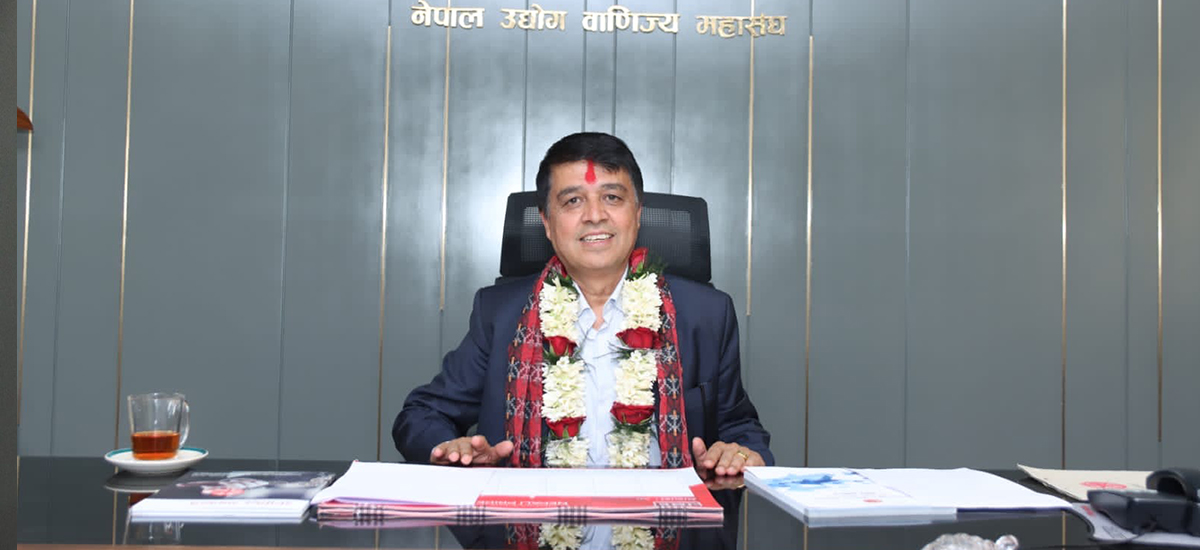
Chandra Prasad Dhakal is retiring after completing his three-year term as the President of the Federation of Nepalese Chambers of Commerce and Industry (FNCCI).TAG_OPEN_div_129 The 60th general meeting of the FNJ is underway in Kathmandu and the counting of votes of office-bearers and central members is underway at the time of this report.
Speaking at the inaugural session of the annual general meeting as the president of the FNCCI, Dhakal shared his experience that he had to face many difficulties due to financial crisis during his tenure.TAG_OPEN_div_127 Stating that Nepal’s industry and business sector have been negatively affected due to various internal factors including the impact of the Russia-Ukraine war on the economy recovering from the Covid pandemic, he said that many measures have been adopted to resolve the problem through cooperation and partnership between the state and private sector.
Recalling the contribution of the Federation as an umbrella organization of the private sector of the country for around TAG_OPEN_div_125 six decades old in the country’s economic development, he advocated for meaningful collaboration between the government and private sector for the country’s development and national prosperity. While leaving the leadership of the organization, Dhakal {{TAG_CLOSE_strong_68 TAG_OPEN_strong_67}} talked to Kamal Kumar Basnet{ Deputy Editor
focusing on this TAG_OPEN_strong_68 issue.
How do you remember your tenure as you are leaving the leadership of the Federation of Nepalese Chambers of Commerce and Industry (FNCCI)?
When I took the responsibility of the President of the Federation of Nepalese Chambers of Commerce and Industry, the country’s economy was going through a challenging situation. The impact of the Covid pandemic was visible on our economy. The Russia-Ukraine war was affecting supply chains around the world. The bank’s interest rate had gone up to a high point. There was a lack of liquidity in the financial institutions. Political instability was a long-term problem. There was also the problem of changing policies and priorities from government to government.
Therefore, in such a situation, I was taking charge of the federation with the responsibility of boosting the morale of the private sector and making economic activities operational. While assuming office, I had said that now the private sector should be run on the basis of modern thinking and style and not on the traditional thinking and style. That is why, during my tenure, we started working by prioritizing the issues of creating investment-friendly environment, identifying the policy level obstacles and taking initiatives to remove such obstacles and establishing the fact that the government and the private sector are complementary to each other. We have established the belief that not only to put suggestions through formal channels, but also to give priority to dialogues and present meaningful and objective suggestions.
First of all, we presented with arguments and facts that these laws, which are obstacles to investment and economic development, should be improved and amended for this reason. We continued to follow up. Therefore, we have achieved encouraging success in creating a private sector-friendly environment and in formulating private sector-friendly laws. I spent a full part of my life in the federation, with the support, support and desire of industrialists and businessmen from all over the country, I became the president.
Now the country has got a stable government. I am confident that the new government will bring policies that encourage investors and industrialists by prioritizing economic prosperity in line with the aspirations of the entire private sector and Nepali people.
What are the memorable achievements made during your tenure in terms of freeing the private sector from policy and legal entanglements?
We had an obligation to take factual and objective initiatives. It was also the responsibility of us to take meaningful and result-oriented initiatives as national and international factors have affected the economy. I had vowed to visit the government, parliamentary committees, ministries and departments for policy reforms and move ahead as per the strategy of taking meaningful initiatives. This process has continued since we came to the present day. We raised our voice that the private sector should be represented in the policy-making process.
The third executive committee meeting of the FNJ held at Dhorpatan in Baglung district had decided to organize the national economic debate programme.TAG_OPEN_div_109 The main objective was to make the political parties and stakeholders focus on economic issues and bring uniformity in the economic agenda. We have been able to bring together political parties, regulatory bodies and the private sector through this debate program. We demanded that a high-level economic reform advisory commission should be formed in that program.
After
}, the government formed a high-level economic reform recommendation commission under the leadership of former secretary Rameshwor Khanal with representation from the private sector. Khanal became the finance minister in the interim government and in a short span of time, he also started some corrective works. The commission has recommended reforms in more than 30 laws to create investment-friendly environment. I would say that this is an important achievement that we have achieved during our tenure.
} The government had said that the investment summit would not be very productive without legal reforms, so I took the initiative to reform these laws and create an environment to give that message to the foreigners who came to the investment conference. That’s what happened.
What has been the relationship or collaboration between the government and the private sector during your tenure?
{{TAG_OPEN_div_101} After I became the President of the Federation, we developed the concept of government-private sector cooperation and cooperation. Since FNCCI is an umbrella organization of the private sector, the government used to call it formally and hold discussions in the past as well. But we emphasized more on policy reforms. During my tenure, there have been the biggest reforms in the private sector-friendly laws and regulations. You can research these topics.
We tried to explain to the state the contribution of the private sector to the economy, employment and revenue. One thing to remember is that the then government had put forward the idea of keeping the private sector under the purview of the CIAA. Through the FNJ, we talked to various committees of the Parliament, the Prime Minister’s Office, the Ministry of Finance, the Ministry of Industry, leaders and whips of various political parties, the chief secretary, secretaries and other officials and constitutional bodies and convinced them that this was not appropriate and necessary. As a result, the proposal was postponed. This provided a great relief to protect the investment climate at that time. In this way, we did such advocacy that the private sector was always begging and giving the government. That this is not the case has been proved by our recent advocacy, and I believe it is further proved that there is a need for collaboration and partnership between the state and the private sector.
There is a narrative that there is no investment opportunity in Nepal, there is no working environment. How do you take it as the president of the federation?
I have repeatedly said publicly that there are opportunities in Nepal. I have never agreed that nothing can be done here, nothing can be done, there is no investment, there is no opportunity. We have also taken initiatives to dispel such misinterpretation through the federation. As part of this initiative, we have formed a public company with a capital of Rs 10 billion. Under my leadership, Nepal Development Public Limited was formed by collecting small capital from Nepalis living in and outside the country, which invests in big infrastructure, manufacturing industries and start-ups. It has already started working. This is to give an example that big projects can be built through internal capital mobilization, rather than why we have done this.
Similarly, we have been gradually creating units to support women entrepreneurs, youth and startups, small and medium enterprises in the federation. Now the number of women entrepreneurs is increasing all over the country, the federation has also been supporting the government and startup entrepreneurs through startup forums. We have also been successful in bringing the policy by taking the initiative for the startup policy.
Interaction and discussion with entrepreneurs of different countries to attract foreign investment has intensified. The FNCCI is also taking initiatives for legal and policy reforms to create an environment conducive for foreign investment. Another priority in the private sector is employment. We are taking initiative to prepare a curriculum by conducting a market survey on how to provide employment to more and more youths in the country and what kind of manpower is needed for it. We have been publicly saying that we will collaborate with the government for technical and skill-based education.
In the agitation of September 23 and TAG_OPEN_div_89 24, the youth raised employment as the main issue. However, when the agitation infiltrated, the companies and industries providing employment were set on fire. The private houses of industrialists and businessmen were also torched. The private sector suffered a loss of more than Rs 84 billion. However, we should not lose courage, it is our responsibility to raise this country from the ashes, so we tried to rise again.
In a program we organized immediately after the movement, we pointed out the need for the Private Sector Protection and Promotion Strategy (PSPP) concept for peace, stability and prosperity.TAG_OPEN_div_87 As the private sector is a job creator, product producer, service provider and revenue collector, we had submitted a concept paper to the government stating that the government should create the necessary business environment for this. The government’s commitment and decision to accept and implement the concept has boosted the morale of the private sector. I want to thank the government for this.
You were of the opinion that there is no investment environment in the country due to lack of political stability. But this time, a new government has been formed with a single majority, what are the expectations of the private sector?
Investment always requires legal stability and a stable government. The country whose government is stable, the laws of the country which are stable for a long time, the country where there is no political instability and conflict, the economic development of those countries is and has been accelerated.
Now I’d say that stability has begun somewhere in us. There is a single majority party government in the parliament, there are experts and young people in the cabinet. They are young and capable of making quick decisions. The government has already started implementing 100 action plans after the formation of the Council of Ministers. The government has given the message of private sector-friendly and investor-friendly by scrapping the Department of Revenue Investigation. We believe that such reforms will gradually take place. Many things will be improved while implementing the recommendations of the High Level Economic Reform Advisory Commission led by Rameshwor Khanal. We are optimistic.
The issue of amending the statute of the federation had been debated for a long time, but it had not been decided. You ended up agreeing. What methods should the next leadership adopt while working on such issues of long-term importance?
The unanimous amendment of the statute of the federation is an unforgettable achievement of my tenure. It was a matter of forming committees, but there were disputes and no conclusions. I unanimously reached the conclusion. At the beginning of my term, I had announced to amend the statute to make a provision to elect the chairman through direct election. Accordingly, we unanimously amended the statute after taking the opinion and suggestions of all our friends, and in some cases, convincing it.
Now the provision of senior vice-president automatically becoming the chairman will be removed. Next time, there will be a direct election for the president. This change in the statute will make the chairman more responsible and accountable to the members.
Another thing was that the District Municipal Chambers of Commerce and Industry saw their presence in the federation as weak, that the federation did not feel that much space. Keeping in mind the 50 per cent vote weightage of the district municipality, we have made provision for two vice-chairpersons from the district municipality in the statute. In order to increase the participation of women in the federation, we have included a provision of women vice-president.
We have been successful in amending the statute with many such positive provisions. I would also like to thank all the office-bearers and friends of the central executive committee in this regard.
In the coming days, I will use my experience and capacity for the development of entrepreneurship, job creation and economic progress of the entire country within Nepal.TAG_OPEN_div_69 I would like to thank former presidents of FNCCI, office-bearers and members of my team, the Government of Nepal, regulatory bodies, diplomatic missions, donor agencies, media friends who supported my tenure in office.














प्रतिक्रिया दिनुहोस्