

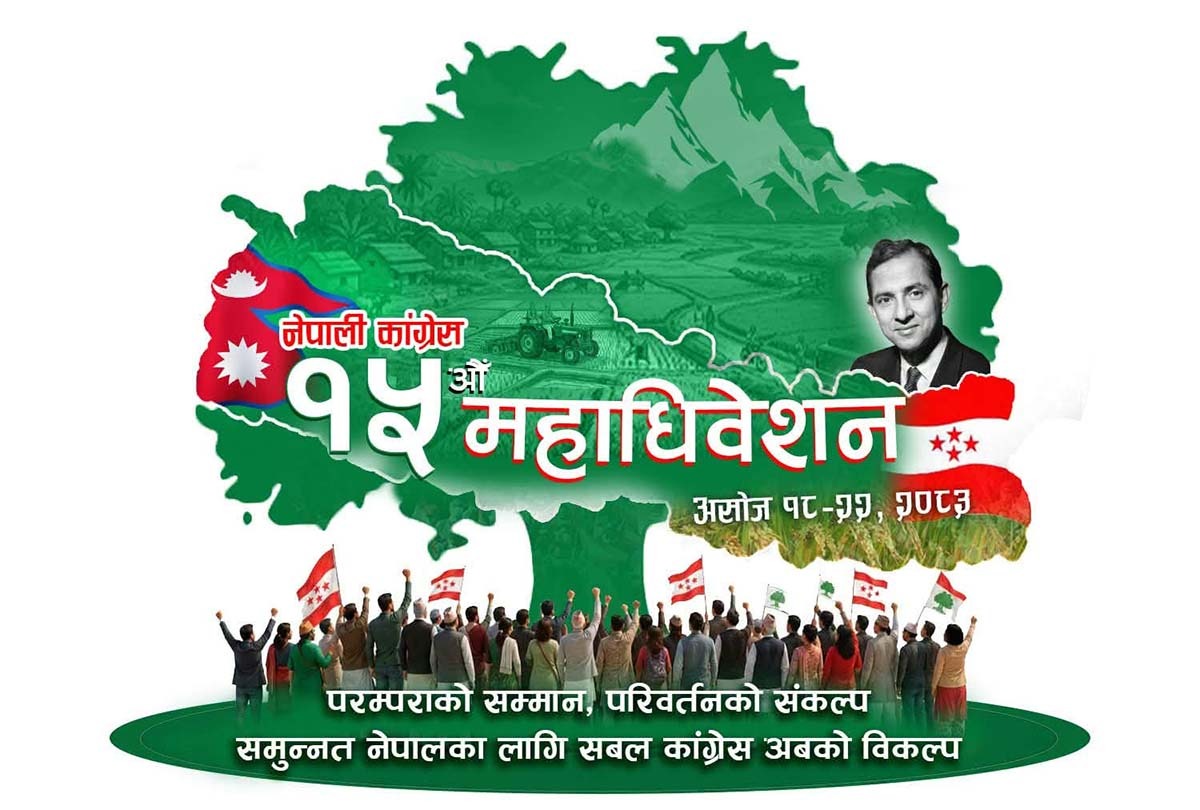
KATHMANDU: The 15th general convention of the Nepali Congress (NC) has decided to clarify the party’s economic current.
Keeping in mind the changing world economy and Nepal’s internal economic situation, the NC has indicated to make economic development with open economy, production and investment led by the private sector and economic development along with social security as the basis of its policy.
There is a debate going on within the Congress to redefine the democratic socialism proposed by BP Koirala with the concept of social democracy. In this context, the role of the private sector, investment security, tax stability and the role of the state are also being redefined, said Umesh Shrestha, treasurer of the Congress.
“We need an environment of trust, collaboration and competition instead of a relationship of mistrust between the state and the private sector,” Shrestha said. ’
The Congress has adopted the policy of promoting the private sector as a major driver of production, employment and revenue. Shrestha said that reducing the legal and administrative hassles seen in the operation of business, formulating enterprise-friendly laws, making the tax policy stable and predictable and ensuring the security of investment have been made important bases of the economic policy.
“Entrepreneurs should not be viewed as criminals just because they are doing business, action should be taken against those who violate the law, but an environment should be created to encourage entrepreneurship and investment,” he said.
State regulator, the main partner of private sector production
}
The Congress has given priority to the issue of clarifying the role of the state and the private sector in the economic debate of the Congress. The concept of giving the private sector a major role in production and investment and focusing on the role of the state in ensuring regulation, equal opportunity and equitable distribution has been put forward.
The Congress has been saying that the open and liberal economic policy adopted after 2048 BS has brought the private sector to the leading role of investment and production. The Congress has been interpreting the expansion of private investment in banking, industry, energy, tourism, services and capital markets as a result of this policy.
The NC is of the view that it will revise the same economic policy as per the time and establish the private sector as the main partner of economic development rather than the area of control.
From investment protection to tax stability
Policy stability has been made a major topic for investors in the economic debate of the Congress. The issues of reducing the administrative hassle involved in starting and operating a business, making tax rates and policies predictable, protecting investment and reducing unnecessary interference from government agencies have been put forward.
The economic concept of the Nepali Congress has also included the issue of maintaining policy stability so as to keep the tax rate and terms stable for a long time.
“Investors should not be confused about what will happen to their investment after five years of change in government or policy,” Shrestha said, “The policy should be stable and predictable so that it can assess the return and risk of investment.” ’
In the economic plan unveiled earlier, the Congress has set a target of mobilizing investment of Rs 137.5 trillion in the next five years. The Congress has proposed to mobilize about 80 percent of this investment from the private sector.
The Congress plans to mobilize a large amount of capital from the private sector, focusing on the role of the state as a facilitator and an impartial regulator. It encapsulates the concept of making the economy private sector friendly, highly growth-oriented and based on social justice.
This shows the priority of the Congress to make private investment, production and employment expansion the main basis of the upcoming economic growth rather than government spending.
The Congress has also given priority to easy access to financial resources to increase the investment of the private sector. In particular, a policy has been put forward to provide easy loans to productive and labor-intensive industries and to flow financial resources to productive sectors.
According to Shrestha, the agenda of expanding private investment in energy, agriculture, industry, tourism, infrastructure development, information technology and new economy was included in the discussions.
“Nepal’s economy cannot be made dependent only on imports and remittance,” he said, adding that an environment conducive for investment should be created to increase production, expand export and create employment and entrepreneurship opportunities for youths in the country. ’
Entrepreneur is not a criminal, but a partner
The Congress has also proposed a review of the legal provisions that criminalize business activities unnecessarily.
The Congress is of the view that although there is a need for regulation and investigation on the private sector, it should not create a situation where entrepreneurs are scared due to the running of business. The Congress has stressed that action should be taken against those who violate the law but an environment should be created where entrepreneurship is not seen as a crime.
For this, priority has been given to simplifying and clarifying laws related to business, reducing dual regulation and unnecessary administrative hassles by government bodies.
Policy stability for foreign investment
}
Along with the concept of open economy, the Congress has also linked the creation of an environment to attract foreign investment to the economic policy. The Congress believes that clear laws, investment protection, predictable tax system and ease of government procedures are the necessary basis for both domestic and foreign investment.
It has been raised in the economic debate of the Nepali Congress that a policy is necessary to link foreign investment not only as a means to bring in capital but also with technology, management, market and employment expansion.
In the new economic discourse of the Nepali Congress, production, employment and value addition have been considered more important than the size of investment.
Modernization of agriculture, expansion of industries, energy production, tourism, information technology, increase investment in infrastructure and new technology has been prioritized for creating employment in the country.
The issue of creating enterprises and employment opportunities in the country by ending the compulsion of youths to go for foreign employment has also been linked to the economic policy.
Social Security with the Open Economy
Although the Congress has given priority to the private sector and the market, it has not put forward a policy to end the role of the state. The concept of the responsibility of the state in education, health, social security, equal opportunity and protection of the weaker sections is in the economic stream of the Congress.
Therefore, efforts are being made to present the new economic discourse within the Congress as a model to link social justice and security with the open and private sector-oriented economy.
Upholding the core values of BP Koirala’s democratic socialism, the changing global economy, expansion of the private sector, expectations of the younger generation and reinterpretation of it by linking it with new technology have been at the center of the debate in the general convention.
The main message that the Congress is trying to give about the economy from the 15th Congress seems to be focused on private investment, production and employment expansion. The Congress believes that security for investment, stability in tax policies, ease of operation of business and cooperation between the state and private sector should be the basis of economic development.
How clearly these issues are included in the political and economic documents to be passed by the general convention and how they will be implemented in the economic policies of the next government and party will be important for the private sector and investors.













प्रतिक्रिया दिनुहोस्