A $270 million climate finance commitment in COPE, awaiting more donors
जलवायु वित्त बढाउन र प्रतिबद्धता कार्यान्वयन गर्न नेपालको आग्रह, जलवायु वित्तसम्बन्धी कोपका मस्यौदामा के-के छन् ?
लगानी न्यूज
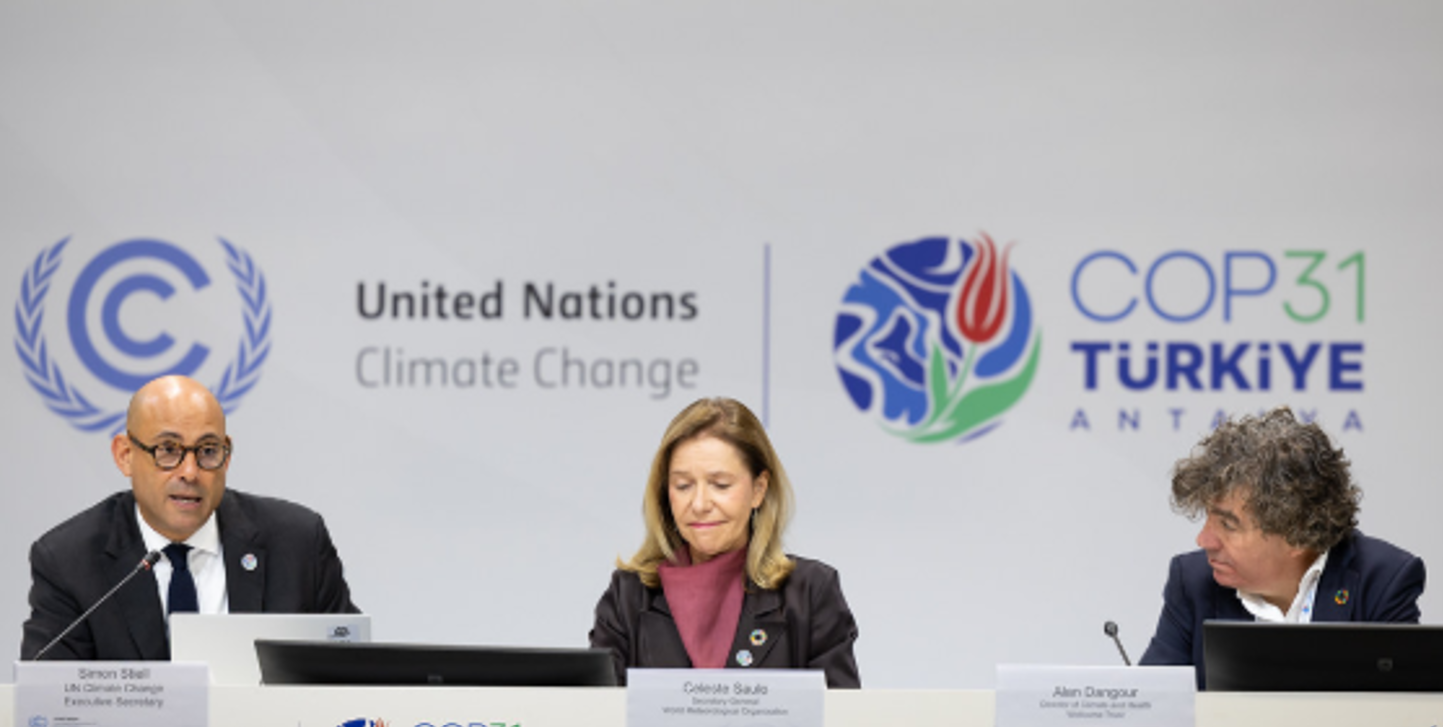
Kathmandu. At the United Nations Climate Conference (COP-31) held in Antalya, Turkey, 11 countries and associated parties committed to providing approximately 273 million US dollars in support for climate finance.
Various countries announced this climate financial support at the COP31 conference to mitigate the impacts of climate change, adapt, and address damage and damage.
Of these amounts, 226.8 million euros and 12,234,000 US dollars are mentioned in the Natural Resources Conservation Council (NRDC) statement.
According to data collected by NRDC, Denmark is at the forefront among climate finance donors in COPs. Denmark has announced a commitment of 107 million euros to the Global Environment Facility (GEF).
Similarly, according to NRDC, Singapore has announced five hundred thousand US dollars in aid to the Pacific Resilience Facility, established to enhance resilience in the Pacific region. South Korea has also announced 6.8 million euros in support for the Global Environment Facility (GEF).
Similarly, Belgium has announced 50 million euros in support of loss, damage, and adaptation to the LDC Fund (LDC Fund), and Germany will contribute 18 million euros.
Spain has announced 45 million euros in aid for damage, damage, and adaptation. Ireland has announced 6.7 million US dollars for adaptation, Belgium’s Brussels region 3.2 million US dollars, and Portugal 1.1 million US dollars.
Similarly, Estonia has committed 334,000 US dollars for adaptation, and the Solomon Islands has committed 400,000 US dollars to the Green Climate Fund (GCF).
These contributions, announced by various countries at COP31, are aimed at enhancing the adaptation capacity of countries and communities at risk of climate change, addressing losses and damage caused by climate disasters, and mobilizing climate finance.
The issue of providing adequate, predictable, and grant-based finance to developing and at-risk countries to combat the impacts of climate change is emerging as a key issue at COP31.
Dr. TAG_OPEN_div_94 Dharmraj Upreti, Executive Chief of the National Disaster Risk Reduction and Management Authority, views the influx of commitments for climate finance positively. “The COP talks continue late into the night. Countries affected by climate risks, including Nepal, are continuously advocating for increased climate finance,” he said, “So far, commitments amounting to approximately 270 million US dollars have been received. Commitments are ongoing. We expect further commitments from other donor bodies and countries as well. ”
Although commitments were made to provide climate finance at past COP conferences, developed and wealthy countries have been reluctant to implement it, forest and climate expert Dr. Sindhuprasad Dhungana says that this time, it is not certain that the commitments made this time will be implemented.
“We have raised the issue of ensuring adequate climate finance in various funds and having easy access to it at past COP conferences. There was also a problem of making commitments but not implementing them in the past. Whether the commitments made this time will be implemented remains to be seen,” he said, “The commitment coming is a positive aspect. Other countries should also commit. We must continue advocating for climate finance not only at the COP conference but at other times as well. ”
Nepal’s call to increase climate finance and implement commitments
Nepal emphasized the need to provide adequate climate finance to countries at risk of climate change and to implement financial commitments made by developed and wealthy countries.
During the closing address of COP 31, Minister of Agriculture, Forests, and Environment, Gita Chaudhary, urged the international community to provide grant-based support to ensure easy and rapid access to climate finance. She stated that climate finance should also be available before, during disasters, and for post-disaster recovery.
“Climate finance must work before, during, and after disasters. Climate finance must be available as needed to reduce risk, save lives, and restore affected communities,” he said, “We call for separate financial arrangements for rapid response under the Loss and Damage Response Fund (FRLD) and timely funding from all climate funds at all stages of the disaster cycle. ”
Minister Chaudhry stated that science, climate finance, and justice must be prioritized to reduce increasing Himalayan risks caused by climate change. He emphasized the need to implement the ‘Himalayan Climate Resilience Mechanism’ proposed by the Prime Minister. Minister Chaudhry stated that continuous scientific study and observation, cross-border data exchange, and the development of multi-disaster early warning systems are necessary for Himalayan countries.
Minister Chaudhary said that although Nepal’s contribution to climate change has been low, its impact and damage have been borne disproportionately. He noted that Nepal’s contribution to global greenhouse gas emissions is less than zero point one percent, ranks 161st globally in per capita emissions, and is the third fastest in the world in expanding the use of electric vehicles.
Discussing Nepal’s contribution to forest conservation, he mentioned that since the 1990s, Nepal’s forest area has been continuously expanding, and now nearly half the land is covered by forests.
During his address, Minister Chaudhary presented the suffering of families affected by the recent Rasuwa-Bhotekoshi disaster as a glaring example of the climate crisis to the international community. He also drew the global community’s attention to climate justice, saying that communities that had no role in creating the climate crisis paid the highest price.
“Although Nepal plays a negligible role in climate change, it is facing a need for reconstruction and reconstruction worth about five billion US dollars due to the Rasuwa Bhotekoshi flood caused by climate disasters,” Minister Chaudhary said, “Access to necessary resources has been difficult. This is not just a matter of financial constraints; it is also a lack of justice and equality. ”
Referring to the Himalayas as the world’s water reservoirs, he said that the climate crisis seen in the Himalayan region affects the water, food security, and livelihoods of billions of people in the lower coastal areas. Minister Chaudhary noted that the protection of Himalayan ecosystems is a shared responsibility not only for Nepal but also for the world.
Here are the draft climate finance cop drafts
The draft proposal proposes tripling adaptation finance to at least 120 billion US dollars by 2035. The draft emphasizes the need to remove obstacles faced by developing countries in climate finance.
High interest rates, limited financial capacity, increasing debt burden, complex financing processes, and costly administrative costs have been cited as major challenges to access climate finance.
Likewise, there is a call to increase grant-based, concessional, and debt-free financial assistance, and to provide easier access to climate funds for least developed countries and small island nations.
The draft also mentions the financial status of the fund addressing losses and losses caused by climate change. The requests received under the Barbados implementation process amounted to approximately two billion 80 million US dollars, with the available allocation being only about 342 million US dollars. It is noted that only about 50 percent of the 822 million US dollars declared for the Loss and Loss Fund has been converted into contributions.
Similarly, under the new Collective Quantitative Targets for Climate Finance (NCQAG), the goal of making 300 billion US dollars available annually by 2035 must be implemented. It is urged to continue implementing the Baku–Belém Roadmap to bring climate finance flows to one point three trillion US dollars.


















प्रतिक्रिया दिनुहोस्