

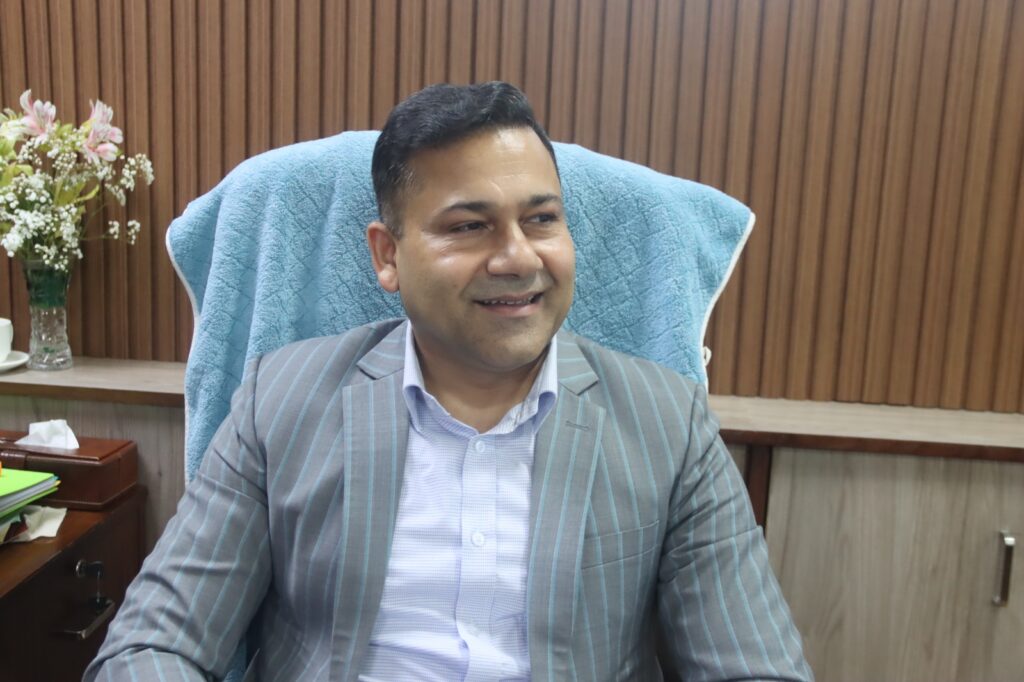
Santosh Prasain TAG_OPEN_em_156, CHIEF Executive Officer of Prabhu Mahalaxmi Life Insurance, has experience of working in regulatory bodies. Prasain, who is currently the CEO of Prabhu Mahalakshmi Life, is also a chartered accountant. Prabhu and Mahalakshmi Life have completed two years of merger. Sobhit Thapaliya spoke to Prasain for Investment News about the merger experience in the insurance sector and the insurance market.
How is it feeling to work after the merger of two organizations?
This is the first merger I have experienced. In Nepal, there have been instances of companies being merged on the basis of asset valuation as well as emotional attachment. Therefore, sometimes the net worth becomes secondary. In the case of merger, we also found it challenging at first. It takes time to bring people from different places together. People of one company come from one culture and people of another company come from another culture. When both of them come together, it is as if they do not match. After the merger of the company, some first-man (chief) had to become second man (deputy mayor). Therefore, the branch managers will be affected because they have already served as the head of the branch, so they feel uncomfortable working as deputy mayor. Since only limited posts are available for the chief, it will be difficult to adjust them.
During the process of merger, we had about 600 employees in one place. That’s why some left before the merger. Even after the merger, we became about 400 employees. The role of leadership will be very important in moving forward after the merger. However, now we are getting back on track.
What are the challenges when two companies merge and start a business with the same company?
When two companies came to the same place, the problem of having two cultures was big and major. We succeeded in managing it. Even before the merger of the company, the insurance business was declining due to the impact of Corona. In the previous year of the merger, we had collected Rs 1.11 billion in the first insurance premium, but in the first year after the merger, it was only close to that. The first five months after the merger were challenging. Even if we look at other companies that have been commercially merged, their insurance premium was reduced by 24-25 percent.
At that time, we were only two percent behind. But after some time of merger, we have made good progress. At present, we are growing by 51 per cent compared to the first year after the merger. Our term work is the main reason behind that. It will take some time to achieve (or stabilize) stability after the merger, a process that is both emotionally and psychologically connected, so there is something special to experience.
How did you get back to the old state of business from the 2 percent drop after the merger?
All the five merged companies in the insurance sector were in a declining state. It has certainly had some effect on us as well. It felt like our portfolio was in balance. After taking over, I have said neither good nor bad about the previous leadership – because everyone has their own way of working.
When I bring in an employee of another company, he has a new experience. But I believed that if the employees could spread the message to the employees, ‘This is your company, and I am your leader’, if this company is good, then all of us will be good, that thinking can also give positive results. Because I understood that success can be achieved only if those who lead in any field move forward with broad thinking and only that will give positive results.
At first, we thought the problem was with the employees. But later it was understood that the biggest challenge was in the agency sector. Agency friends have their own psychology and emotional attachment. No one is working for themselves, not for the CEO or others. It is important to be able to get such a feeling.
There are good opportunities for anyone working in this company, but they have to work hard for that. Here, to get a promotion, the notion that you have to be your own person should be removed. As chief executive of a company, I feel that all employees are equal. The main thing is not who has worked for how long, but who is doing what kind of work and whether his work is result oriented or not.
How is it in terms of returns? What will be the strategy in the coming days?
Now we have paid good dividends. For the last three years, about 8-9 percent dividend is good except taxes. In the past, 70 to 80 percent of the fund’s returns were around 10 to 11 percent. The situation today is different. It is difficult to get even 4-5 percent interest on the term which was kept at 13 percent until some time ago.
At present, even banks are reluctant to take deposits on fixed deposits. Against this backdrop, we need to make some changes in our strategies. In the coming days, the focus should be on selling high-yield products.
The main areas of income of the company are investment profit and underwriting profit. Investment profit is profit from investment and underwriting profit is surplus from insurance business. Now is the time to pay special attention to these areas. In particular, we are taking various measures to improve the underwriting profit. These include strategies such as making the claim management system more transparent and effective through digital means. It is believed that such measures will help ensure long-term profits while balancing the company’s claim ratio.
We are preparing to bring some term products( term insurance). Strategic transformation is necessary to maintain the current results. In the past, we have seen such challenges only after a gap of 4-5 years. At that time, the bank’s interest rate had come down from 11 percent to 5 percent, but it did not happen for a long time. For almost a year and a half now, interest rates have come down from 11-12 per cent to 3.5 per cent, and we don’t know how long it will last.
When The Nepal Rastra Bank (NRB) eased the policy, cash was made available to the public and deposits were deposited in the bank. However, the flow of credit has not increased. Some banks have started lending at a flat rate of 7-8 per cent for seven years, but that too has not significantly increased the demand for loans. Therefore, it is unlikely that the current interest rate will increase. There is no sign of a rise as soon as in the past.
Interest rates are a part of an insurance company’s income. The Insurance Authority has opened the way for investment in various sectors. However, the main part of the insurance company is in the bank’s term. Most of the life insurance products currently being sold in Nepal are cross-products, also known as participating policies. In such products, the insurers get the facility to participate in the company’s profits.
When the interest rate was around 11-12 per cent, we were not worried much. Because we were able to give a good percentage bonus return to the customer. At present, people are reluctant to keep deposits in banks due to low bank interest rates, which makes it easier for the insurance sector to sell a single insurance policy.
For example, if someone wants to get insurance coverage of Rs 10 lakh, then the amount has to be kept in full in the bank. However, due to the time value of money, depositing only 70-75 percent of the amount will also get that insurance coverage. Therefore, single premium insurance has become more attractive now.
However, this is not always the case. If bank interest rates rise again, people can turn to fixed deposits. But the point to understand here is that the concept of bank and insurance is different.
Insurance products in Nepal are still linked to the trend of interest rates. While non-participating and term products are selling more in developed countries like Japan or america. The tax system and social security structure are different. After people retire, the government takes over, so there is no need to worry too much about future savings.
However, we can have a source of income immediately after retirement, no matter how much tax we pay. Therefore, we have a high demand for savings-based products. After 60 years, people plan now thinking they need money. But term products are also important, which work to hold big risks at low insurance costs. However, up to 96-97 per cent of the participating policies are being accepted. Now there is a need to expand the term product. It is not a matter of choosing one, it is a strategy to move both forward in a balanced manner.
Capital increased after the merger of two entities, how much is the business growing in proportion to it?
Why did capital rise and how did it rise? I don’t want to go to that. At present, the company’s first insurance premium has exceeded billions. We can reach around 1.8 billion this year. Renewals are about Rs 3.5-4 billion. In both cases, it is more than 6 billion.
Banks and insurance are different sectors. Insurance is also reinsurance. If I take an insurance policy of Rs 10 million, i will take a risk of Rs 5 00,000 or Rs 10 lakh and give the rest to the reinsurance company.
In such a situation, i don’t think the paid-up capital carries the risk. Because capital cannot bear all the risks in life insurance. It’s been two years since the two companies were merged. It’s been seven years since we came into operation. Mahalakshmi Life is one year behind the previous Prabhu Life. Now we will be able to make the first insurance equivalent to our capital in the near future or in the interval of 3-4 years.
A company with a capital of Rs 5 billion has to earn Rs 500-600 million to get only 10 per cent return. Shareholders must pay dividends. An insurance company needs profit to run. We have done well so far. I believe you will do well in the future.
You are now running an insurance company through a regulatory body. What does nepal’s insurance market look like?
Nepal’s insurance market is good. We are not weaker than other countries in the contribution of GDP. Even today, life insurance contributes 2.74 per cent to the GDP and on average, the insurance sector contributes 3.47 per cent. Ten years ago and now, awareness among people has increased.
Many people know what happens when people are insured. But i don’t think that’s all. Now the regulatory body has also become very active. Programs are being carried out in coordination with the local levels. A regulatory body has reached every province. I believe this will increase the awareness level.
Insurance companies are yet to reach far and wide. Insurance is more concentrated in cities. How long will this last?
There is no doubt that insurance should be extended to the villages. Insurance is the right of all citizens, whether it is a city or a remote village. We have already reached From Jumla to Bajura, Bajhang, Darchula – what can be farther away than there? But opening a branch is not the only solution, it should also be able to operate that branch in a sustainable manner. We believe that if a branch is to be opened, it should be in a position to operate on its own within two years. At present, our company has 115 branches, out of which 30 branches are in Kathmandu Valley.
The regulator’s aim to start micro insurance is the same – to provide insurance services to places where traditional insurance companies have not been able to reach. Micro Insurance aims to target customers with an insurance limit of less than Rs 500,000, and they have to work at that level. Awareness is also necessary for that. Our company alone has more than 25,000 active agents, a large part of whom represent rural areas. Therefore, it may not be entirely true that insurance has not reached the village.
How much do you see the idea that the general public should be insured now?
Initially, access to insurance in Nepal was limited to only 7 to 10 percent of the population. Today, about 44 percent of the population has taken insurance services, which is a remarkable progress. This indicates that there is a growing awareness among the public that life is uncertain, that death is true, and that accidents can ever happen.
In most families in Nepal, there is only one earning person, on which other members such as wives, children and parents depend. If something happens to such a person, it will have a complete impact on the family.
Nowadays, people are looking at insurance as a preparation for the future. Some have learned from the experiences of others, and some have started insuring themselves. Nepal’s current tax system cannot ensure social security for old age. As a result, people have come to understand that they have to plan for old age themselves.
Moreover, most of the young people go abroad. Since they themselves are busy with the responsibilities of their families and children, there is a growing thinking that parents should also be self-reliant now. For example, if a child is insured worth Rs 10-15 lakh today, then he will not have to face any hassle to raise Rs 20-25 lakh for education or other needs in the future. Now many parents understand that.
The insurance market is now expanding rapidly. But the expansion of this consciousness is not enough. To expand it further, the active participation of insurance regulators, the government, and companies like us is essential. There is no doubt that public awareness is increasing, but it is yet to reach many parts of the country. So we have to keep trying.
How to insure low-income people?
Insurance is not a luxury, it is a necessity. Many people are under the impression that it takes a lot of money to insure, but that is not a reality. If you work according to the plan, people with low incomes can easily get insurance.
For example, if someone has a life insurance of Rs 10 to 15 lakh for 15 years, then the annual insurance premium is an average of Rs 90,000 to Rs 1 lakh. If you look at it in a month, it is only Rs 7,000-8,000. If you take insurance of Rs 10 lakh instead of Rs 15 lakh, then the monthly insurance fee will be more. This is the amount that ordinary people spend on ordinary things. The problem is that we think we need crores of rupees at once, which is not practical. A large amount of money is made from small savings.
And insurance is essentially for the same person whose income is limited. Because those who have a low income need more protection to bear the risks in life. Therefore, the time has come to spread the perception that insurance is not a cost, but a plan that is linked to savings.
Why do insurance policies all look the same?
Yes, on the surface, most insurance policies look the same. This is because the basic structure of insurance — such as the sum assured, period time, and bonus structure — is often similar to the company. If a company gives more bonus, then its insurance fee is also higher. If the insurance fee is equal, the bonus is almost the same.
However, the real difference is in the quality of service – especially in the process of claim payment. How easy is service when an insurer needs it? How quickly will the claim be completed? What is the net worth of the company? What is his past claim payment record? These are all important aspects, which many do not see at first sight.
Now the trend of focusing on service is increasing. Almost all the claims in our company are paid on time except those who do not have documents. If the required documents are complete, we are in the practice of paying the claim within 3-4 days. In the end, the real price is service. It’s not just written on the policy paper, it’s about how much the company supports you when you’re in a difficult time.
But, why are there so many questions about claim payment lately?
Every company has its own strategy. However, in the case of our company, more than 99 percent of the claims have been paid so far. With a few exceptions, most claims have been easily settled.
But the problem is often seen in cases when the customer does not disclose the necessary information while insuring. For example, if someone already has cancer, that person cannot be insured. But due to lack of information or negligence, people get insurance.
The insurance offer form asks, “Do you have any illness?” However, the customer gives false information by saying ‘no’, even if he has already been tested or has the disease. In such a situation, there is a problem in the claim later.
This cannot be called the fault of the insurance company. This is related to the supreme faith. If all the information is given in truth, there will be no complications in the claim process.
This needs to be understood by the insurers. When everything is made clear while insuring, claim payments can also be easily obtained. With such exceptions, claims such as death claims generally do not have any problems.

The issue of money laundering in the insurance sector has become very complicated in recent times. Is the problem increasing?
I haven’t seen it personally. It can happen sometimes. Sometimes we are looking for an income source of rs 200,000 to prevent money laundering. We have been submitting the details of insurance fees of more than Rs 100,000 to the concerned department of the Rastra Bank. We also show suspicious transactions. It may have been a little stricter to avoid creating an unusual situation in the coming days.
The bank does not look at resources up to Rs 990,000. We compulsorily charge more than Rs 100,000 through banking. How can we re-authenticate the money in the bank? We have to remember that the money must have come by paying taxes. However, if there is any doubt, there is also a mechanism to inform the concerned body. Also, we do not have any basis to say that money coming through banking means is money laundered. The source is initially submitted to the bank.
Why does the data show that the number of insurance policy surrenders has increased in recent times?
First of all, it is necessary to understand what surrender (insurance dedication) is. Insurance surrender refers to the condition in which the insured is unable to continue the policy or leaves it midway. There is a legal provision that surrender can be made only after paying three installments of the policy and after the completion of the full three years. However, surrender is not beneficial for anyone – neither for the company, nor for the insured, nor for the agency.
There are many reasons for the increase in life insurance policy surrender in Nepal – such as the tendency to consider insurance as only helpful than mandatory, the sale of insurance on the basis of forced or incomplete information without understanding people’s income and income, unstable economic conditions of the country, changes in personal life (e.g. departure, job loss, business closure, etc.) The emergent financial requirements are like surrendering an old insurance policy to take a new plan.
Although we want the surrender to be zero, the surrender rate of 15-20 percent is considered normal in the Nepali insurance market. But it is important to understand how much it affects the premium. Sometimes a large premium (insurance fee) can be surrendered even if a few policies (insurance policies) are surrendered, and sometimes even if many insurance policies are surrendered, there may be less insurance surrender. Surrender of the policy is not beneficial for anyone: The company invests up to 50-55 percent of the initial cost, the insured does not get the benefit according to his plan when surrendered in a short period of time, and the agent’s commission is also stopped.
The insured usually plans to pay for 15 years, but when he leaves within three years, he does not get the same amount he paid back. The agency friends also get commission from the premium continuously, so the surrender also stops the commission. That’s why we call our agents brand ambassadors and first underwriters. Their commission is from the company. It’s not the policyholder’s money. If it was the insured’s money, it would have been deducted from the payment.
Ultimately, the future of insurance will become brighter and more sustainable if it is spread through a conscious, transparent and positive dialogue between companies, agents and insurers that insurance is for long-term financial security and family stability.
What are the challenges in the insurance sector now?
Challenges are always there, but the main thing is how to take those challenges as opportunities. This is one of the biggest challenges in the present context. Building a strong agency network, and more importantly, providing accurate information about insurance to agency peers. It is important to empower agents professionally.
Although insurance penetration now reaches about 44 per cent of the population, expanding it is another challenge. Taking insurance to every home, and reaching it in an understandable way, is still a distant journey.
Similarly, there are policy and regulatory challenges such as acting in accordance with the Anti-Money Laundering Act, complying with new circulars and regulations brought in by regulatory bodies, and adapting to them. Another challenge is to complete the AGM on time, which depends on the will and preparedness of the regulator and the company.
But all these challenges are not new. They were yesterday, they are today, they will be tomorrow. The question is how to solve those challenges in a systematic manner and move forward.









प्रतिक्रिया दिनुहोस्