

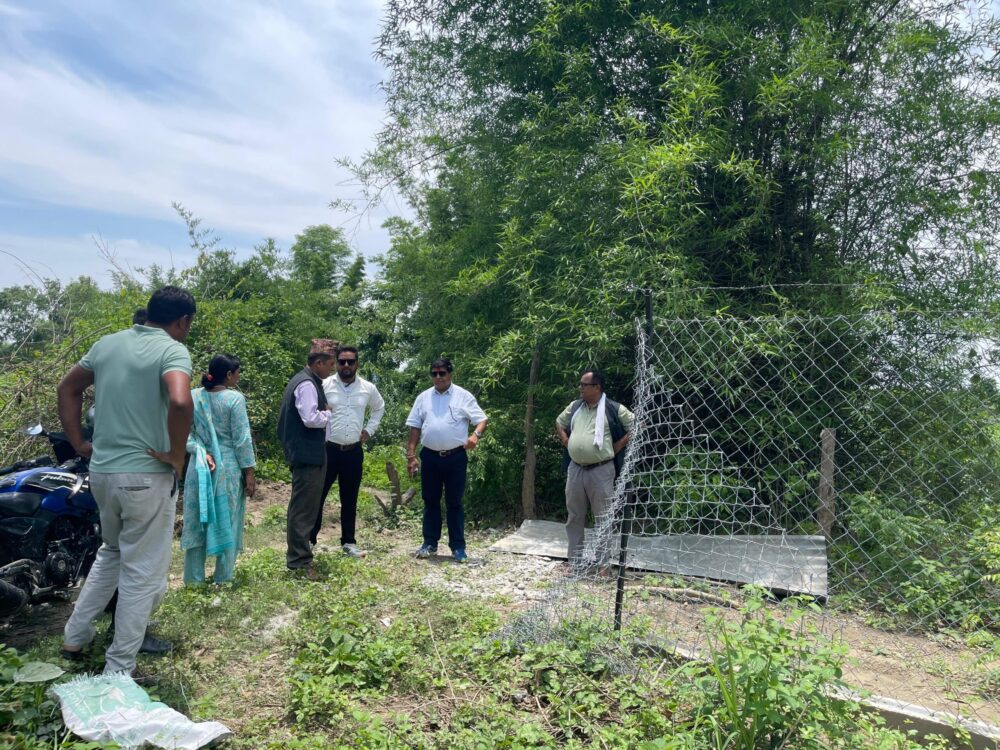
Kailali. Kailali: A ‘mess wire’ wire mesh has been constructed in Kailali to reduce the human-wildlife conflict that has been a challenge for years. The wire mesh has been installed in the community forests along the sensitive Karnali Biological Route under the Pahalmanpur Division Forest Office in the district.
Divisional Forest Officer at the Division Forest Office, Pahalmanpur, Ram Chandra Kandel, said that a 1,650-metre long fence has been constructed at Kailasheshwor Community Forest in Janaki Rural Municipality-6, 1,000 metres in Karnali Corridor Community Forest and 1,100 metres in Rani Karnali Community Forest at Tikapur Municipality-2 under the Integrated Land Perimeter Project run by the Ministry of Forest and Environment.
According to him, a strong meswire fence has been constructed along the border of community forests and human settlements with the foundation of PCC (cement, concrete). It is believed that this action will prevent wildlife from entering the settlement and also reduce the loss of crops, pets and human beings of the local residents.
Kandel said, “Tikapur municipality, Janaki rural municipality and Lamkichuha municipality are important parts of karnali biological route, which is connected to Bardiya National Park. ’
According to him, large and protected wildlife including tigers, elephants and leopards continue to come from the park in search of food and habitat. “Therefore, the region is at high risk of conflict and this fence will be effective in preventing damage not only to large animals but also to small animals like chital, bandel and nilgai to farmers’ crops,” he said. ’
For a long time, the residents of this area had suffered due to the entry of wild animals into human settlements. As the Karnali Biological Route is connected to Bardiya National Park, this area is the main transit route for wildlife like tigers, leopards, elephants, boars, nilgai and chital.
These animals used to enter the settlement in the middle of the night and destroy crops like paddy, wheat, corn, and kill goats, pigs and other domestic animals tied to the cowshed. At times, there were incidents of attacks on people, forcing the locals to live in fear.
Tek Bahadur Shahi, chairman of Kailasheshwor Community Forest, said that the construction of the fence has brought great relief to the locals. He said, “Earlier, we were forced to stay awake all night and wait for crops, there was always a fear of when wild animals would come and damage, now this strong fence will help to limit the wildlife to the forest area.” “This will not only protect our crops and livestock, but will also reduce unpleasant human-wildlife incidents,” he said.
Dilip Yadav, senior forest officer at the Sub-Division Forest Office, Tikapur, said the fencing is an important task towards maintaining human-wildlife coexistence. According to him, in the past, there was a high possibility of wildlife and human interaction in the absence of any physical barrier between the forest and the settlement, which led to conflict. Meswire fencing with PCC keeps both sides safe in their respective areas. On the one hand, wildlife can roam freely in their natural habitat and on the other hand, the livelihood of the local community is protected.
Prakash Thapa, field manager at the Integrated Land Perimeter Management Project Implementation Unit, said the main objective of the project was to strengthen human-nature relations by preserving important biological pathways. “We have seen the Karnali biological route connecting Kailali and Bardiya as an entire land periphery,” Thapa said, adding, “It is not only limited to the construction of fencing, but we have also restored the biological route to support tree plantation and natural regeneration to connect the fragmented forest areas.” ’
According to Thapa, the project has implemented alternative income generation programmes such as systematic cattle shed construction, unseasonal vegetable farming and non-timber forest produce-based enterprises to reduce the dependence of the local community on forests. We are also carrying out activities such as capacity building of community forest users’ groups, training on wildlife rescue and spreading awareness at the local level to mitigate the impact of climate change,” Thapa said.
















प्रतिक्रिया दिनुहोस्