



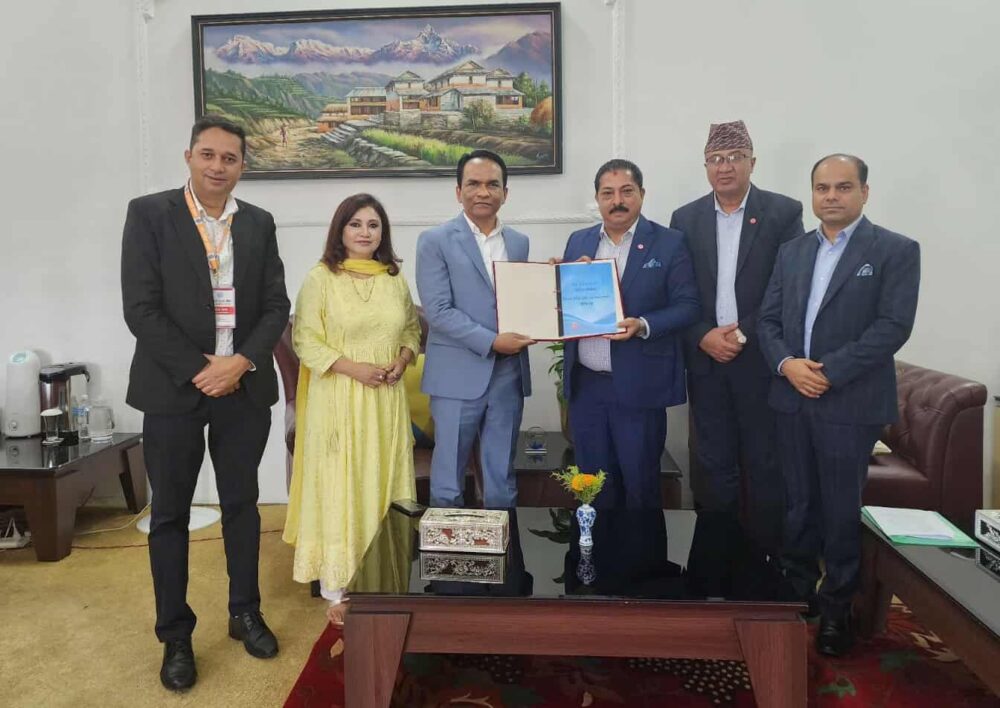
Kathmandu. The Federation of Nepalese Chambers of Commerce and Industry (FNCCI) has submitted its recommendations to the Nepal Rastra Bank (NRB) for the monetary policy for the fiscal year 2082/83 BS. FNCCI office-bearers led by its executive chairman Anjan Shrestha met Nepal Rastra Bank (NRB) Governor Bishwanath Poudel on Tuesday and submitted suggestions for the upcoming monetary policy.
The Federation stressed the need for policy reforms to accelerate the reform-oriented economy, boost the morale of the private sector, and address the risks of money laundering, keeping in mind the slowdown in the economy, the risks in the financial sector, and a large part of the informal sector.
Stating that the lack of sanitation and infrastructure has not yielded the results of policy reforms, the FNJ has stressed on the need to carry out monetary policy plans targeting infrastructure construction among the main suggestions of the monetary policy, said Shrestha, acting president of the Federation.
The FNCCI has suggested to include concrete programs to implement the provision of loan rescheduling and restructuring mentioned in the budget and make this facility available to all small, medium and large industries and businesses, and implement the provision of more working capital flow and interest penalty in a clear and effective manner.
Similarly, executive chairman Shrestha suggested facilitating the provision of working capital loans for productive, tourism, construction industry, and housing development companies in a simple and accessible manner, giving the concerned banks and borrowers the right to decide current capital loans according to the nature of the business, and reducing the interest rate on loans received by industries to 12.45 in the context of the decline in the share of industry sector in the economy should be 1-25 less than the business. told.
In the context of Upgrading Nepal from least developed country in 2026, policy arrangements should be made to provide concessional loans to maintain the competitiveness of the export-oriented industries run by micro, domestic, small and women, organize the arrangement of interest subsidy by linking women entrepreneurship loans with production and provide loans at a maximum premium rate of 25 premium for loans up to Rs 50 million. ।
Similarly, the Federation has suggested to facilitate the provision of watch list, to attract the Zen-G generation to the business for the promotion of youth entrepreneurship, to provide business registration through the Citizen App and project loans up to Rs 10 million, and to implement the feasibility study conducted by the Federation in this regard.
Similarly, the FNJ is of the view that concessional loans should be provided to the dependent families of the person sending remittance through formal means while in foreign employment. The FNCCI has also suggested revising the existing targeted lending policy and formulating a guided policy by giving priority to productive industries, tourism and infrastructure, establishing and operating asset management companies in the context of increasing non-commercial wealth of banks and financial institutions.
At present, there is a provision to not send internal remittances to remittance companies and due to this, the low income group, students, workers working in the informal sector, working outside the home and people who do not have access to smart phones are most affected. ।
It has also suggested raising the limit of residential home loan from Rs 20 million to Rs 30 million, making policy arrangements to facilitate the construction of 100,000 houses mentioned in the budget, implementing the arrangement that can be obtained by the concerned bodies through electronic means by linking KYC to the national identity card and implementing interoperability for QR free of cost.
In the context of investing abroad, the Federation has suggested to effectively implement the budget announcement of allowing Nepali entrepreneurs and companies to open sales branches or processing factories abroad and allow them to invest up to 25 percent of the total exports abroad.
Similarly, there should be no additional capital charge on the investment of banks in private equity and venture capital, and the investment made in such funds should be recognized as providing loans in the directed sector.
On the occasion, FNCCI vice-presidents Hemraj Dhakal and Jyotsna Shrestha and treasurer Bharat Raj Acharya stressed the need for effective monetary policy to address the existing challenges in nepal’s economy.



















प्रतिक्रिया दिनुहोस्