

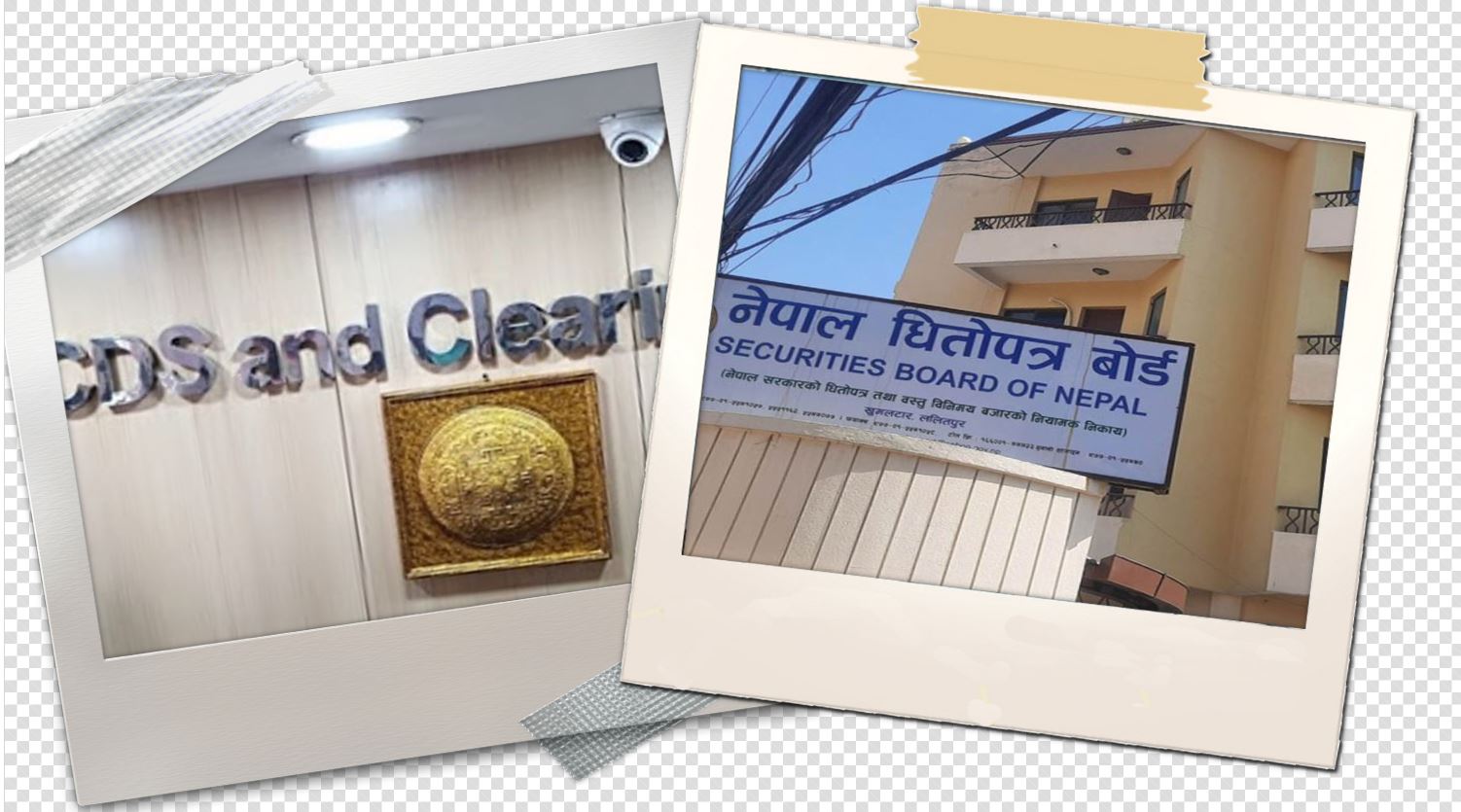
Kathmandu. The International Security Identification Number (IGEN) has gained a lot of attention in nepal’s capital market for the past few months. Several letters were also exchanged between the Securities Board and the CDSC, the regulatory body of the capital market, for a long time.
A meeting of the Board of Directors held at the CDSC for about four hours in the evening of July 17 passed the ‘Securities Dematerialization Operation Guideline-2082’ and sent it to the Securities Board for approval.
During this period, there was a discussion everywhere whether the icon would give one or two. As a result, the founder shares of some companies have not been listed while the shares of the general public are being traded in the secondary market by issuing IPOs. Earlier, shares were listed from the same iGene number. However, the CDSC has not been able to list due to the fact that it has not yet made arrangements (different igen numbers should be made for ordinary shares and founder shares). For the last three months, there has been no share in the demat account of the shareholders.
On the other hand, the officials of the Securities Board, NEPSE and CDSC are not satisfied with the need for two IGN numbers as sought by the CDSC. Everyone understands that the CDSC is trying to make arrangements that are not yet in the world and it is not necessary. However, there has been a controversy for about four months regarding the IGN as the regulatory body Securities Board has not been able to give proper instructions to the CDSC in time.
The dispute has escalated for a long time as the board has not been able to give directions according to its regulatory status.
At that time, Emerging Nepal was given two engine numbers. The controversy started after the company asked for only one IGene number. The CDSC had approached the Emerging Securities Board after it refused to give an icon. The board had written a letter to the CDSC on April 1, 2018, requesting it to approve the creation of a single ISIN for the founders and the general public. The CDSC did not accept the request.
She looked at Sebon. Subsequently, on May 14, SEBON registered the CDSC to dematerialize the securities of the organizations organized in accordance with Rule 24 of the Securities Central Deposit Service Rules, 2067 and Regulation 3 of the Securities Central Deposit Service Bye-laws, 2068. “There is no provision to grant approval from the board regarding registration and grant of ISIN and no decision has been taken by the board in this regard in the past,” the letter read.
Sebon, which did not respond to this question, has given three directives to the CDSC on July 27, giving a seven-day deadline. There is talk within the board that the directive has questioned the regulatory capacity of the Securities Board. “If Sebon wanted to resolve the iGen number dispute, it could have given clear instructions on international practice and the practice currently being used in Nepal,” said a senior board official. It is a matter of shame to send a letter keeping in the language of those who have to instruct the CDSC to do so in the beginning, to do so, to do so, such a provision, information is made. If such issues had come up in banks and financial institutions, would the Rastra Bank have stayed for such a long time, if there was such a problem in India, would Sebi have only given instructions for such a long time? Inside, it seems that everyone should not be given two iGene numbers, unable to give instructions, this is Sebon’s weakness. ’
The employee said Sebon should take timely decisions on such matters.
Sebon, in a letter sent on July 27, informed the Board that the CDSC was in the process of formulating a law on ISIN, but in the context of the lack of clarity on the time period for making that legal provision, if a clear legal provision has to be made on the issue of ISIN, then it will be done immediately. If it takes time for the CDSC to make legal arrangements (bye-laws÷ guidelines÷ procedures) regarding ISIN, arrangements should be made to keep the securities in the beneficiary account in accordance with the prevailing arrangements and prevailing good practices.
According to a letter submitted by cdsc to the board, Emerging Nepal Ltd. Informing him that the information was submitted to the Board on time as it was found that emerging Nepal did not establish a single ISIN only because it did not inform the special general meeting of the organization, it should be done according to the prevailing practice regarding the mixing÷ of ISIN of the founder and general shares of the organization. it is said.
“If Sebon had regulatory capabilities, instead of sending such a letter, it should have been asked to give the same iGene number as per international practice and current arrangements,” the board official added. The securities board’s failure to do so adds another problem to Sebon. Some have argued that this happened because Sebon did not make a clear policy arrangement. Banks and financial institutions are regulated by the Rastra Bank and insurance companies by the Insurance Authority.
Although the Electricity Regulatory Commission regulates the hydropower companies, the share of founders and ordinary shares has not been allocated. Other manufacturing companies, hotels, tourism and other companies do not have a separate regulatory body. The ‘super regulator’ of such companies is Sebon. Sebon’s lack of attention to such disputes has caused problems from time to time. “Even though it seems that SEBON is the only authority to issue IPOs, rights, FPOs, bonds, mutual funds, such issues do not come up in time,” said a high-ranking official of the board. ’
The guidelines passed by the CDSC on Sunday and sent to Sebon for approval are going to be in conflict with any issue of the Companies Act. According to the guidelines sent to the board, now after the IPO of each company, there will be two different igns for the founder and general shares as per the provisions in the management letter and regulations of the company issuing shares.
But this provision is contrary to the Companies Act. In definition 2 of the Companies Act, 2063, ‘T’ states that ‘ordinary shares mean shares other than preference shares’. If we look at the definition of the Companies Act, then the founder share and the general share are the same and the preference share is one. Based on this Act, it appears that the founder and the general public share will be operated by the same iGene. Priority requires another icon.
Since the Act is above the guidelines, it is now a matter of concern for everyone how many igones will be given by SEBON while approving the guidelines passed by the CDSC. If the securities board takes a long time to accept this guideline, the founder shares of the shareholders of many companies will not go to the demat account. According to the understanding of the employees of the Securities Board and the letter dated July 15, if they go by the prevailing practice, then an icon will reach.
Still, high-ranking officials of SEBON and NEPSE say that different igns are needed for different price companies. Investors with different titles do not need two IGN numbers.
Cdsc Managing Director Prabin Pandak, on the other hand, claims that the company is going to set up two engines to stop the distortion in the founder shares in the market. Pandak argued that this arrangement will be maintained only till the lock-in period of the shares and after the completion of the lock-in period, the founder and the ordinary shares will be kept in the same IGEN number after the general assembly approves it.
She told Investment News that the guidelines would be formulated and implemented as per rule 30 of the Securities Central Deposit Service Regulations-2067 bs. He claimed that after the implementation of this guideline, no shareholder will be able to run away by selling shares during the lock-in period. After the implementation of this guideline, there will be no problem of one type of share ownership on paper, one type of share ownership in the index of CDSC or other bodies. He said that there will be uniformity in all systems. He argued that the company should inform the investors that the company will issue information when the founder and ordinary shares are in the same iGene after the lock-in.
She said that after the lock-in, when the transaction is done from the same iGene, the company does not have two types of price, founder and ordinary. Will giving two ISINs in terms of founders and ordinary shares now lead to two market values for each company in the future? There is a question everywhere whether new companies will not come to the capital market as the share price of the promoter is low by opening a company by taking risks, setting up a company. However, Pandak claims that the price will be the same after the lock-in period is over.


















प्रतिक्रिया दिनुहोस्