

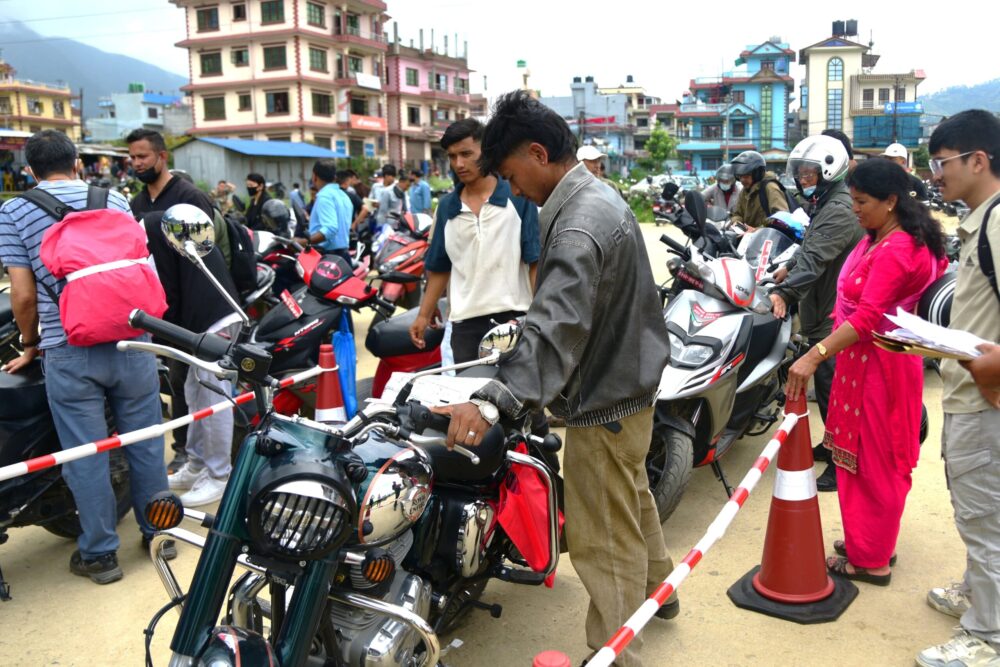
Kathmandu. The government has decided to implement the installation of embossed numbers in private and public vehicles from September 1.

A meeting of the thematic committee chaired by the Minister for Physical Infrastructure and Transport held on August 12, 2018, has been protesting from all sides after the Department of Transport Management made public the information that the transport management offices under all the state governments should compulsorily install embossed number plates while registering, transferring and renewing vehicles from September 1, 2082. ।

At present, most of the vehicles use traditional hand-written number plates, which can be easily removed or replaced, so the embossed number is also the correct option to control the possibility of vehicle theft and use in various criminal activities.

Since the Radio Frequency Identification Technology (RFID) chip on the embossed number plate helps to track the movement of the vehicle, it also helps to find out if the vehicle is lost or stolen and get the real one of which vehicles are going.

In this context, content based on a conversation with the service seekers at the Transport Management Office, Gurjudhara and a video interview with Rajiv Pokharel, Director General of the Department of Transport Management.

There has been a rush of service seekers before the office hours to install embossed number plates at the Transport Management Office, Gurjudhara. The service providers complain that it takes a heavy time to install the number plate. Sitaram Hemba, a customer from Bhaktapur, said that it takes hours to complete various processes including banking transactions for the plate. He complained that he came at 9 am and could not work till 2 pm.

Similarly, Raju Upadhyay, another customer from Basundhara, complained that he had to go to one place to take the number plate and another place to take its stand and screw and did not even pay the bill of the embossed number plate.

According to Rajiv Pokharel, director general of the Department of Transport Management, the embossed is digitally readable, so it has the advantage of managing the data of vehicles and formulating policies accordingly.

Unlike traditional number plates, metal plates have different embossed number letters and numbers above the surface of the plate, which is retro-reflecting and easy to read the number of vehicles.
The technology chips installed on this number plate also contain details of the vehicle owner and the vehicle. Pokharel said that the letters and digits used in this can be monitored and data can be collected from the frequency identification (RFID) gate.

If the handwritten number plates used in traditional vehicles were stolen, there was a possibility that the number plates could be easily replaced and those vehicles could be used for criminal activities.

There was also a problem in keeping the track of the vehicle. Therefore, the government has introduced the concept of embossed number plates that can be tracked and uniformity can be brought in all vehicles, he said. It is impossible to steal and drive the vehicle as it cannot be removed once it is installed.

At present, the radio frequency identification (RFID) track of embossed number plates has been installed in Nagdhunga and Machhapokhari areas of Kathmandu (going to Nuwakot). Apart from Kathmandu Valley, RFID gates will be installed at 10 places including Birgunj, Pokhara and Butwal. This will make it easier to track the movement of vehicles.

He informed that work was underway to ease the service delivery as all transport management offices are now under the provincial government.

 Photo/video/Safal Prakash Shrestha/Saroj Shahi













प्रतिक्रिया दिनुहोस्