



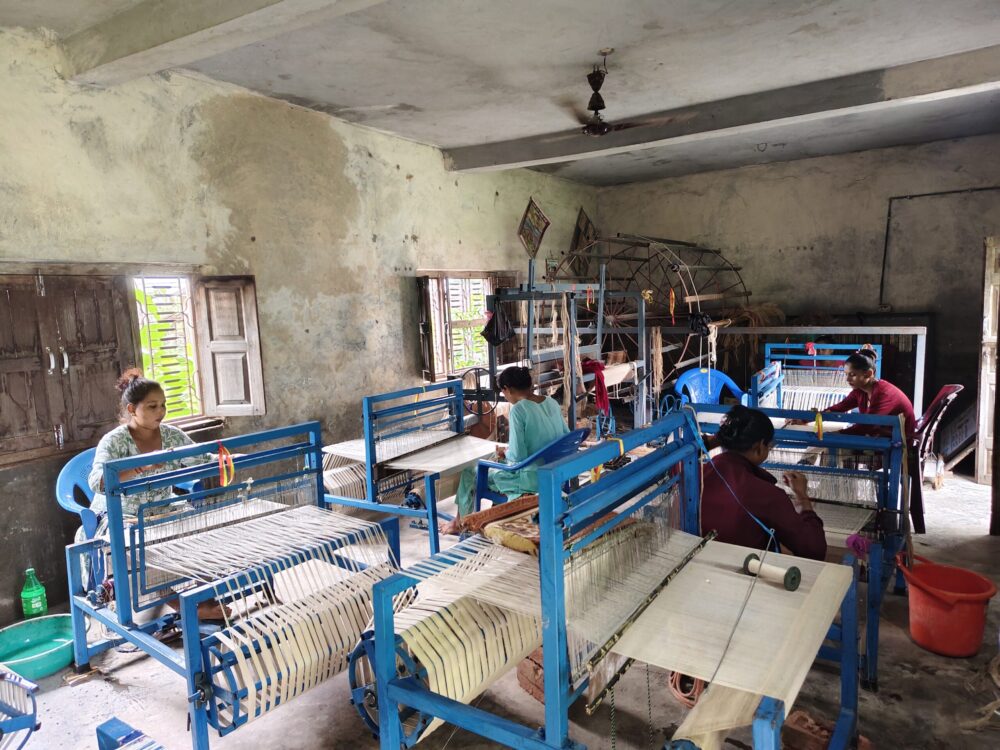
Kailali. Jugarani Chaudhary of Tikapur Municipality-5 had a difficult time two months ago. His family was not satisfied with his work, which was busy with household chores all day. She said that no matter how much work she does at home, there is no income from it. The 25-day training that Jugrani learned by recommending her for training by a cooperative has changed her life. She was able to join the industry after 25 days of training provided by an organization.
Women including Jugarani have been able to join the industry after providing 25 days of free training and 50 percent subsidy to weave clothes. Jugrani has now started weaving raw cloth from banana fiber. Nowadays, I spend my day making clothes. “I couldn’t believe that clothes can be made from the waste banana tree (tham) and I have started making clothes myself,” she said, adding, “Nowadays, even my family has started believing in it.” You also feel self-reliant. ’
Dhansinghpur Ekta Samaj Savings and Credit Cooperatives Limited based in Tikapur Municipality-8 has started producing garments by involving eight members in the cooperative. Women who have become self-reliant through training are working very enthusiastically after getting work. “There is no problem in earning money after having skills. The way society looks at it is changing. Kamala Saud, a local of the same place, said, “Yesterday it was difficult to spend the day at home, but nowadays there is no time.” ’
The clothes produced by the women are taken to Kathmandu. Allo Bazaar of Kathmandu has been buying clothes at three hundred rupees per meter. Sakuntala Chaudhary of Ward No. 7 said that they could not meet the demand. “There is a lot of demand in the market. “We have not been able to reach out to a single company,” she said. She expressed confidence that more could be produced if there were modern machines.
The cooperatives have been facilitating the export of manufactured garments. The cooperative, which has been producing fibre from the waste of banana since two years ago, had been producing fibre before this. Ram Krishna Chaudhary, manager of the cooperative, said that they have not been able to meet the demand for fibre in the market. “We have not yet had to pay for the raw material for the fibre. “We have not been able to meet the demand of the market,” he said. ’
The women are looking for help from the government. The women expect the skills needed to produce other materials from the finished garments and help with modern machines. “Along with the production of clothes, we could make better income if we could make necessary materials from it. Kamala Kumari Chaudhary, a local, said, “We need more skills and help with modern machines.” We can also invest some money ourselves. ’
He said that caps, bags, slippers, shoes, knuckles and other items can be produced from banana cloth. Chaudhary said that although the local government has been spending millions of rupees every year on tailoring and training of local women, it is necessary to invest in making them self-reliant by using the raw materials wasted in their area. “Tikapur is known as banana. There are bases for every citizen to become self-reliant with bananas,” he said, adding, “Investment is necessary.”
If the local government can provide similar training to other women, it can create jobs on its own. Banana farming is done on more than one thousand hectares of land in Tikapur at present. After the production of bananas, the waste banana plant (Tham) is being produced by producing fiber.

















प्रतिक्रिया दिनुहोस्