

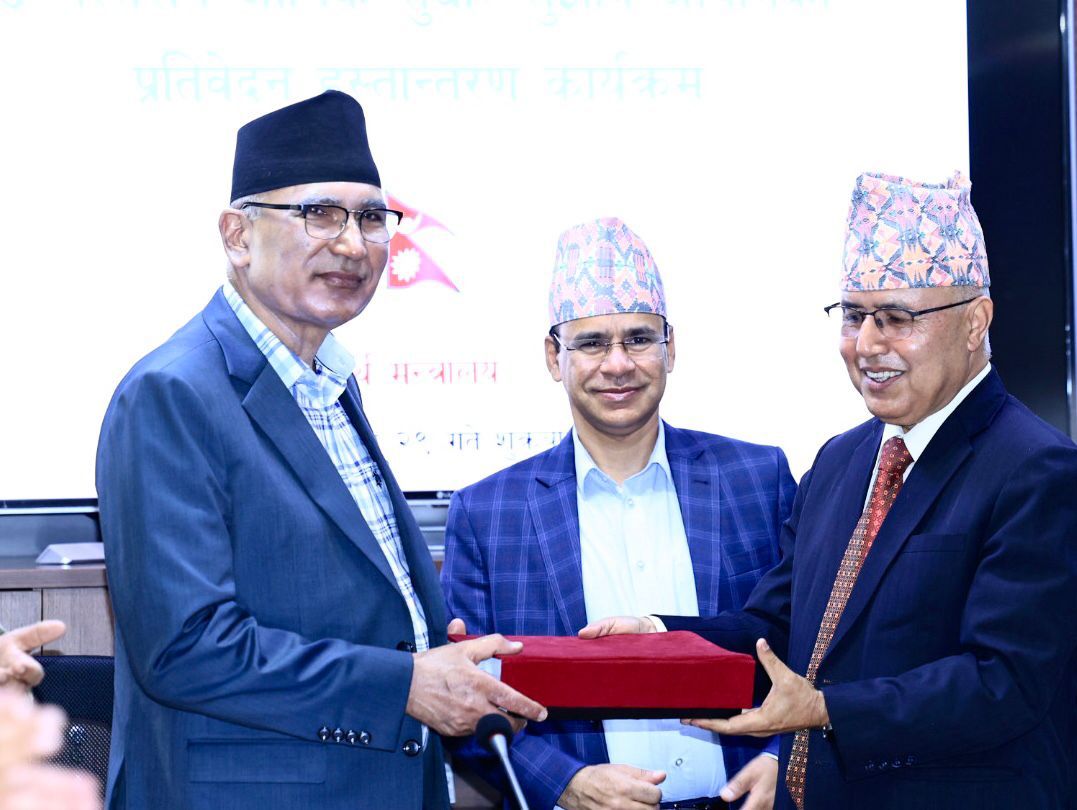
Kathmandu. The then KP Sharma Oli-led government had formed the High Level Economic Reform Suggestion Commission 2081 BS under the leadership of incumbent Finance Minister Rameshwor Khanal. The Action Plan 2082 has also been issued to implement the recommendations given by the Commission for economic reforms.
The commission had also presented an action plan on what sectors should be carried out. The responsibility of implementing the report is now on the part of Minister Khanal. Khanal, who prepared the report, is currently the Finance Minister of the government.
The report submitted by the commission led by Khanal to the government on April 29, 2081 clearly mentions the current situation of the capital market and the steps to be taken by the government.
According to the report, the capital market is a powerful means of mobilizing capital from the market as an alternative to the bank for investment.
The report has prepared the working procedure for the development of capital market by the Ministry of Finance, Nepal Rastra Bank, Securities Board of Nepal and the Office of the Prime Minister and Council of Ministers.
However, the work has not been done accordingly. Minister Khanal, who had given a dozen suggestions for market reform, has formed another task force without implementing the previous report. As per the decision of September 3, another task force has been formed. According to the decision of the Finance Minister, the taskforce has been formed to study the anomalies and problems developed in the capital market and to submit suggestions and concrete implementation action plan for systemic and procedural reforms to boost the morale of the general investors within 5 days.
It will study the anomalies and problems in the market. If the recommendations of the previous task force could have been implemented on time, there would not have been any need to form the committee again and again.
The report of the Khanal Commission states that although capital market was a means of mobilizing capital at that time, further development is yet to take place in Nepal. The report states that other productive companies of the economy have not entered the capital market, the derivative market required to manage the risk arising in the capital market has not started and the commodity exchange market has not started.
According to Khanal’s report, the process of allowing the real sector companies to enter the capital market at a premium and the process of issuing shares through book building was controversial in the beginning.
The commission headed by former finance secretary and current Finance Minister Khanal had submitted an interim report on January 10, 2081. The report presents 13 suggestions for the improvement of the capital market. It has been suggested to allow non-resident Nepalis to invest individually in the secondary market of shares. It has also suggested restructuring of Securities Board, NEPSE and CDSC.
Here are the suggestions
(1) To promote investment by mobilizing financial instruments from the capital market by creating public awareness about the capital market.
(2) To facilitate the second market trading of government bonds.
(3) The Securities Board shall be restructured and provisions shall be made for representation of the Secretary of Revenue and the Deputy Governor in the Board. Adding expert members, removing the representation of the private sector and other ministries.
(4) To make arrangements for the availability of margin credit through securities business persons for securities transactions.
(5) Hydropower companies shall be allowed to issue primary shares only after they start generation.
(6) Instead of investing loans in government institutions, the government should make arrangements to mobilize financial instruments for investment by issuing bonds.
7. To restructure the Nepal Stock Exchange for private sector participation and capital increase.
(8) CDS and Clearing Limited shall be restructured in such a way as to provide safe depository service of securities with the participation of shares of institutions other than Nepal Stock Exchange.
(9) To reduce the cost of issuing shares and bonds and simplify the process so as to facilitate private sector productive companies to mobilize capital from the capital market.
(10) A transparent method shall be adopted for the issuance of shares through the premium and book building process.
It is not a new tradition to form such task forces, study and give suggestions for capital market reform. This is a very old practice. No matter which committee recommends it, the report is prepared, but it is not implemented.
The task force formed under the coordination of Deputy Governor of Nepal Rastra Bank Shiva Raj Shrestha had given 58-point suggestions when Yubaraj Khatiwada was the Finance Minister. Neither the Securities Board nor the investors know how much of the suggestion has been implemented and how much is yet to be implemented.
Similarly, when Ramesh Hamal was the chairman of the Securities Board of Nepal (SEBON), he signed an 18-point agreement with the investors who were staging a hunger strike. No one knows whether it has been implemented or not. As soon as the market happens, some investors go to the Securities Board and NEPSE. After they are gheraoed, the government has been calling for discussions, studying and giving suggestions. However, it has not been implemented.















प्रतिक्रिया दिनुहोस्