

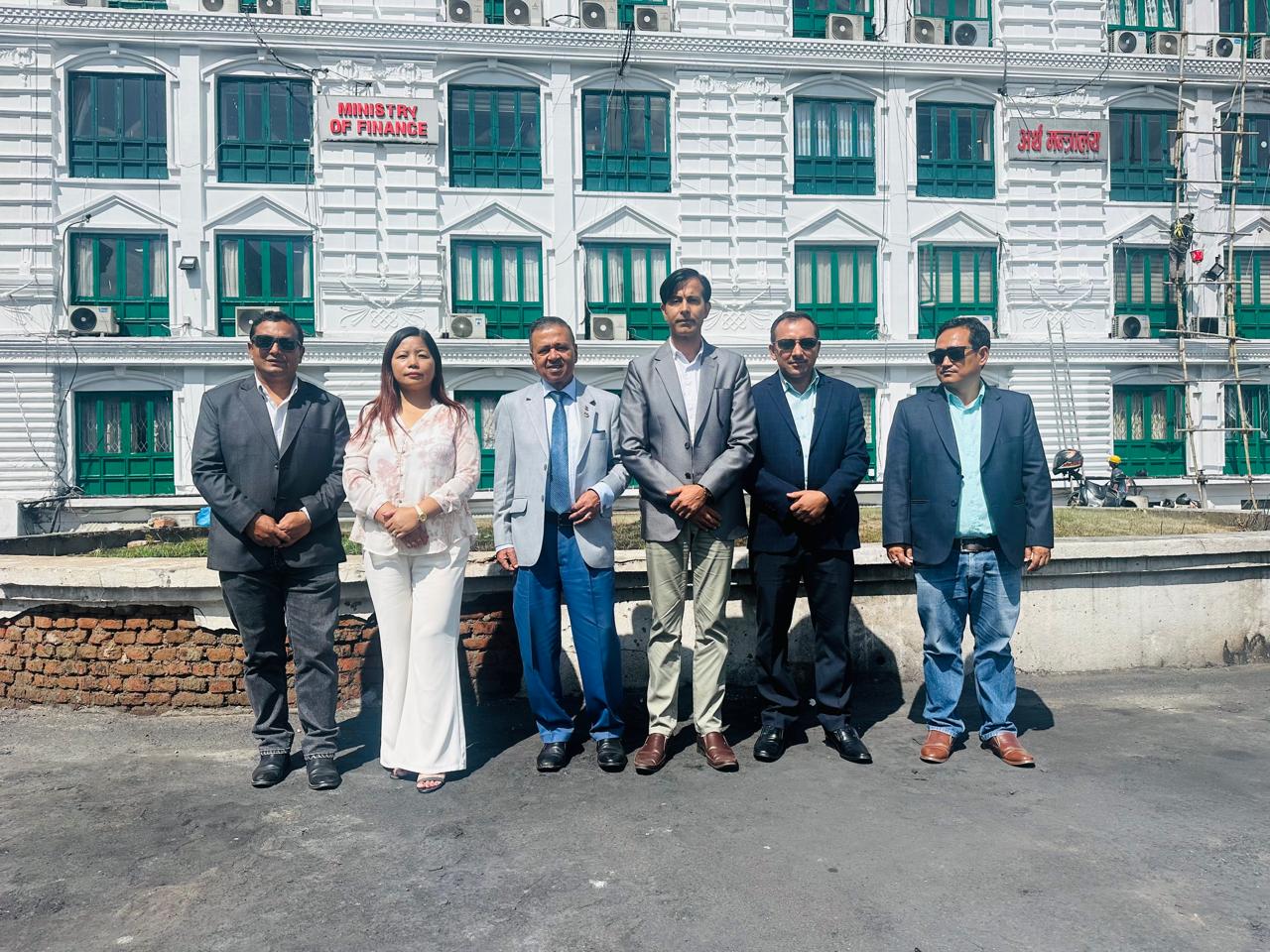
Kathmandu. Investors have given 7-point suggestions to Finance Minister Rameshwor Khanal. The investors gave this suggestion to Minister Khanal today.
Investors have been suggesting that banks and financial institutions should not be allowed to buy shares in the secondary market to curb the dividend of microfinance. Investors who reached the Ministry today have said that it is necessary to ease the necessary policy provisions for the banks and financial institutions to participate in the share market and to make the capital market more dynamic.
“Allowing banks and financial institutions to buy and sell in the secondary market without a time limit will create an environment where they can invest voluntarily and prudently, which will not only increase long÷term liquidity flow but also create a basis for stability and confidence in the entire capital market,” he said.
Similarly, 7.5 percent capital gains tax has been levied on short-term transactions and 5 percent on long-term gains. It has been requested to reduce the short-term profit to 5 percent and long-term profit to 3 percent respectively. He claimed that reducing the capital gains tax will boost the morale of investors. This will also increase liquidity and turnover in the stock market and have a positive impact on revenue.
He also suggested removing the confusion among the investors by making a clear provision through the Finance Act by considering the capital gains tax levied on short-term and long-term profit as the final tax while selling shares. Banks and financial institutions have said that there is a need to completely remove the limit of Rs 25 crore for lending to individuals to single families.
They have also argued that the current provision barring microfinance institutions from distributing more than 25 percent dividend is against the principle of open economy adopted by Nepal. They have demanded that this rule be amended to provide for the distribution of dividend on the basis of the actual profit and financial capacity of the institutions.
Likewise, NRNs have reminded that they are not able to easily repatriate the profit earned with their investment outside the country due to the current legal and procedural hurdles while investing in Nepal’s capital market. It is necessary to create easy and transparent investment environment to attract Non-Resident Nepalis by modifying this complexity. He suggested that the policy should be immediately amended to call the Non-Resident Nepalis for investment as it would have positive impact not only on capital market but also on overall economy.
He also suggested ensuring the institutional autonomy of the Securities Board of Nepal to make the capital market of Nepal sustainable and transparent. This requires giving the board independence over budgetary, administrative and policy decisions, enabling it to appoint expert staff, and providing independent oversight and enforcement powers to control market irregularities. “The board should be provided with adequate tools and authority to regulate digital financial instruments, protect investors, and promote international cooperation,” he said.

















प्रतिक्रिया दिनुहोस्