

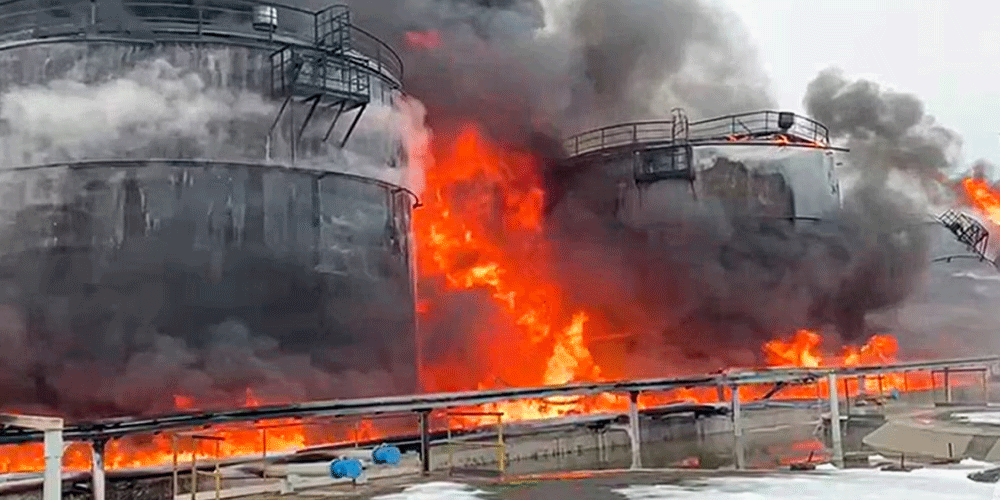
London. Ukraine has stepped up attacks on Russian refineries and oil infrastructure in recent months. More than 30 attacks since the beginning of August. The purpose of the attack is to undermine Moscow’s war financing capacity.
Russia is the world’s third-largest oil producer and second-largest exporter of crude oil. According to the Oxford Institute for Energy Studies, oil and gas revenues accounted for about 30 percent of Russia’s total budget in 2024.
Homayun Falkahi, an analyst at energy research group Klar, said the Kyiv offensive was “very effective”, reducing Russian refinery output by about 10 percent.
Fearing shortages, Moscow has banned the export of petroleum products and extended restrictions on petrol exports. Russia’s refinery production fell to 4.9 million barrels a day by mid-September. According to energy analyst Janib Shah, this is about 400,000 barrels less than in the first six months of 2025.
This has significantly widened the gap between the prices of Russian crude oil and refined products. Russian consumers are already feeling the impact of gasoline prices at the pump. As of Sept. 1, retail gasoline prices were up 6.7% from the end of 2024, according to Rosstat data. However, the price of crude oil fell during the same period.
Analyst Shah said that Russia’s situation could worsen in the long run, as it is likely to take “a long time” to restart damaged oil infrastructure.
This comes at a time when global oil prices are falling and markets expect supply to be plentiful in the coming months. “The situation is likely to get worse as Ukraine improves its ability to attack Russian refineries,” said Barney Schildrup, an analyst at SEB Bank. At the same time, he warned that the suspension of Russian oil exports and domestic rationing could be the beginning of “people being allowed to keep only a certain amount of ‘goods'”.
Ukraine’s ambassador to the United States, Keith Kellogg, has indicated that Ukraine could launch a long-range attack on Russia using American weapons. Russia is trying to reroute some oil exports, but it is facing difficult logistical problems. At the same time, the number of countries willing to buy its crude oil is shrinking.
Adi Imsirovic, director of the Surrey Clean Energy consultancy, said international sanctions on Moscow had not yet had the desired effect. “The delayed implementation of some of the sanctions gave President Vladimir Putin enough time to build a parallel trading system,” he said.
Meanwhile, Washington’s doubling of tariffs on some Indian products has not significantly reduced India’s purchases of Russian oil. On the other hand, investment in energy infrastructure in Russia has been declining since Western oil companies withdrew, which is likely to hamper production capacity in the near future.
According to Falshahi, Russia is currently producing about 9.25 million barrels of oil per day. This is less than the pre-war MBPD of about 10 million barrels per day. Currently, its maximum generation capacity is limited to 9.45 million Mbpd.


















प्रतिक्रिया दिनुहोस्