



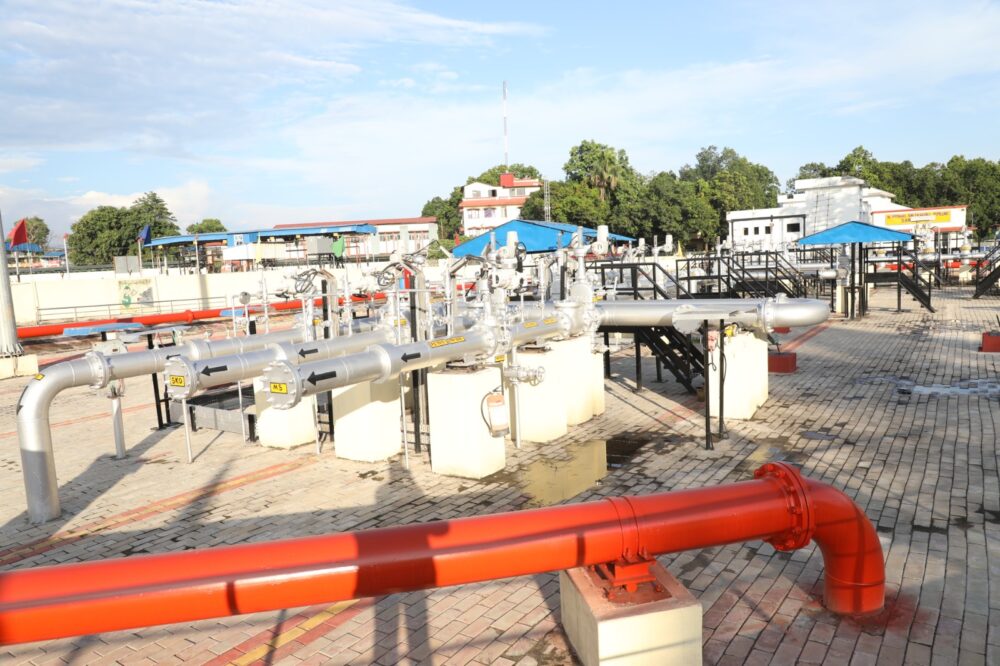
Kathmandu. It has been 6 years since the Nepal-India cross-border petroleum pipeline project came into operation. According to the Madhes Provincial Office of Nepal Oil Corporation (NOC), Amlekhgunj, 6.34 billion liters of petroleum products have been imported through the pipeline since the pipeline came into operation from Motihari of India to Amlekhgunj of Nepal.
A total of 6.14 billion litres of diesel, 201.5 million litres petrol and 4.1 million litres kerosene have been imported through the pipeline so far, said provincial chief Pralayankar Acharya. Currently, petrol, diesel and kerosene are being imported from Motihari to Amlekhgunj through pipeline. Prime Minister KP Sharma Oli and his Indian counterpart Narendra Modi had jointly inaugurated the project on September 9, 2076.
Diesel has been imported through the pipeline since the same day. Similarly, petrol has been imported through the pipeline from October 1, 2081 and kerosene from December 2, 2081. The total length of the pipeline is 69.2 kilometers. Out of this area, 33 kilometers lies in the Indian side and 36.2 kilometers in the Nepali side.
A multi-product pipeline has been constructed to allow the import of petrol, diesel and kerosene. About 70 percent of the demand of petroleum products imported through the pipeline is fulfilled. Fuel is supplied to Kathmandu, Biratnagar, Bhairahawa, Thankot, Pokhara, Birgunj and Janakpur depots from Amlekhgunj. Petroleum products are also being sold from Amlekhgunj to local level pumps.
“Around 70 percent of petroleum products consumed by Nepal are supplied from Amlekhgunj,” Acharya said. Six thousand kiloliters of petroleum products can be brought to Amlekhgunj every day through the pipeline. However, the pipeline is not in a position to operate in full capacity due to lack of demand for petroleum products. “The NOC is not in a position to import six thousand kilolitres of petroleum products daily,” Acharya said.
In the first phase of the project, pipeline was laid from Motihari of India to Amlekhgunj of Nepal. In the second phase, automation work has been completed along with the enhancement of petroleum storage capacity at Amlekhgunj. Under the second phase of the pipeline project, four new vertical tanks have been constructed for petrol, diesel and kerosene storage at the depot. Two transmix tracks and a fire control system have been installed to maintain the purity of petroleum products brought through the pipeline.
The storage capacity has been expanded to store 17,500 kilolitres petrol, 27,500 kilolitres diesel and 2,200 kilolitres kerosene. Amlegunj depot is the biggest and most modern depot in Nepal. Amlekhgunj has the capacity to store 94,000 kilolitres of petroleum products, both old and new.
Construction of Amlekhgunj depot was started in 2030 BS to ensure smooth supply and distribution of petroleum products in the country. The depot spread over an area of around 67,724 square meters was completed and came into operation on January 2033. It is the largest depot in the country.
The depot at Amlekhgunj has a storage capacity of 15,110 kilolitres petrol, 24,810 kilolitres diesel and 2,270 kilolitres kerosene. The government has put forward a plan to expand the storage capacity in all seven provinces to meet the demand for at least three months. As per the plan, the corporation has been carrying out programs to expand storage capacity in various provinces.
Import of fuel through petroleum pipeline has ended the obstruction in the roadway. “The risk of tanker accidents and problems on the road has reduced,” Acharya said, adding, “There is no question of fuel theft and adulteration.” According to him, transporting fuel through pipelines will also reduce the environmental impact.
The huge cost of transporting petroleum products has also been saved. After the import of oil through the pipeline, the transportation cost has been saved by Rs 3 billion annually. The corporation has also reduced the consumer price of fuel after saving transportation cost.
Siliguri-Charali and Amlekhgunj-Lothar Pipeline National Priority Projects
The government has forwarded the construction works of Siliguri (India)-Charlaali (Jhapa) and Amlekhgunj-Lothar petroleum pipeline and green field terminal projects by designing them as national priority projects. Work to extend the pipeline from Amlekhgunj of Bara to Lothar of Chitwan has already started. The NOC has started the work of expanding the petroleum pipeline in the second phase from August 1.
The greenfield terminal with modern facilities will be constructed in about 23 bigha and 12 kattha land located in Lothar of Rapti Municipality-1. The 10.75-inch pipeline will be laid on the 62-kilometer stretch from Amlekhgunj to Lothar.
Pradeep Yadav, chief of the project, said that the project is expected to be completed within three years. The pipeline will be constructed parallel to the East-West Highway. The 62-kilometer-long pipeline will be storing 3200 kiloliters of fuel at any given time. The pipeline will supply oil at a speed of 273 kilolitres per hour.
According to the NOC, 20 million tonnes of fuel can be transported annually through the pipeline. The pipeline station will be constructed in an area of 160 square meters in Lothar.
Three vertical tanks with a capacity of 11,000 kiloliters will be constructed at the site. Likewise, three diesel storage tanks with a capacity of 15,500 kiloliters and two kerosene storage tanks with a capacity of 800 kiloliters will be constructed.
The NOC said it will manufacture three tanks with a capacity of 3,600 kiloliters for aviation fuel. The new depot will store 91,900 kilolitres of petroleum products. In addition, two transmix tanks will be constructed. The estimated cost of the construction of the pipeline and storage house is estimated to be Rs 14.09 billion.
















प्रतिक्रिया दिनुहोस्