



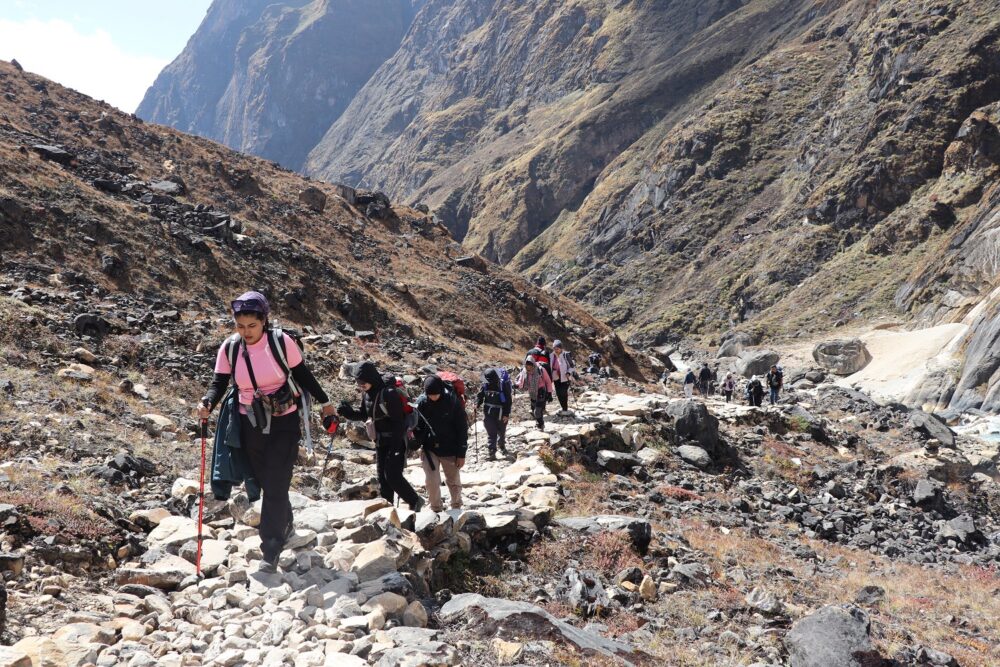
Myagdi. Diwana Sunuwar, 25, a third-year postgraduate student from Pokhara, has set out for the Dashain and Tihar holidays along with her friends to the Annapurna Base Camp and Maurice Herzog trekking route.
Anusha Lama of Banepa in Kavre also returned from Annapurna Base Camp with her college friends. Diwana of Pokhara and Anusha Lama of Banepa are the representatives of the adolescents and youths visiting the Annapurna Base Camp in Annapurna Rural Municipality-4 of Annapurna Rural Municipality.
More domestic tourists than expected have visited the Maurice Herzog trekking route and Annapurna Base Camp during the holiday season with improvement in the weather following Dashain. Narmaya Garbuja Gurung, who runs a hotel near Panchakunda lake, said that 80 percent of the domestic tourists visiting the Annapurna Base Camp on a daily basis are of the ‘Genji’ generation.
“There are many visitors who come here watching videos and photos on social media and media,” he said, adding, “We have found it difficult to manage food and stay as more tourists come than expected and exceed the capacity of our hotel.” “The number of foreign tourists is very low. Elderly and elderly trekkers are rarely found on the trekking route. Groups of young people of the age group of ten plus two and college level students are found enjoying nature by making pictures and videos. Sangita Lama, a local of Devghat in Tanahun district, said that they had come to visit the Annapurna Base Camp after being lured by the pictures and videos seen on social media and social media.
“The main feature of this place is to observe the big lakes in the mountains and foothills at the same time,” he said, “The trend of vacationing by visiting new places has increased in our generation.” Reference Acharya of Jaljala Rural Municipality-4 of Parbat said that people who are accustomed to social media and technology want to visit new places and enjoy nature.
He said that the Annapurna Base Camp and Maurice Hergos Trekking Route are the preferred destinations for the Jennies as they can reach the base camp in a short distance, and observe mountains, lakes, different geography, rivers, waterfalls, forests, wildlife and birds in one go.
A 20-km dirt road and an 18-km trekking route from Narchyang to Humkhola under the Beni-Jomsom-Korala road section of the Kaligandaki Corridor leads to Annapurna Base Camp at an altitude of 4,150 metres from the sea level.
On the trekking route along the banks of the Nilgiri River, there are beautiful waterfalls like Phutphute, Chhayali, Rato, etc. Strange and different geography can be observed, including sky caves. This trekking route is home to deer, mountain goats and other wildlife. Panchakunda Lake is located at the foothills of Annapurna Mountain. Bijay Sentang from Jhapa shared his experience that observing the blue lake and the mountains in the background would take away all the fatigue of the journey and fill his heart with joy.
It takes an hour’s trek from Panchakunda Lake at an altitude of 4,050 meters above sea level to reach Annapurna Base Camp. The base camp is located on the plains at the foothills of the Nilgiri and Annapurna mountains. The Kagbhusundi hill near Panchakunda Lake has religious significance. Kagbhusundi Rishi and Panchakunda Lake are mentioned in the Hindu scripture Pancharamanaya.
The Annapurna rural municipality in 2077 BS had announced the route ‘Maurice Herzog’ in honour of French national Maurice Herzog who scaled Mt Annapurna for the first time on June 3, 1950. On the occasion of 75 years of Annapurna Expedition, the rural municipality has set up an open museum with the statues of the members of the first expedition team and details of the climbers.
Annapurna is known as the eldest mountain as the first human step was made at an altitude of more than eight thousand meters. The Maurice Herzog trekking route was identified in 2068 BS at the initiative of Tej Gurung of Narchyang and was brought into operation since 2080 BS after the basic infrastructure was developed. For two years, tourists themselves went to the base camp with their own equipment on this trekking route. The expedition teams used to travel by helicopter.
Locals of Narchyang had built temporary structures at Humkhola, Phutphute waterfall, Sanghikharka, Gufaphant, Bhusket and Panchakunda with a capacity of 50÷50 after obtaining permission from the Annapurna Conservation Area Project and the rural municipality.
For the construction of permanent physical infrastructure in the Annapurna Conservation Area Project (ACAP), the government has to take permission after completing the process. Michael Pun, a hotel entrepreneur of Bhusket, said that tourists are accommodated in tents, tents, tents made of timber, tarpaulin. “Since ACAP does not allow the construction of concrete structures, we have to keep guests in tents and tents,” he said. ’
The locals have been employed as hotel workers and porters. Earlier, only climbers and locals used to visit the base camp in the spring season, but now tourists have started coming in other seasons as well. There is a problem of electricity and communication facilities. Hoteliers have requested to come for the visit only after booking in advance.
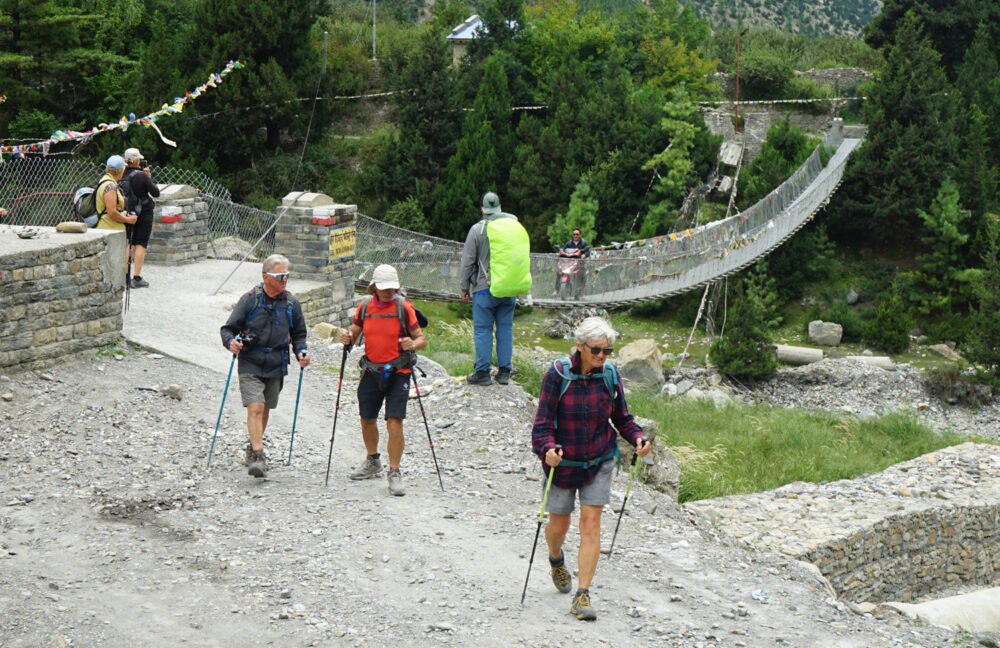
With the increasing number of guests, the challenge of garbage has increased. It has been difficult to mobilize people on temporary wooden suspension bridges and narrow footpaths in some places. Trekking route campaigner Tej Gurung said they have taken initiative with the rural municipality and ACAP to enhance the capacity of the hotel for waste management and ease of guests.
Gandaki State Assembly member Hari Bahadur Bhandari, who returned from the Annapurna Base Camp, pledged to coordinate with the rural municipality, Annapurna Conservation Area Project and the state and federal government for upgrading the road from Tatopani to Humkhola. He said, “It is necessary to pay attention to maintain sanitation and access to communication at Annapurna Base Camp and Maurice Herzog trekking route, which is a wonderful confluence of nature and culture.” I will help as much as I can for this. ’
Annapurna rural municipality chair Bharat Kumar Pun said works like celebrating a festival and climbing day for the promotion of the Maurice Herzog Trekking Route, establishing the fact that the base camp to climb Mt Annapurna lies in the geography of Myagdi and formulating an integrated master plan have been given continuity for the construction of infrastructures. The rural municipality has given continuity to the construction of trekking route, public toilets, drinking water management and shelters.












प्रतिक्रिया दिनुहोस्