

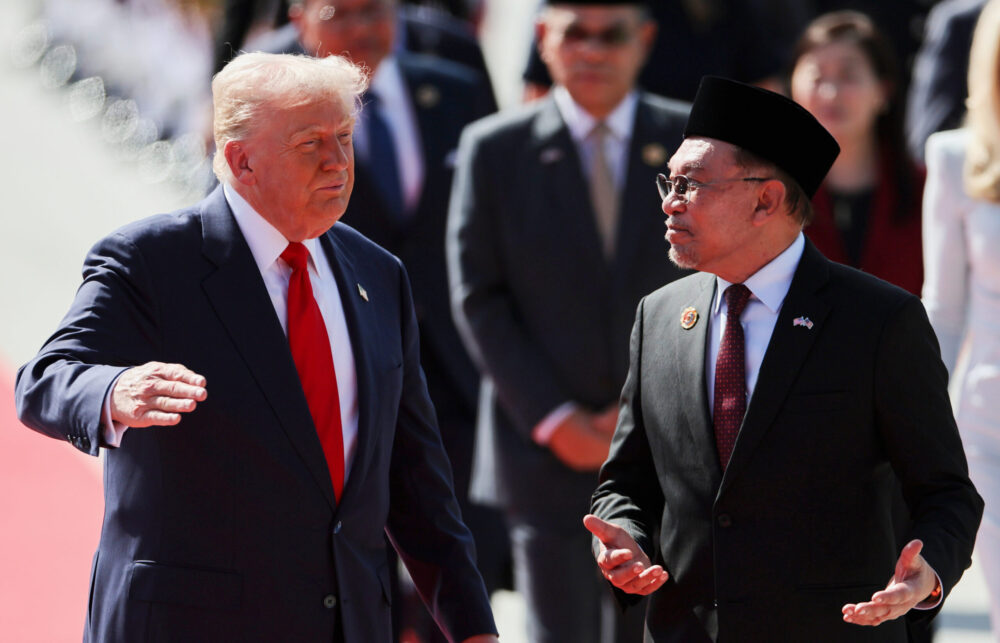
Kuala Lumpur. Thailand and Cambodia signed an expanded ceasefire agreement on Sunday in the presence of US President Donald Trump. Both countries were forced to halt border clashes earlier this year after warnings of US economic pressure.
Under the agreement, Thailand will free Cambodian prisoners, while Cambodia will begin withdrawing its heavy artillery in the first phase. Regional observers will monitor the border areas to ensure stability.
“We’ve done what a lot of people can’t do,” Trump said. Cambodian Prime Minister Hun Manet hailed the deal as a “historic day”, while Thailand’s Prime Minister Anutin Charnvirakul said it “laid the groundwork for lasting peace”.
It was Trump’s first official appearance since arriving at the annual summit of the Association of Southeast Asian Nations (ASEAN) in Kuala Lumpur.
The trips, which include trips to Japan and South Korea as well as a possible meeting with Chinese President Xi Jinping, have given Trump an opportunity to bolster his “image as an international contract-builder”.
Trump arrived in the Malaysian capital at 02:00 GMT. He danced with local artists in his famous campaign style and waved the American and Malaysian flags simultaneously. The next day, he is expected to sign agreements with Malaysia on trade and critical minerals.
The United States is currently pursuing a strategy to reduce its dependence on China, especially to diversify the supply of components needed for technology production. In this context, Trump’s visit is seen as a step to rebuild relations with the Asian market.
Trump attended the ASEAN summit only once in his first term. In this program, he has demonstrated a new role in the efforts to establish world peace.
Thailand and Cambodia have been locked in fierce fighting for five days in July, killing dozens and displacing millions. It was the biggest armed conflict in decades.
At that time, President Trump threatened to stop economic sanctions and trade deals, and the two countries were ready to sit down for talks. Since then, a temporary ceasefire has been in place, which was formalized by Sunday’s agreement.
After the agreement, President Trump also signed separate economic cooperation agreements with Cambodia and Thailand. “Trump’s tax card proved decisive. “This is probably the main reason why the two countries immediately agreed to a ceasefire,” said Ou Werak, president of the Phnom Penh-based Future Forum think tank. ’
In recent years, Trump has repeatedly claimed that he has “helped keep the peace” by mediating a series of international conflicts. Malaysian Prime Minister Anwar Ibrahim praised the Thailand-Cambodia agreement in his opening remarks at the ASEAN summit, saying the agreement reminds all of us that reconciliation is not a weakness, it is a testament to courage. ’
Thai Foreign Ministry spokesman Nikonradze Balankura described Saturday’s agreement as a “joint declaration” signaling that Thailand and Cambodia are committed to rebuilding their relationship in a new way. The work has just begun, not the end. ’
At the same time, tariffs policy and trade disputes are also at the center of Trump’s visit. While in Kuala Lumpur, he is expected to hold talks with Brazilian President Luiz Inacio Lula da Silva, but will not hold talks with Canadian Prime Minister Mark Carney.
Canada’s president has been unhappy with Canada after television commercials protested its tax tariff policy. Trump recently responded by imposing tariffs of 10 per cent on Canadian goods.
Trade relations with China are another major topic of his visit. Speaking to reporters aboard Air Force One, Trump said he hoped a possible meeting with Xi Jinping in South Korea would be “productive”. He said he would prioritize controlling fentanyl smuggling and expanding soybean sales in the best interest of American farmers.
“We have a good opportunity to make a big and inclusive deal,” he said. I want to protect the interests of American farmers, and Xi wants something for his country. However, the specific details of Trump’s economic dealings since leaving Washington have not yet been made public. This leaves open the question of whether long-term trade problems will actually be solved or limited to political demonstrations.
During the visit, he expressed hope that long-term trade agreements with Japan and South Korea would be finalized. “We have excellent agreements with many countries,” he said with a laugh.
Indian Prime Minister Narendra Modi was one of the key leaders absent from this year’s Kuala Lumpur summit. Modi, who had a close relationship with Trump during his first term, and the US leader have been at odds lately. The two leaders are said to be at odds after Trump boasted that he had resolved the current conflict between India and Pakistan and boasted about raising tariffs on India for buying Russian oil.










प्रतिक्रिया दिनुहोस्