

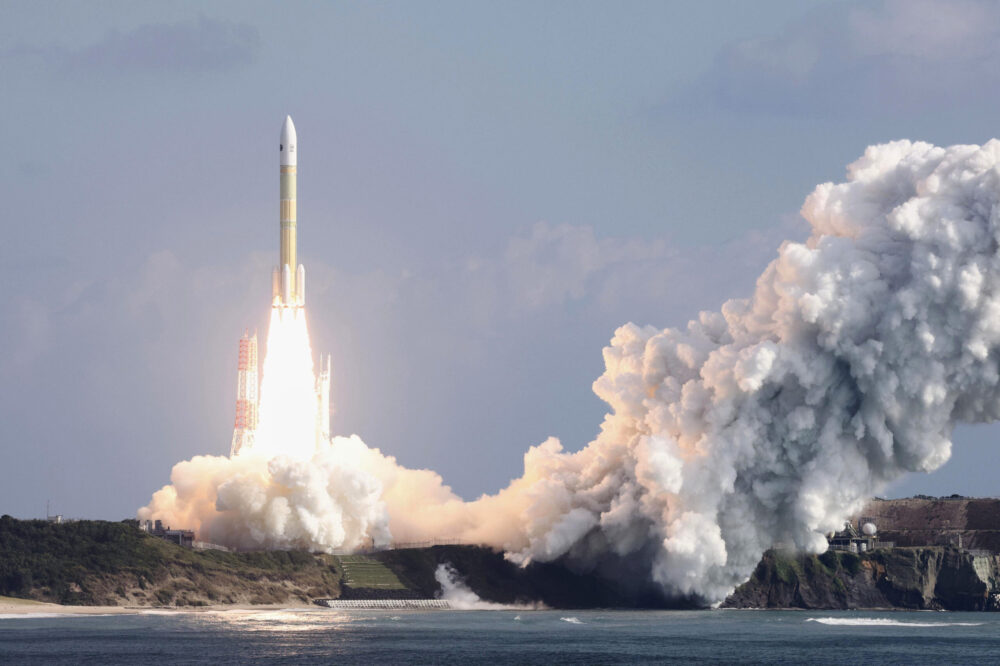
Tokyo. Japan’s space agency successfully launched its most powerful flagship H-3 rocket on Sunday. It carries the latest unmanned cargo spacecraft HTV-X1 for the first mission to deliver supplies to the International Space Station (ISS).
The Japan Aerospace Exploration Agency (JAXA) confirmed that the HTV-X1 had successfully lifted off and entered the intended orbit about 14 minutes after liftoff from the Tanegashima Space Center in southern Japan. The spacecraft is planned to be separated and stationary in the designated orbit and if all goes according to plan, it is expected to reach the ISS within a few days.
Japanese astronaut Kimiya Yui, currently working on the ISS, is preparing to catch it with a robotic arm on Thursday morning. The HTV-X is the successor to JAXA’s predecessor, the Unmanned H-2 Transfer Vehicle (Conotori or ‘Stork’).
It completed nine successful missions to the ISS from 2009 to 2020. The new cargo vehicle is capable of carrying a larger payload than the previous one and can safely ship laboratory samples that need storage at lower temperatures.
The spacecraft is designed to stay connected to the ISS for up to six months and bring back debris from the station after delivering needed supplies. After the completion of the mission, it will remain in orbit flight for about three months to conduct technical research.
Sunday’s successful launch also marked the debut of the most powerful version of the H-3 rocket, which uses four boosters and a large fairing (payload compartment). JAXA President Hiroshi Yamakawa described the launch as a “symbolic great achievement of Japan’s independent capabilities in space supply” and a “solid foundation for autonomous space activity”.
Ibao Igarashi, head of the space business division of Mitsubishi Heavy Industries, which is responsible for developing and operating the H-3 rocket, said Japan has proven its reliability in delivering payloads on time to meet customer needs. According to him, the company plans to expand its launch facility in the coming years.
The H-3 replaces Japan’s previous main H-2A rocket, which recently completed its last flight. The new flagship model is designed to become more cost-competitive in the global space market. After the failure of the first attempt in 2023, the H-3 has completed six consecutive successful flights.
Japan’s space program is a key pillar of national security, and the development of a stable and commercially competitive space transportation capability is a long-term priority.


















प्रतिक्रिया दिनुहोस्