



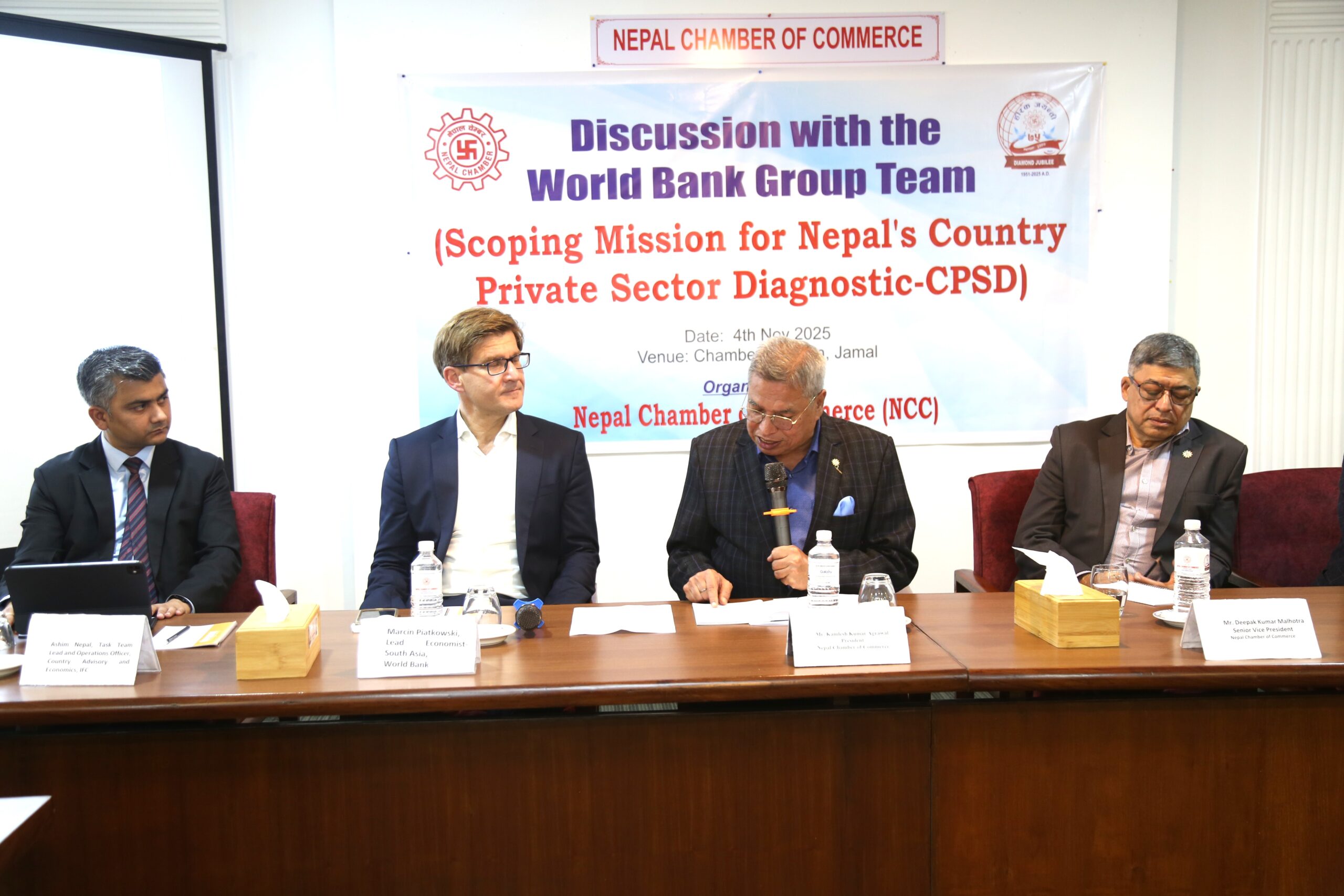
Kathmandu. KATHMANDU: Nepal Chamber of Commerce (NCC) and World Bank Group held high-level discussions on the situation of Nepal’s private sector, investment opportunities and current challenges.
The program was attended by chamber president Kamlesh Kumar Agrawal, office-bearers, presidents of various committees, industrialists and businessmen, and Merchin Piatkowski, South Asia Lead Economist of the World Bank Group.
During the discussion, President Agrawal shared his views on the current economic situation of the country, economic impact after the ‘Genji Movement’, investment climate, necessary aspects of policy and legal reforms and the possibility of sustainable economic development. Agrawal said that Nepal is the best in South Asia in terms of natural resources.
“The basis for long-term economic prosperity could be determined through the exploration and effective utilization of country’s abundant natural resources. “We are aiming to establish Nepal as the country with the highest per capita income not only as a LDC country but also as the country with the highest per capita income in South Asia,” he said.
Agrawal said that 57 percent youth population in Nepal, low cost of production, favorable weather conditions and guaranteed return on investment have made Nepal an attractive destination for foreign investment. “There is huge potential for investment in physical infrastructure, agriculture, hydropower, tourism, mines, medicinal herbs and other sectors,” he said.
Agrawal said that despite the impact on the economy after the agitation, the morale of the private sector is high. Stating that the World Bank’s projection of 2.1 percent economic growth after the Genji movement was not realistic, Agrawal urged the government to review the project. On the occasion, chairpersons of various committees of NCC and industrialists and entrepreneurs presented problems related to agriculture, information technology, land and housing, energy, tourism and service sectors and suggestions for improvement.
World Bank Group representative Marchin Piatkowski underscored the need for institutional reforms, investment promotion, policy harmonization and innovation to strengthen the private sector of Nepal. On behalf of the World Bank, a working paper was presented on ‘Investment Opportunities in Nepal, Policy Stability and Strengthening Implementation Capacity’.
From the World Bank, Asim Nepal Task Team Leader and Operation Officer, Country Advisory and Economics IFC, Faria Tassin, Senior Operations Officer IFC, and Kamalika Das, Economist South Asia Country Advisory and Economics IFC participated in the meeting.











प्रतिक्रिया दिनुहोस्