

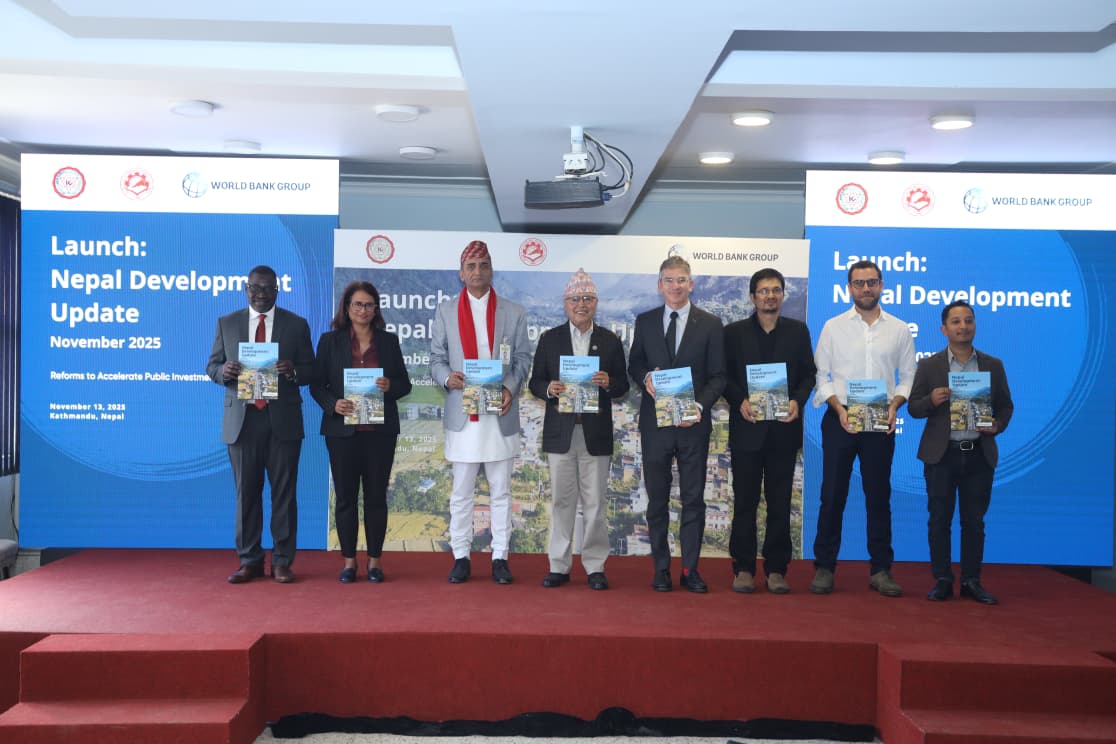
Kathmandu. The World Bank has projected that Nepal’s economic growth will slow down due to the Genji movement on September 23 and 24. Nepal’s economic growth is projected to slow from 4.6 percent in 2025 to 2.1 percent in 2026, reflecting the impact of political instability caused by the Genji movement. The World Bank has projected the economic growth rate to reach 4.7 percent in fiscal year 2027 on the basis of progress in reconstruction efforts.
According to the Nepal Development Update Report released by the World Bank on Thursday, the service sector will be the most affected. However, this projection is still uncertain. The success of the political transition and the guarantee of sustainable, sound economic management can accelerate an investor-stimulating economic recovery. On the downside, the continued uncertainty is expected to discourage investors.
“The Government of Nepal has launched the Integrated Business Revival Plan to restore business confidence and accelerate the recovery. Under this, facilities such as grants, tax exemptions and operational support have been arranged,” said Finance Minister Rameshwor Prasad Khanal. A fund has also been set up for the reconstruction of damaged public and private properties. These steps aim to reinvigorate private sector activity while laying the foundation for a strong economy. ’
In addition to the immediate actions needed for recovery, the report stresses the need to strengthen public investment management for sustainable economic growth. In fiscal year 2024, the capital expenditure of the federal, provincial and local governments was 7.9 percent of the GDP. This is far less than the investment required to meet Nepal’s infrastructure needs. To meet Nepal’s infrastructure needs, it will require investment of 10 to 15 percent of GDP.
“Scaling up public investment is critical to improving Nepal’s economic growth, job creation and prosperity for all Nepalis,” said David Sislen, World Bank Division Director for the Maldives, Nepal and Sri Lanka. Strengthening project construction and budgeting, land acquisition and tree acquisition, streamlining the tree process, making fund management more effective, amending the Public Procurement Act and Regulations should be given priority. This will help in speeding up the projects. The Nepal Development Update is released twice a year. This report has been providing in-depth study and analysis of economic development for a long time.














प्रतिक्रिया दिनुहोस्