

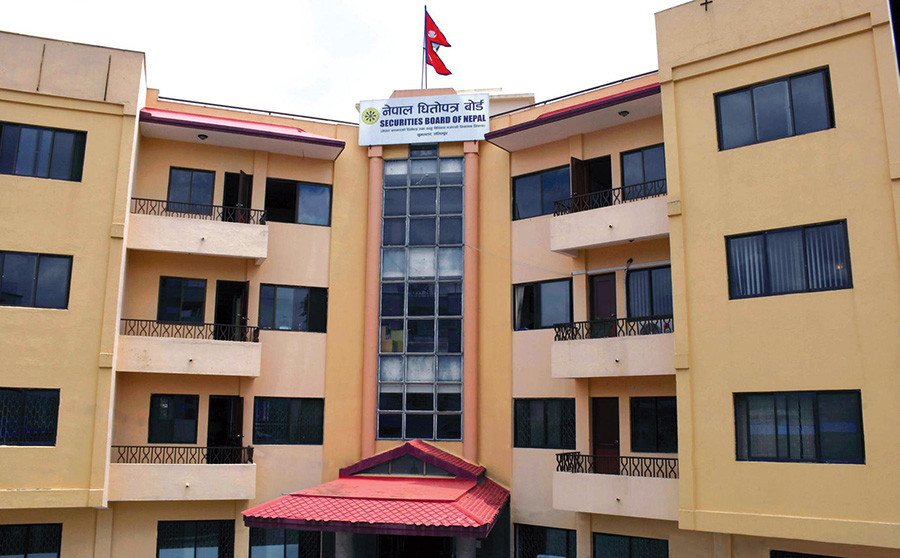
Kathmandu. At present, the Securities Board of India (SEBON) is the body responsible for regulating, supervising more than 500 companies and corporations. Numerically speaking, there is no shortage of people who consider SEBON as a major regulatory body that regulates many companies.
From the outside, how eager are the employees to work in such a large organization? It’s also a longing cry for many. But in recent years, Sebon has seen more distraction than employee attraction. From the outside, there is not much enthusiasm at the level of the staff when it comes to being a numerically large regulatory body.
Even the most skilled employees at various levels of Sebon have started leaving the service. It’s not hard to say if this is also reducing the attractiveness of Sebon’s job. Executive Director Krishna Raj Pokharel resigned from the post in the second week of January 2081. He was promoted to the post of executive director on October 1, 2022 without conducting an ONM survey in Sebon. He left without completing his term.
Now other employees are also going to other agencies instead of living in Sebon. Board employees say this is more of a distraction than an attraction for employees to work at Sebon. Last week, second-class officer Rishiram Pandit left Sebon.
He was appointed as the Deputy Chief Executive Officer (Finance) of Hydroelectricity Investment and Development Company. He has been appointed to the company’s 11th level.
Pandit was considered to be a very capable employee in the board. He worked briefly at Sebon. Not only Pandits, skilled employees have also left their jobs from SEBON and have been reduced to the same position or positions in private and other institutions and regulatory bodies. Two Chartered Accountants (CAs) of Sebon have already resigned before the completion of their service period.
Earlier, CAs Namuna Joshi and Aarati Koirala had resigned from their posts. Joshi has gone to work in a private insurance company while Koirala has been appointed in the Social Security Fund.
Similarly, another officer of the board, Roshan Rai, has left Sebon and joined Nepal Rastra Bank. According to an employee of the board, some skilled employees are still preparing to leave the job. He said that employees in various branches of Sebon are now looking for alternatives to other companies and corporations.
“The Securities Board of Nepal (SEBON) is not a bad place for employees, it is a regulatory body that regulates more than 500 companies,” said the staffer. This has also weakened the morale of the employees who want to work honestly.
According to the staffers, the letter sent by the Commission for the Investigation of Abuse of Authority (CIAA) and the letter sent by the Revenue Secretary of the Ministry of Finance to the Board on September 2 have also weakened the morale of the employees to work.
The letter reads, “Clause 22 of the Securities Act, 2063, Section 116 of the Securities Act, 2063, Section 15 of the Legislation Act, 2081, Rule 16 of the Government of Nepal (Division of Work) Regulations, 2074 and Rule 167 of the Securities Board Employees Service and Conditions Regulations, 2068. 2075 will be revoked immediately.”
Employees of Sebon have been on strike for the past 2 months after the ministry said it would scrap the procedure. The ministry has assured to review the letter. If the review is not done, the day may come when there will be a shortage of staff at Sebon.
Lately, the CIAA has come under the scanner of the CIAA.
Complaints have been filed against the former chairman of Sebon, some executive directors and other employees. It has not been settled. Since then, the Commission has been keeping a close eye on Sebon. “If a file is forwarded honestly, the CIAA is worried about when it will issue the letter,” said another staffer of the board. You can’t work in Sebon anymore by putting your career at stake. ’
About half a dozen employees on the board are currently looking for an alternative to Sebon. It is said that some employees have to look for alternatives because they are not able to trade shares in Sebon.
Similarly, the government has not yet made the Securities Board of Nepal an autonomous body. The board’s employees say that Sebon is like a division of the ministry. Sebon is not autonomous, and the number of people looking for alternatives is increasing as board employees are not able to work autonomously.
It is said that the financial and employment security of the employees living in Sebon is now a major concern.


















प्रतिक्रिया दिनुहोस्