


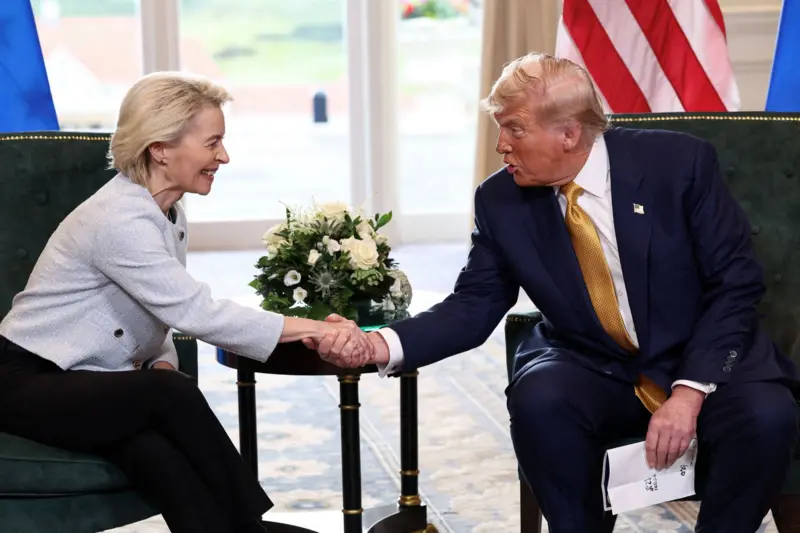
Turnberry. The United States and the European Union (EU) signed a trade deal on Sunday. Under the agreement, eu exports will be taxed at 15 percent. The deal was signed to resolve the transatlantic customs duty dispute that threatened to escalate into a full-fledged trade war.
Us President Donald Trump walked out of a high-level meeting with European Commission President Ursula von der Leyen at his Golf Resort in Scotland, calling the deal “the biggest”.
The leaders reached the deal in about an hour after the August 1 deadline expired to avoid a 30 percent U.S. tax on European goods.
“We have made an agreement. It’s a good deal for everyone. This is probably the biggest deal ever negotiated in any field,” Trump said.
According to Trump, the basic tax of 15 percent will apply to europe’s important automobile sector, including pharmaceuticals and semiconductors.
Trump said the 27-nation EU bloc had agreed to buy “$750 billion worth of energy” from the United States and invest $600 billion more as part of the deal.
Von der Leyen said “significant” purchases of U.S. liquefied natural gas, oil and nuclear fuel would take place in three years as part of the bloc’s efforts to diversify away from Russian sources.
Negotiating on behalf of 27 EU countries, von der Leyen has been working hard to save $1.9 trillion a year in trade relations in goods and services.
“This is a good deal,” the EU chief told reporters. It will bring predictive power. This is very important for our businesses on both sides of the Atlantic. ’
He said that bilateral customs duty exemption has been agreed on many ‘strategic products’, especially aircraft, some chemicals, some agricultural products and important raw materials.
He said the EU still hopes to secure so-called “zero for zero” agreements, especially for alcohol. He hoped it would be a “solution” in the coming days.
Trump also said eu members, who have recently pledged to increase their defense spending within NATO, will buy “hundreds of billions of dollars worth of military equipment.”
Best we can find
The EU has faced several waves of customs duties since Trump reinstated himself in the White House. It is currently subject to 25 per cent customs duty on cars, 50 per cent on steel and aluminum and 10 per cent on all goods. Washington had threatened to increase it to 30 percent if there was no agreement.
The group has been strongly demanding customs duty exemptions for key industries ranging from aircraft to alcohol, and its automotive industry, important for France and Germany, has already suffered from customs duties imposed.
“It doesn’t underestimate 15 percent, but it’s the best we can achieve,” admitted von der Leyen.
Any agreement needs to be ratified by EU member states. The commission updated on Sunday morning as eu ambassadors are on a visit to Greenland. After the agreement in Scotland, they were preparing to meet again.
German Chancellor Frederic Merz quickly praised the deal, saying it prevented “unnecessary growth in transatlantic trade relations”.
But German exporters were less enthusiastic. The powerful BDI Federation of Industrial Groups said the deal would have “substantial negative consequences”, while the country’s VCI Chemical Trade Association said the deal left rates “too high”.
Ireland, one of the EU’s top exporters to the United States, welcomed the deal on Sunday, saying it would bring “much-needed certainty measures” but said in a statement from its Department of Foreign Affairs and Trade it “regretted” basic taxes.
The EU has pushed for a deal on steel that could allow certain quotas to enter the United States before customs duties come into effect. Trump appears to have rejected it, saying steel “will remain as it is”, but the EU chief later insisted that “customs duties will be cut and quota systems will be installed” for steel.
large one
Fifteen percent of European goods are much higher than previous U.S. customs duties, an average of around 4.8 percent. This reflects the current situation. Companies are currently facing an additional uniform rate of 10 per cent.
If the talks failed, EU countries would have allowed per-duty tariffs on $109 billion (93 billion euros) of U.S. goods, including planes and cars, to be implemented in a phased manner from August 7.
Trump has launched a campaign to reshape U.S. trade with the world and promised to impose punitive tariffs on dozens of countries if they don’t make a deal with Washington by August 1.
Asked what the next deal would be, Trump replied: “It was a big deal. This is the biggest of them all. ’
















प्रतिक्रिया दिनुहोस्