


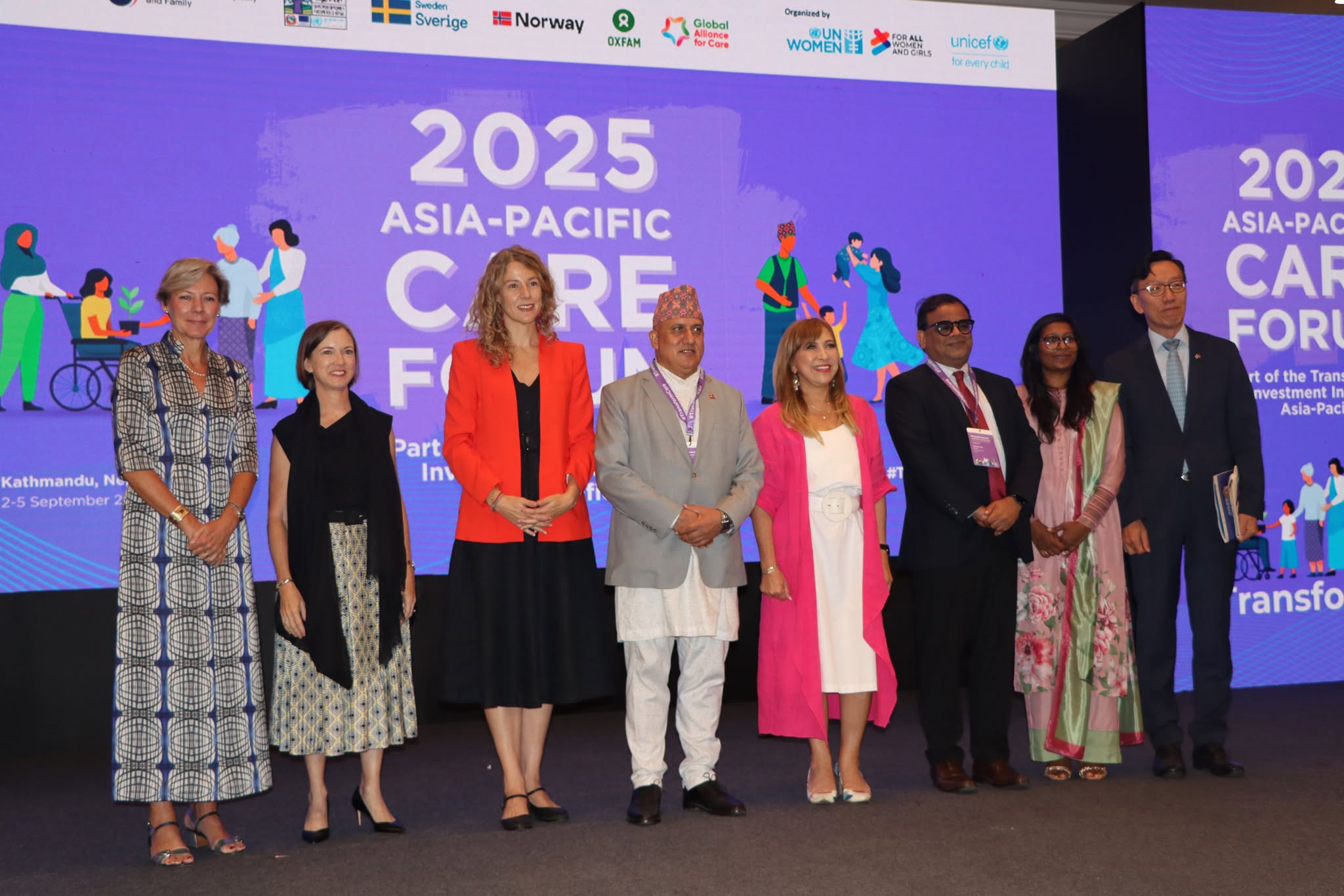
Kathmandu. National Planning Commission Vice-Chairman Prof Dr Shivaraj Adhikari stressed the need to bring care economy into the mainstream.
Addressing the Asia-Pacific Care Learning Week 2025 as the chief guest at the Asia-Pacific Care Learning Week 2025 in Kathmandu today, Vice President Adhikari said that unpaid care work and undervalued care jobs are the invisible basis of the society.
He also said that mainstream economic measurements have failed to accommodate this and ignoring CARE will reduce its cost inequality, fragility, productivity and loss of development opportunities. Vice-Chair Adhikari said that the 16th Plan of Nepal aims to formalize care work, create employment and emphasize on economic empowerment of women and transform care work into decent employment through a glorious labor promotion program.
He said that women are bearing the greatest burden of caring for children, the elderly and people with disabilities, which has limited their participation in education and employment. At the same time, he said that preparations are being made to bring a national care policy soon, which will include CARE in the larger economy.
Stating that Nepal has been practicing gender responsive budgeting since 2007 BS, he pointed out that financial management and resource allocation with gender perspective was inevitable at the local level. He said investing in care is not only social or ethical, it is a smart economy, which will increase employment and productivity, and this will enable inclusive economic growth.
Calling upon the private sector, civil society and development partners to invest in care infrastructure and labour force development, Adhikari said regional cooperation was also necessary for this purpose. Stating that it was important to organize the programme on the eve of Nepal’s transformation as a developing nation, he said nepal’s transformation was not limited to income and growth but the basis of tolerance, inclusion and shared prosperity.
Stating that although half of our population is women, structural barriers still hinder their full participation in the formal economy, Vice President Adhikari stressed that economic empowerment of women is essential for sustainable and irrevocable LDC graduates and for this, unpaid care work must be evaluated and recognized.
Vice President Adhikari said that Nepal is moving ahead with the National CARE Policy, which will include CARE in the comprehensive macro-economic plan. He also stressed the need for investment in care infrastructure, expansion of public services, and encouraging the private sector to become care providers.
“These measures are not only socially progressive but also economically sound, impacting women’s employment, labour market participation, productivity and inclusive growth,” he said. He stressed the need for incorporating gender perspectives in public finance management for sustainable financial assurance and stressed that local governments should have the necessary capacity to set priorities and allocate resources for care services.
He said that investment in local-level care should not be seen as welfare expenditure but as a strategic economic investment and this requires close coordination with development partners. Vice-Chairman Adhikari said that only governments cannot build a care economy, adding that multilateral involvement is also necessary for this.
He also called on the private sector, civil society, and development partners to invest in care infrastructure, innovation, and labor force development. He also said that new models of inclusive and financially sustainable care delivery can be developed through public-private partnerships.
As the CARE economy is a common challenge and opportunity in the Asia-Pacific, he expressed the belief that such forums would promote South-Cooperation and regional solidarity would be important for this, which would help build an economically sustainable and socially just care system.
He also called for a commitment to use such forums to transform the care system into an engine of gender equality, inclusive economic growth, and social justice. Care can be used for the benefit of all by identifying, evaluating, and financially supporting it, he added.















प्रतिक्रिया दिनुहोस्