



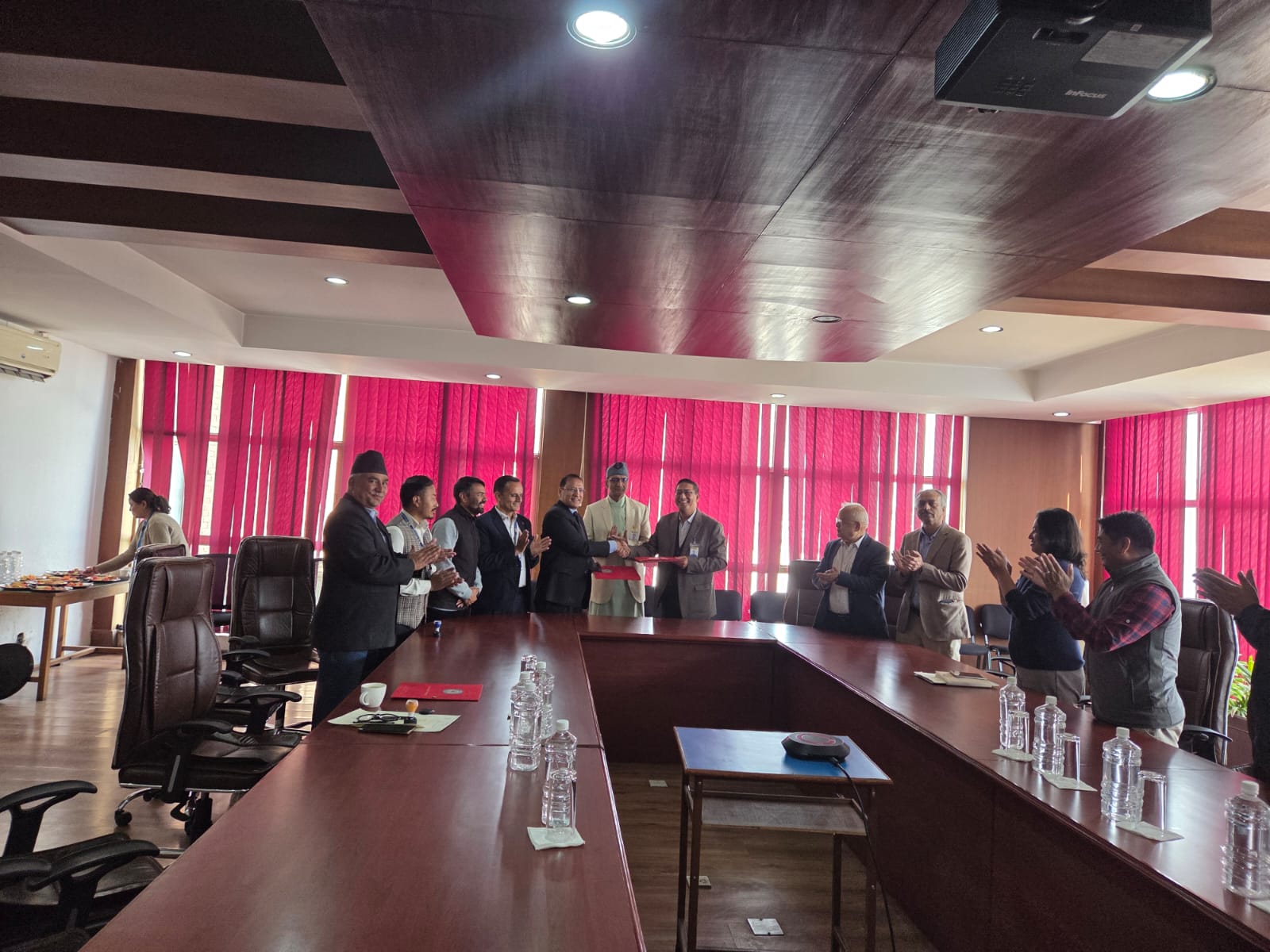
Kathmandu. Some investors have met Nepal Rastra Bank (NRB) Governor Bishwanath Poudel to discuss the fall in the stock market. The investors met Poudel today.
The investors have also submitted a 6-point memorandum to Governor Prof Dr Poudel to draw his attention towards the unusual fall in the share market.
During the Genji movement, it was closed for about a week due to protests by investors’ associations. The market was in the negative circuit of 6 percent on the first trading day. Investors then met with the governor today.
In Thursday’s trading, the market was trading in the negative circuit of 6 percent, with only 720 million turnovers. Investors claim that the index has declined by more than 160 points and about Rs 300 billion has been depreciated. The investors have submitted a 6-point memorandum in the meeting with the governor. They have demanded that the banks and financial institutions should be allowed to carry out easy transactions in the secondary market.
He said that there is a need to ease the policy provisions for the banks and financial institutions to participate in the share market and to make the capital market more dynamic.
For this, the demand is to amend the existing policy restrictions to allow banks and financial institutions to buy ÷ sell in the secondary market easily and to create an environment where they can invest voluntarily and judiciously. This will not only increase the long-term liquidity flow to the market but also lay the foundation for stability and confidence in the entire capital market.
They have also demanded the scrapping of the limit on personal share mortgage loans. Banks and financial institutions need to completely abolish the limit of Rs 25 crore for individual single-family loans. This will not only ease access to investors but also contribute to building a trustworthy and investor-friendly environment.
He also said that the current provision barring microfinance institutions from distributing more than 25 percent dividend is against the principle of open economy adopted by Nepal. They have demanded that this rule be amended to provide for the distribution of dividends on the basis of the actual profit and financial capacity of the institutions.
As per the current provision, the banks and financial institutions (BFIs) are required to revise the ceiling of their primary capital fund to invest in the capital market and maintain the ceiling as per the Bank and Financial Institutions Act-2073 BS.
Similarly, the limit of share loans issued by banks and financial institutions has become very old compared to the current economic situation and the expansion of the capital market. It needs to be increased over time, which will ease liquidity in the market, increase access to investors, and help stimulate the overall economy
.
Investors have said that due to the current legal and procedural hurdles while investing in the capital market of Nepal, the Non-Resident Nepalese (NRNs) are not able to easily take the profit earned from their investment abroad. It is necessary to create an easy and transparent investment environment that attracts Non-Resident Nepalis by modifying such complexities.
Since this will have a positive impact not only on Nepal’s capital market but also on the overall economy, it is necessary to immediately amend the policy and call the Non-Resident Nepalis for investment. The above suggestions will be addressed as far as possible to help the capital market towards stability and sustainable development.













प्रतिक्रिया दिनुहोस्