


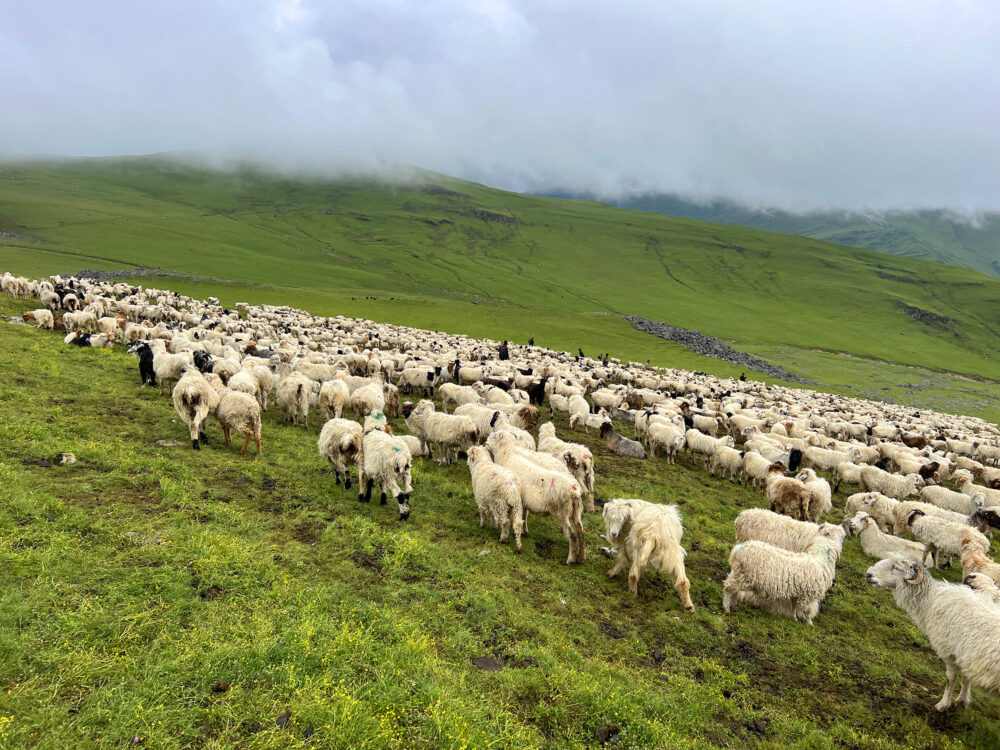
Baglung. As Dashain approaches, more sheep sheds have started coming from the lake. During the rainy season, the herdsmen who stay in the lake for about four months have started coming down with their livestock.
The shepherds who have been climbing the lake since the second week of May have started descending to Basi with the beginning of the Dashain festival. The shepherds, who have been living in the lake for months, are desperate to be reunited with their families. During the rainy season, locals from Nisikhola, Dhorpatan, Tamankhola and other areas of Baglung climb the mountain with cattle.
The herders visit Tikdhara, Fagune, Garpachheda, Syachung, Rig, Khola Khani, Tilachan and Soledanda of Tamankhola which fall in the Dhorpatan Hunting Reserve area. These areas range from three thousand to four thousand five hundred meters above sea level.
The movement of shepherds has increased in the Besi area after the sheep herd started coming down from the lake. Most of the farmers in West Baglung are involved in animal husbandry. After four months, it is a big festival for the shepherds.
After being separated from their families for months, they will now be together until June. A single family has been rearing more than two hundred to one thousand sheep. The shepherds travel for weeks to board the bookies and drop the bass. As there is enough grazing area and nutritious grass for the sheep and goats in the Buki area, they start climbing the mountain from June.
At this time, large herds of sheep are found in Dhorpatan valley, Patihalne, Soledanda, Varkobang and other areas. Since this is the season for selling sheep and goats, the shepherds go to the market in the valley. Shepherds who have fallen to Bessi now walk for weeks to the main cities to sell sheep and goats. They sell sheep and goats for the Dashain festival.
Kuman Singh Bishwakarma of Nisikhola Rural Municipality-6 said that he returned home from the highland in three months and 23 days. He said that he has more than two hundred sheep and it is difficult to get grass due to early fall. Bishwakarma said that he has already taken the expenses for four months.
He said, “Our forefathers used to do business here, we have been continuing it, but our sons and grandsons did not want to become sheep herders, if they study and write, they go abroad, climbing the mountain in June and descending the peak in September has become a culture for us. I don’t want to be away from my family for months, but that’s what the shepherd is compelled to do. ’
A single sheep farmer earns millions of rupees annually as the price of goats, goats and sheep fed by eating nutritious grass during the rainy season is good. The shepherds who have fallen in the market have started choosing which goats, goats and sheep to take to the market. Some of the shepherds go to Butwal via Burtibang, Kharbang, Ridi of Gulmi, Palpa while some are preparing to reach Pokhara via Galkot, Baglung and Parbat. Tul Bahadur Pun of Dhorpatan municipality-9 said that the cold in the mountain valley has gradually decreased.
According to him, he had climbed Bukipatan on June 17 and that he used to come down on the day of Ghatasthapana every year to celebrate the festival. “It has been 40÷42 years since I started rearing livestock in Lekbesi, I have not stayed in the lake till October during this period, it is very difficult to stay in the lake, now the cold has started increasing, the sheep and goats are ÷dying. There is no lake nearby, so we take the expense slip at once and come to celebrate Dashain. ’
Activity has increased in the lower areas after the price of cattle fell from the lake. Which has increased the atmosphere of Dashain. According to Kul Bahadur Gharti of Nisikhola-6, 55 cows are still in the lake. According to him, a relative was sent to the lake to collect the cows. Gharti said the cow could be weighed by May 13.

















प्रतिक्रिया दिनुहोस्