


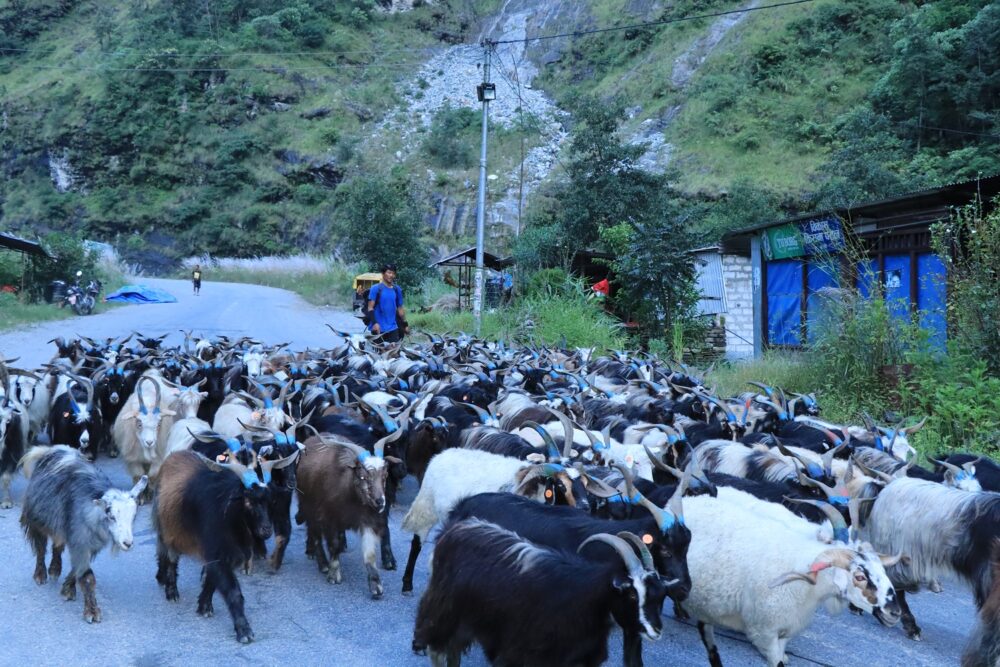
Myagdi. The price of sheep and mountain goats brought to the market from Mustang for the Dashain festival has been reduced this year.
According to traders and consumers, the price of live sheep and mountain goats has fallen by Rs 5,000 to Rs 100 per kg compared to last year. Bharat Rakal, a local of Beni, said he had bought sheep and mountain goats for Rs 40,000 last year, but this time he got Rs 35,000.
“Three years ago, the price of mountain goats was Rs 52,000 per piece and the price of chylu (mountain sheep) was Rs 40,000 each,” he said, adding, “With the reduction in price, it has become easier to fulfill the desire of middle-class consumers who celebrate Dashain by eating the meat of mountain goats.” ”
Gyan Kumar Shrestha, founding president of Nepal Cattle Purchase and Sale Association, said that the price of mountain goats has been slashed due to the arrival of mountain goats from Dolpa, Mugu, Jumla and Tibet, increase in mountain goat farming in Mustang and fear of a decline in consumption due to uneasy situation in the country following the movement of the ‘Genji generation’.
Shrestha’s team has transported 2,500 mountain goats from Mustang to Kathmandu in the last 10 days. According to Shrestha, live mountain goats were sold at Rs 1,300 per kg in Kathmandu last year but this time it has been sold at Rs 1,250.
Mustang, Jumla, Mugu and Dolpa are the major source of sheep and mountain goats brought to the markets of Myagdi, Baglung, Parbat, Pokhara, Kathmandu, Chitwan and Butwal for the Dashain festival. Only sheep and mountain goats have landed in big cities this year due to the closure of Tatopani and Rasuwa border points.
Netra Raj Subedi, a local of Beni, said that the meat of mountain goats grazed on herbs is popular during the festival as it is nutritious, health producing, energy booster and tasty.
According to the Veterinary Hospital and Livestock Service Expert Centre, Mustang, 14,668 sheep and mountain goats worth more than Rs 350 million were sold this year. A total of 7,668 farmers of Mustang and 6,868 sheep and mountain goats from Dolpa, Mugu and Jumla were allowed to be sent to the market after health check-up, said Lalmani Aryal, chief of the centre.
The farmers will get a maximum of Rs. They sold sheep and mushrooms for Rs 35,000 and lamb for Rs 28,000. Mountain goats that are five years old are considered to be consumers for meat. The long-haired mountain goats are native. The body of the mountain goat brought from Tibet is short.
Tenzing Gurung, a farmer of Namgyal in Lomanthang Rural Municipality-3, said that he has been making a living from mountain goat farming. He said he sold 50 mountain goats this year. Pokhara is a big market for sheep and mountain goats.
Sheep and mountain goats are also consumed in markets of Myagdi, Baglung, Parbat, Syangja, Tanahun and Lamjung. As many as 50,000 mountain goats have been reared at Waragung Mukti Chhetra, Gharpajhong, Loghekar Damodar Kund and Lomanthang rural municipalities in Mustang district. Mountain goat farming is the main source of income for the farmers of Upper Mustang.
The main challenge for mountain goat farmers is to protect them from the attacks of snow leopards and buffaloes. Similarly, there is a shortage of food for sheep and mountain goats as grass has grown less in the mountainous region due to lack of snowfall. There is also the problem of sheep and goats dying due to lack of food due to excessive snowfall in winter.














प्रतिक्रिया दिनुहोस्