


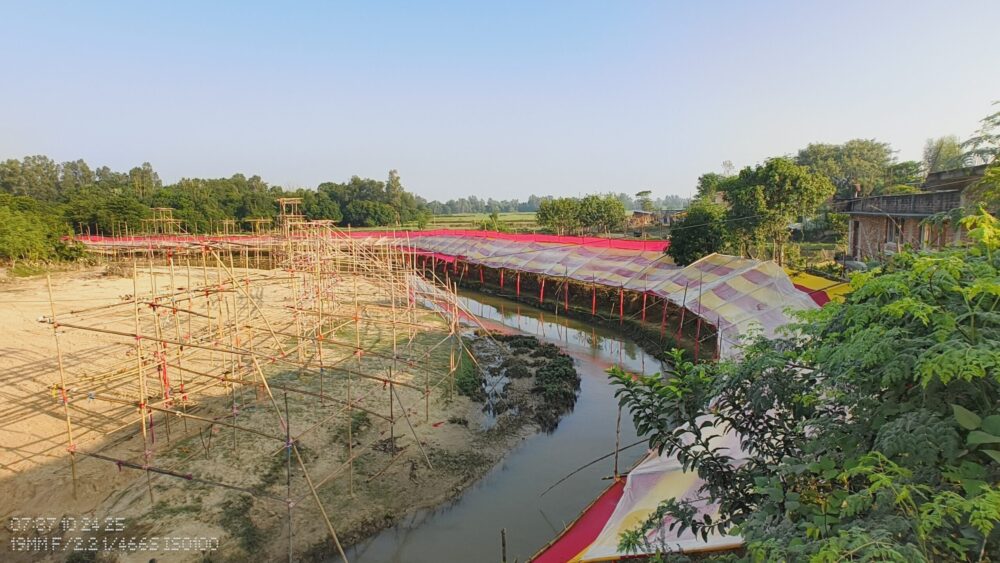
Mahottari. The common ghat of Nepal and India has been constructed on the Bigahi River on the border of Mahottari and Dhanusha. An attractive ghat has been constructed on the bank of the Bigahi River in about two kilometers long.
According to Matihani municipality mayor Hari Prasad Mandal, Chhatighat has been constructed for ward no 6, 7 and 8 of Matihani municipality in Nepal and Tulsiyahi of Mukhiyapatti Musharniya rural municipality-3 in Dhanusha district and Madhawapur and Rampur bazaar in India.
According to him, despite being two countries and two nationalities, people of both countries have been constructing common Chhath Ghat due to the advanced practice of common religion, culture, festivals, marriage and exchange of happiness and sorrow. “The no-man’s land separates the two countries. Our attire, language, culture and festivals are similar. We have established culture of celebrating cultural festivals together, and this ghat is an example of that,” Mandal said.
This year’s Chhath festival will begin with the ‘Nahay-Khay’ ritual on Saturday. The festival will be celebrated with the rituals of ‘Kharna’ on Sunday, ‘Sajukaghat’ on Monday and ‘Paran’ (Ghat of dawn) on Tuesday. People from Matihani and Tulsirahi on the Nepali side and Madhwapur and Rampur on the Indian side have come together to decorate the common ghat of Nepal and India.
In this festival, the Sun God and Shashthi Devi (colloquially Chhathidevi) are worshipped, the devotees will bathe in the evening of Kartik Shukla Shashti Tithi and the rising sun on the morning of Saptami Tithi in this ghat and offer Arghya (Arghya). According to Jeet Narayan Majhi, ward chairman of Matihani-7, more than 2,000 devotees from both countries are expected to offer Arghya to the ghat and more than 10,000 devotees are expected to visit the ghat.
The devotees and family members stay awake singing Chhath songs at the ghat from the time of Arghya at Sajukaghat till the next morning Arghya is offered.











प्रतिक्रिया दिनुहोस्