


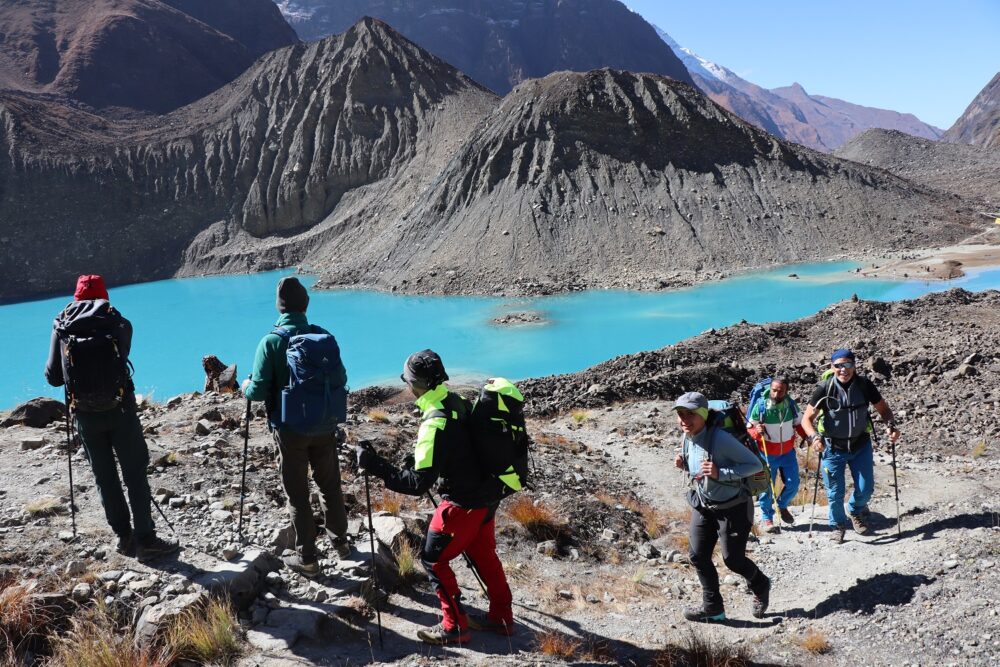
Myagdi. The base camp of Annapurna Mountain has been developed as a new tourist destination. The 8,091-metre-high Annapurna Peak and the Everest Base Camp are located in Annapurna Rural Municipality-4 of Myagdi. The Annapurna Base Camp is located at an altitude of 4,150 metres above sea level and is preferred for trekking in short distance.
According to Annapurna Rural Municipality Chairperson Bharat Kumar Pun, an unexpected number of tourists have arrived at the base camp this autumn following trekking route, infrastructure development, food and accommodation and promotional programmes. “The number of tourists visiting the Annapurna Base Camp this season is more than expected following the preparation and promotion of trekking route to Myagdi as the geography of the Annapurna mountain and the base camp is established in Myagdi,” he said. ’
Chairman Pun said that around two hundred to five hundred tourists have been visiting the base camp every day following the Dashain festival. Until two years ago, only climbers used to reach the base camp by helicopter during the spring season. Entrepreneurs have said that the number of guests coming to the trekking route is more than the capacity, which has caused problems in the management of the hotels.
Similarly, 20 kilometers road from Narchyang to Humkhola and 22 kilometers trekking route from Humkhola to Base Camp have been completed. Lakpa Angbu Sherpa, guide of Sherpa Alpine Trekking, said that Annapurna Base Camp is a virgin destination for tourists.
The camp can be reached by observing high waterfalls, mesmerizing mountain ranges, majestic geography, hills, rare plants and wildlife along the banks of Mistri River flowing from the foothills of Annapurna and Nilgiri Mountains. You can reach the base camp in two days and return on the third day.
The facts and trekking route falling in Myagdi and Annapurna Mountain and Base Camp Myagdi were identified in 2068 BS under the leadership of Tej Gurung of Narchyang. The route was mapped and named ‘Maurice Herzog’ by Annapurna rural municipality in 2077 BS.
On June 3, 1950, a French team led by Maurice and Louis Lachenel climbed Mt Everest three years after they reached the summit of Annapurna. Annapurna is known as the eldest mountain because the first human step on a mountain above eight thousand meters.
The Annapurna Festival held in 2077 BS and the diamond jubilee of Annapurna Expedition last May have helped publicize the trekking route, mountains and base camps. Sudip Bhatta, a local of Kathmandu, said that they came to visit the base camp after seeing the media and social media contents.
Gurung said that a team of locals carried out research of the route after the local people informed about the route used by Herzog in 2012 and the base camp at Narchyang which is the entry point of the trekking route. Two local units of Kaski and Myagdi have been named after the Annapurna Mountains. According to the Department of Tourism, 536 mountaineers have climbed Mt Annapurna so far.
The base camp is located in the foothills of the Nilgiri and Annapurna mountains. Below the base camp is the Panchakunda lake at an altitude of 4,050 metres above sea level. You can see the lakes and mountains by sitting on the hill of the base camp. Trekkers take pictures and make videos of the mountains and lakes as a backdrop.
The lake which covers an area of 107,684 square meters is a natural glacial lake formed by the melting snow of the Annapurna Himalaya. Sushma Khatri, a local of Beni, said that the main feature of the Annapurna Base Camp is the opportunity to observe the Annapurna Mountain and Panchakunda Lake at the same time.
“I was enchanted and delighted by the lakes around me and the lakes at the foothills”, he said, adding, “I am filled with joy in the supernatural beauty of this place, forgetting all the sorrows and tensions.” ’
The installation of statues of Mauriette Herzog, Louis Lachenel and Sonam Walung Sherpa of France who led the first expedition team and an open museum with the names of 536 people who have climbed Mt Annapurna so far has been set up at the base camp.
In the last fiscal year, Annapurna Rural Municipality had constructed a shelter building, toilets and drinking water for the operation of tea and snack shops at Phutphute waterfall. Drinking water and toilets have been constructed in Humkhola.
A toilet each has been constructed in the cave ground and the base camp. The trekking route from Humkhola to Sadhikharka has been laid with stones and railings have been placed on the side of the trekking route at difficult places. Locals of Narchyang have been operating hotels at Humkhola, Phutphute, Sadhikharka, Guphanphant, Bhusket and Panchakunda since last spring.
As the Annapurna Conservation Area falls under the ACAP project, the government has to take permission to build a permanent physical structure here. According to Michael Pun, a hotel entrepreneur of Bhusket, ACAP has given permission to build a temporary structure that can accommodate 50 guests, but the number of guests has increased by four to five times.
In the absence of hotels, trekkers had to carry their own belongings. There is a lack of communication and electricity facilities above Humkhola. Due to lack of communication facilities, there is a problem in rescuing tourists and managing guests. With the increasing number of tourists, waste management has also become another challenge here. There is a need to complete the construction of trekking route and upgrade the suspension bridge.
Hari Bahadur Bhandari, a member of the Gandaki Province Assembly elected from Myagdi constituency no 1 (a), who returned from the Annapurna Base Camp last week, pledged to coordinate with the local, ACAP, state and federal governments in infrastructure development and promotion.
“Annapurna Base Camp and Panchakunda Lake have huge potentials for tourism as they can be reached in short distance and quickly,” he said, adding that he would take initiatives to draw the government’s attention and budget for expansion of communication and electricity facilities, upgradation of trekking routes, waste management and construction of infrastructures including suspension bridges. ’













प्रतिक्रिया दिनुहोस्