


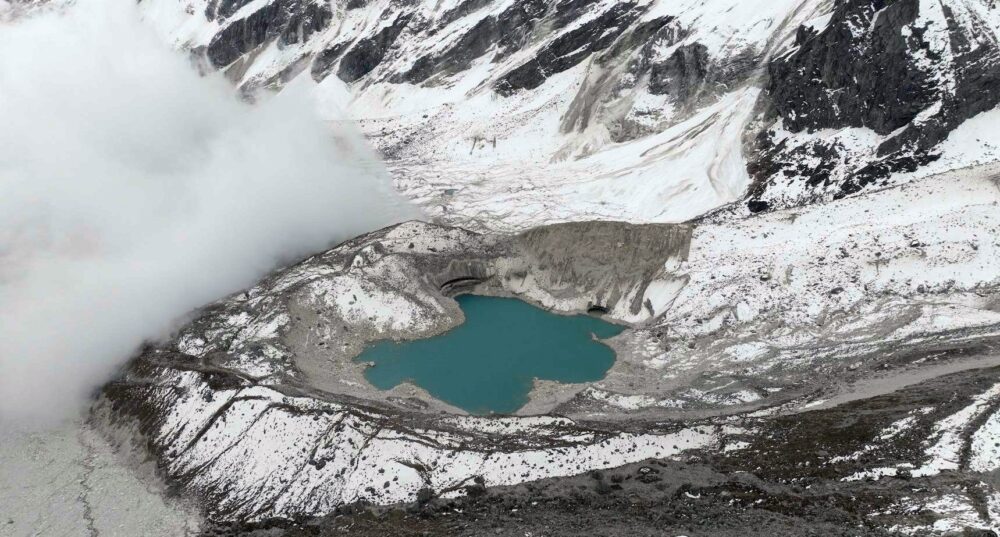
Kathmandu. KATHMANDU: The increasing impact of climate change has increased the risk of glacial lake outbursts, avalanches and rapid melting of snow in the Hindu Kush Himalaya region.
A study titled ‘Causes, Effects, and Future Risks of Thame Valley Glacial Lake Outburst Flood’ conducted by the International Centre for Integrated Mountain Development (ICIMOD) states that the temperature in the region is increasing by an average of 0.28 degrees Celsius every 10 years. The study was conducted by ICIMOD’s risk experts Sudan Bikash Maharjan, Tenzing Chogyal Sherpa and Arun Bhakta Shrestha.
According to the study, the Everest region is facing problems such as unprecedented glacial melting due to climate change. This rate has increased by 65 percent in the last decade compared to the previous year. The report states that more than 25,000 glacial lakes in the Amu Darya, Indus, Ganges, Brahmaputra and Irrawaddy basins are increasing due to the impact of the fast glaciers.
The study carried out on the floods caused by the glacial lake outburst in Thame area of Solukhumbu last year confirmed this. Glacial lake outbursts in the region have increased the intensity of floods due to destructive, complex and series of geomorphic and geomorphic factors, the study said.
“There are more than 25,000 glacial lakes in the Hindu Kush Himalaya and the Thame incident shows that more than a few efforts are needed to understand and prevent the risks posed by relatively small lakes,” said remote sensing analyst Sudan Bikash Maharjan, one of the authors of the ICIMOD study. According to the study, climate change has caused devastating damage to Thame.
According to the study, a large rock fell on the glacial lake at an altitude of 4,900 meters, causing the dam to collapse, releasing 156,000 cubic meters of water. When the water fell 120 meters downstream into another lake, a hole 22 meters high and 51 meters wide was left in the lake. According to the study report, an additional three lakh three thousand cubic meters of water has been released from it.
The water in both the lakes flowed together and the water level was so strong that it carried the debris along with the big boulders up to 80 kilometers downstream. The floods that followed caused damage to the river banks along its route.
The flood took a major form when the naturally narrow part of the river and the temporarily accumulated flood water flowed away. “The valley near the village of Thame, about half a kilometre wide, was covered in debris. ’
The floods damaged private houses, a school, a health post, bridges and a hydropower project. According to the report, there was no human casualty as the incident occurred in the afternoon and the flood occurred in a phased manner due to the accumulation of water. The disaster displaced 135 people and destroyed 25 houses.
More than 90 glacial lakes have erupted in Nepal since the 1920s. Of these, five such major incidents have taken place in the Sagarmatha region in less than 50 years.
Glacial lake outbursts and floods are among the most devastating and major threats in the high mountainous region. These events, which have the potential to release millions of cubic metres of water and debris in a matter of hours, wreak devastating damage on low-lying coastal areas.
Study co-author Tenzing Chogyal Sherpa, a snow analyst at Imidod, said floods such as Thame’s are a harsh reminder and a moment of self-reflection as extreme climate events are on the rise. “This shows how mountain communities are bearing the brunt of climate-induced disasters,” he said. Such studies help to understand the realities of climate change. ’
ICIMOD’s senior advisor and study co-author Arun Bhakta Shrestha said the Thame incident is increasing the temperature in the Hindu Kush Himalaya region three times as compared to the world, which has increased the risk of glaciers in this region. “In the last two years alone, we have seen a number of high mountain hazards, including glacial lake outburst flooding in the region, so there is a need to install more flood and weather forecasting stations to immediately strengthen real-time information in the region, and to build engineering infrastructure, such as riverbank protection, to reduce the damage from future events,” he said.
The Thame incident has taught us a lesson to understand the Himalayas and disaster-related incidents and to formulate policies that can be implemented in the future. More recently, the Building Adaptation and Resilience in the Hindu Kush Himalayas project has focused on reducing disaster costs and risks.














प्रतिक्रिया दिनुहोस्