



Kathmandu. The government has brought the Public Enterprises Management and Good Governance Policy-2082 into implementation. The policy states that it will not interfere in the day-to-day operations of the corporation except the government directs the strategy brought by the government.
Similarly, the public corporations will be gradually converted into companies, the public corporations in the sector competing with the private sector will be categorized as commercial public corporations and the bylaws, directives and working procedures that are designed to interfere or duplicate in the work area of management will be scrapped. As per the policy, administrative expenses of public enterprises should not exceed 20 per cent of the total expenditure.
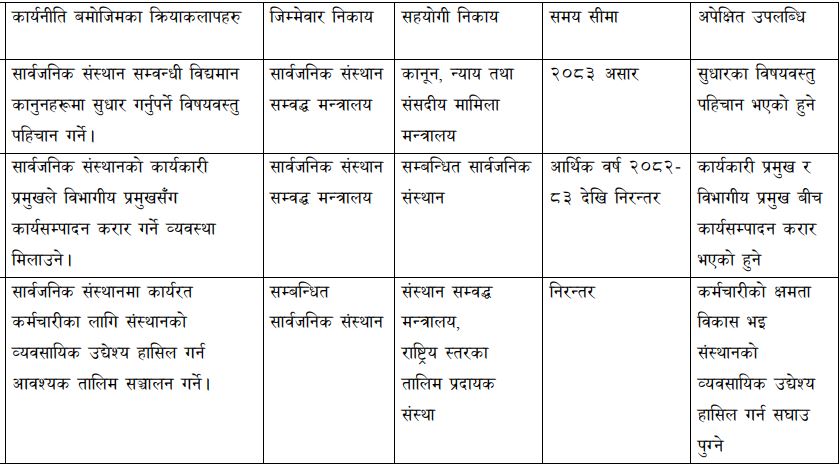
With the implementation of this policy, the functions related to the regulation and operation of public corporations will now be separated. The Board of Directors shall be made capable and independent to formulate policies and formulate and implement business objectives and operation strategies.
Likewise, the policy states that the office bearers and employees would be made fully responsible and accountable to their performance. The management and board of directors will determine the price of the goods and services produced and distributed by the corporation on the basis of market situation, national and international environment and cost of goods and services.
Public enterprises will be classified into two groups: commercial and strategic. Public enterprises in the sector competing with the private sector will be classified as commercial public corporations. The procurement process of public enterprises that have to compete with the private sector will be simplified.
The strategy is to classify the public corporations as strategic public corporations that are necessary to implement the policies and programs of the government, to fulfill national and international commitments, or to provide essential services that are not involved in the private sector.
The strategy is to gradually convert all public corporations into companies, changing the legal basis for the establishment of public corporations.
The existing law will be amended to provide for the representation of directors on the basis of share ownership, and the board of directors of public enterprises will be made capable and independent to formulate policies and formulate and implement business objectives and operation strategies.
The strategy is to make the Board of Directors and management fully responsible in the overall decision-making process and performance of the public corporation under the prevailing law and not to interfere in the day-to-day functioning of the corporation except the government’s directive.
In order to guide and facilitate the management, the Board of Directors shall meet at least six times a year and there shall be a gap of not more than two months between the two meetings. As per the policy, every board of directors should attend at least 75 percent of the meetings in a fiscal year.
Similarly, the policy states that an independent or expert director should sign a tripartite performance agreement with the ministry’s secretary and the chairperson of the board of directors. It is strategic to repeal the bylaws, directives and procedures that have been arranged to interfere or duplicate in the scope of management.
It is stated that the work details of the Board of Directors of a public corporation shall be clarified. The strategy is to approve and implement the business action plan, annual budget and financial report of the corporation, evaluate the performance of the chief executive, make the arrangements related to auditing, risk management, business governance and remuneration of the corporation transparent and timely, to approve and implement the organizational structure of the public corporation, to ensure financial discipline in the corporation and to carry out the tasks specified by the law for the formation of the corporation ।
To compulsorily take a decision on the creation of posts of employees, increase in new posts, additional facilities (including contractual and wage employees) only with the approval of the Ministry of Finance, prepare and implement bylaws, standards, guidelines and procedures related to employee administration, financial administration and procurement process subject to the prevailing laws, and make arrangements for regular monitoring and evaluation of the implementation of the decisions of the Board of Directors, The strategy is to update the bylaws related to the procurement of the corporation in a way that is in line with the prevailing public procurement laws.
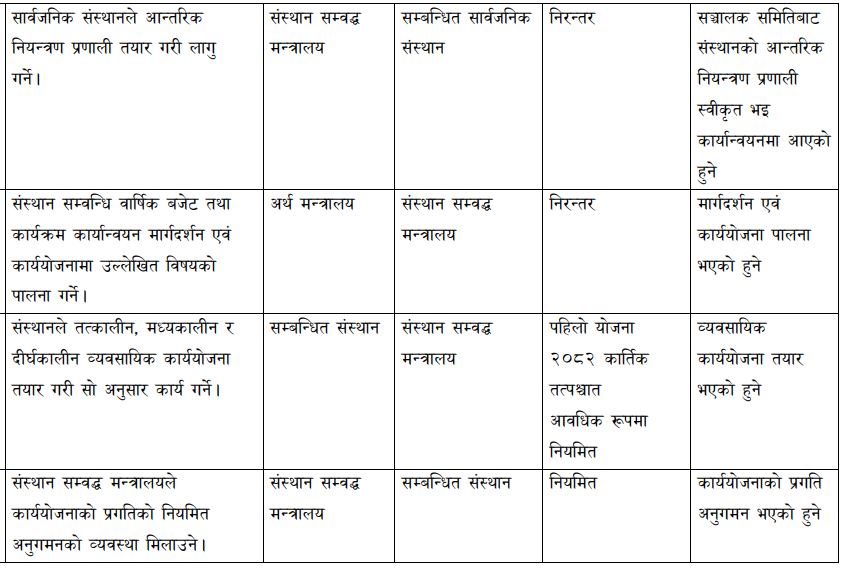
Likewise, the strategy is to regularly monitor the implementation status of the Corporation’s accounts, budget, procurement system and internal control system, examine the records of the Corporation’s books and internal audit system, and regularly monitor the implementation status of the Corporation’s Regulations.
According to the policy, it will be the responsibility of the CEO to implement the issues raised in the final audit report. Public enterprises have to send a copy of the final audit report to the concerned ministry and the Ministry of Finance. The chief executive shall prepare a reform action plan incorporating the issues raised in the final audit report and submit it to the Board of Directors and implement the reform action plan as per the directives of the Board of Directors.
Provision would be made that the administrative expenditure of the public corporation shall not exceed 20 per cent of the total expenditure, the pension system based on contribution would be implemented in lieu of the pension and gratuity received by the employees working in the public corporation after retirement.
According to the government’s policy, the accounting system of public corporations would be made reliable and comparable, Nepal Financial Reporting Standard would be implemented in public corporations and the accounting management of public corporations would be made mandatory to keep it in the information system. Likewise, arrangements will be made to publish the financial reports of public enterprises regularly.
It is stated that the employees, experts and assistants working in public corporations will be given responsibilities on the basis of qualifications and competencies, responsibilities will be given on the basis of the qualifications, competencies and expertise of the employees. It is stated that the capacity of the human resources working in the corporation will be developed in the budget and program formulation of the public corporation and the program related to the leadership development of the corporation will be conducted regularly.
It is stated in the policy that an amendment would be made in the existing employees by-laws of the corporation to make arrangements to get the required technical human resources in the corporation through early means.
The strategy is to scrap unnecessary and irrelevant posts by completing the organization and management survey of public corporations and to make the organizational structure of public corporations functional and flat. According to the strategy, the time and level of decision to be taken in the public corporation will be specified and the work responsibilities of the departmental head of the public corporation and the head of the service center or unit will be clearly specified.


















प्रतिक्रिया दिनुहोस्