


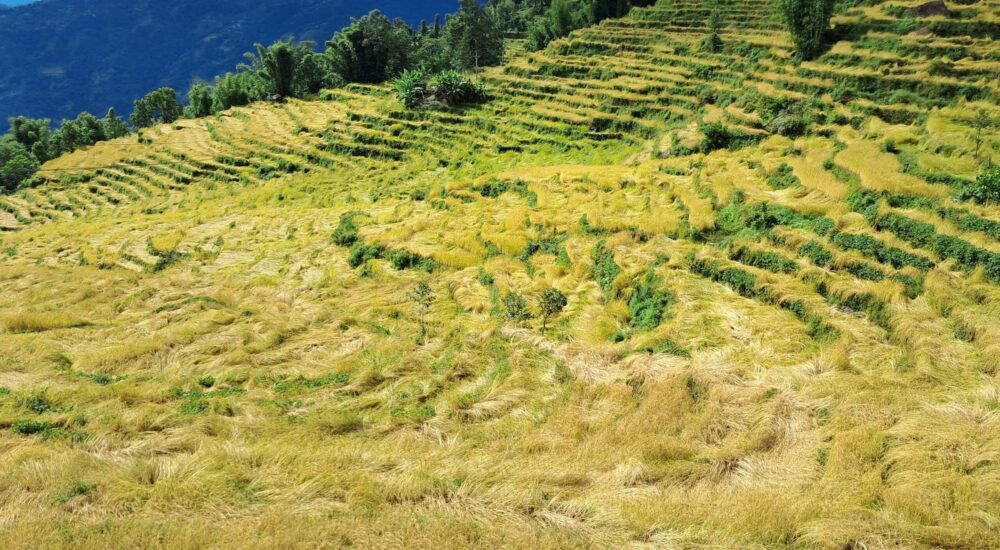
Khotang. Over 70 per cent paddy crop has been damaged in Khotang district due to incessant rainfall for four days since November 30. According to the information provided by Agriculture Knowledge Centre, Khotang, 15 per cent of paddy crops in Khotang have been cut to storage, 45 per cent have turned yellow and 10 per cent of green paddy crops have been damaged.
This year, paddy has been planted in 9,988.03 hectares of land in the district. Out of this, paddy crops planted in 6,991.6 hectares of land have been damaged due to incessant rains, said Bishal Modi, chief of Agriculture Knowledge Centre, Khotang.
With the incessant rain stopping for the past few days, farmers in the district are in a hurry to store the remaining paddy crop damaged by the rains. Farmers are now working in their fields to store the paddy damaged by the incessant rains.
Worried farmers are in a hurry to save paddy from monkeys and other wild animals. Around 41.63 hectares of paddy crop has been damaged in Diktel Rupakot Majhuwagadhi municipality alone. Paddy is cultivated on 3,500 hectares of land in the municipality. Around 8,995 metric tonnes of rice is produced in the district.
Hemanta Rai, a youth farmer of ward no 11, said that the paddy crop has been badly damaged due to the harvest. “Due to incessant rains, the paddy harvested in the paddy crop has grown in Ali. Crops including paddy, millet and buckwheat have been badly damaged due to the incessant rainfall,” he said. The government should provide relief in this. ’
Municipality spokesperson Kamal Giri said paddy crops in Halesi Tuwachung Municipality also suffered a big loss. Paddy is cultivated on 120 hectares of land in the municipality, which is the second largest local level in the district. It produces 308.4 metric tons of rice.
Jantedhunga rural municipality has also suffered extensive damage in paddy fields, said Khem Bahadur Khadka, deputy mayor of Jantedhunga rural municipality. According to deputy mayor Khadka, 40 percent of paddy crops have been destroyed in the rural municipality.
Paddy is cultivated on 240.96 hectares of land in the rural municipality. According to the rural municipality data, around 619.27 metric tons are produced in the district.
Paddy cultivation has also been damaged in Barahapokhari rural municipality. Rural municipality chief Shalikram Banjara said that the rural municipality has more than 60 percent coverage. Paddy is cultivated on 657 hectares of land in this rural municipality. Of this, 1,688.49 metric tonnes will be produced, according to the rural municipality data.
Khotehang rural municipality has also suffered a big loss in paddy fields, said Udim Bahadur Rai ‘Mukti’, chief of Khotehang rural municipality. Although the details are yet to be received, around 40 percent of the paddy has been destroyed by the rain.
Paddy is cultivated on 1,200 hectares of land in this rural municipality, the largest among the rural municipality (with nine wards). The rural municipality produces around 3,084 metric tonnes of paddy.
Diprung Chuichumma rural municipality has also suffered damages in paddy fields, said Chairperson of Diprung Chuichumma rural municipality. According to Agriculture Knowledge Centre, 3,084 metric tonnes of paddy is being produced in 1,200 hectares of land in the rural municipality.
Sakela, Rawabesi, Kepilasgadhi and Aiselukharka rural municipalities were also badly damaged by the rain. A total of 2,056 metric tonnes is produced in eight hectares of land in Sakela rural municipality, 2,184.5 metric tonnes in 850 hectares of land in Rawabesi, 1,927.5 metric tonnes in 750 hectares of land in Kepilasgadhi and 2,570 metric tonnes in 1,000 hectares of land in Aiselukharka rural municipality.
According to Agriculture Knowledge Centre, Khotang, around 26,000 metric tonnes of paddy is produced in all 10 local levels of the district. It was expected that the production would increase this year due to timely rainfall for paddy plantation.













प्रतिक्रिया दिनुहोस्