


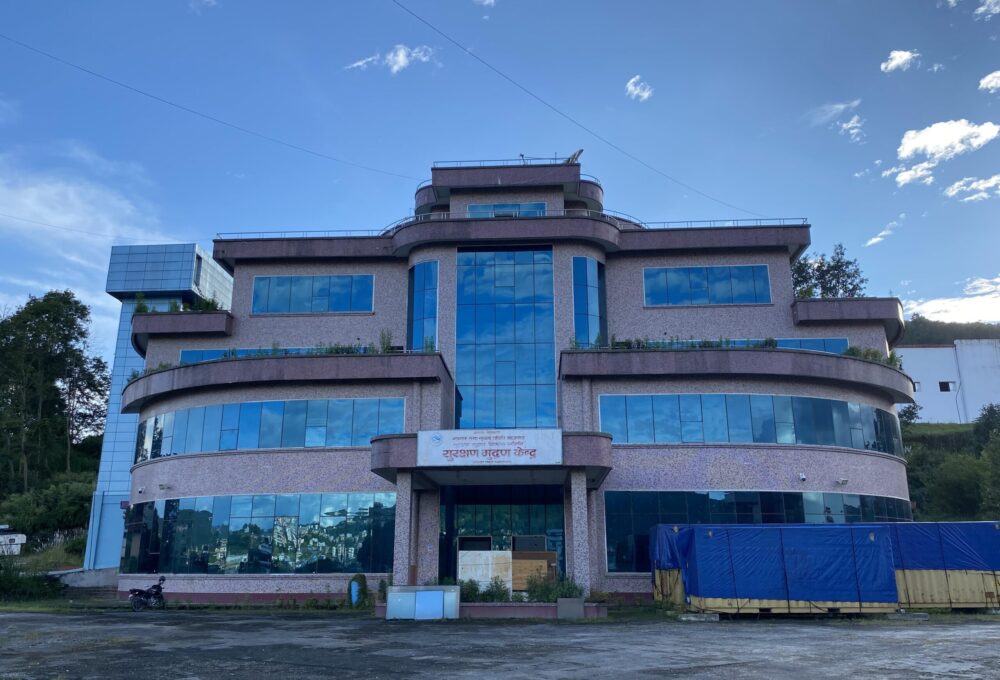
Kavrepalanchok. The Security Printing Press based in Panauti municipality-5 of Kavrepalanchowk district will be fully operational within the next six months. The Centre has said that it will provide nine types of paper-based services within this period if the plan as per the target is successful.
It is stated that it will take six months to bring the printing machines including excise duty stickers into full operation after cleaning and installing them. Executive Director of Security Printing Centre under the Ministry of Communications and Information Technology, Devraj Dhungana, said that human resources should be brought from abroad to operate some machines.
According to him, nine types of paper-based services including citizenship, excise duty sticker, land ownership certificate, postal stamp and visa sticker can be provided once the center is fully operational. “The Centre is formulating separate plans for services based on documents, cards and banknotes,” Dhungana said.
So far, more than three billion rupees have been invested in the center, including physical construction and management of equipment. According to Dhungana, machines worth Rs 50 crore have already been installed at the centre. According to Dhungana, the Centre is capable of providing 11 types of services if manpower and equipment are managed. He said, “The 14th amendment to the Procurement Regulations has opened the stalled contracts and seven contracts have also been signed within the centre. ’
Meanwhile, the printing of driving licenses has begun at the centre from Friday. Minister for Communications and Information Technology, Jagadish Kharel, inaugurated the printing system from the machine installed at the centre last Friday. On the occasion, Kharel said that the printing of license has been started after making necessary arrangements despite legal confusion and various difficulties. Minister Kharel said that there is a need to print 28 lakh driving licenses at present. He said, “Printing license, passport, national identity card and other printing materials were always done by giving contract to foreign companies and the printing license was started by making policy reforms when it could not be printed despite having the infrastructure and resources.” He said that the machines under the center have been lying idle for years and the parts have become dusty and the center has started printing by knocking dust.
According to the center, the work has started from Friday as per the agreement for printing 12 lakh copies license in the first phase. Executive Director Dhungana said that in the initial days, 500 would be printed daily and the quantity would be increased. According to him, the central government will be able to provide 23.74 per cent profit of the annual investment within the next five years. The government has already issued the Security Printing Centre Act, 2081. He said that the ambitious plan of the then government to invest Rs 33 billion has been limited to Rs 8 billion. According to the center, positions for 62 employees have been approved.
Prior to this, the physical construction and other management works of the center were halted in April 2081 due to lack of budget. At that time, the construction of a multi-purpose building on the premises of the center was in the final stage, but the work of painting and installing windows and doors had also stopped. The Information Technology Park (ITPARK) was converted into a center only a few years back after the physical infrastructure constructed for the park remained unused.
Until a year ago, the façade of the main building of the center was renovated and the construction of infrastructure, including the required warehouse, equipment purchase, and renovation of the existing buildings was carried out.
The warehouse building constructed a year ago with a length of 50 meters and 25 meters wide will store safe printing paper, ink and other raw materials for a long time. Storing the raw materials and the safe print produced in the building will prevent the occurrence of ‘paper shrink’ and there will be no problem of drying ink. The multipurpose building has been constructed with earthquake-resistant, fire-resistant steel truss system. Secure printing equipment can also be installed in the building.
Earlier, two highly secure digital machines brought from Iraq had printed samples of the excise stickers. At present, the two machines can print 60 million excise duty stickers annually. The machine and some IT equipment were purchased from the previous fiscal year’s budget of Rs 730 million. There is one die cutting machine at the centre while other three machines were installed but not in operation. The Centre has started preparations to bring other machines into full operation within the next six months after the management of human resources and raw materials.
The work of the press was started four years ago for the construction of the physical infrastructure of the center. The then Minister for Communications and Information Technology, Gokul Prasad Banskota, had selected the park at Panauti Municipality-5 for the purpose. A budget of Rs 1.09 billion was allocated in the fiscal year 2076÷77 BS to start the work of the press. It was then decided to set up a security printing centre for printing passports, banknotes, driving license, smart cards, postal tickets, excise duty stickers, SIM cards among others.
The works of preparing land for the construction of the physical infrastructure, construction of wall and construction of access road to the building within the park have been completed. Two drinking water tanks each have been constructed for drinking water, four large generators required for printing presses and an underground diesel tank with a capacity of three hundred thousand liters has been constructed for fuel storage.÷
The press is expected to save Rs 10 billion annually from Nepal for safe printing. It is said that around 1,000 human resources including 200 technicians will be required for the center. The then government had prepared a work-oriented and result-oriented master plan two years ago to develop security printing in three phases.
In the first phase, Nepal will be made self-reliant within five years and in the second phase, reliable services related to security printing and quality security goods will be made available to SAARC and South-East Asian countries in the next ten years. In the third phase, a strategy has been set to provide reliable security printing services and quality security products to the rest of the third countries within the next 15 years.
The Park was initiated in 2057 BS and handed over to the Government of Nepal in 2061 BS. Spread over 257 ropanis of land, the park has nine buildings including two big commercial÷administration buildings and four well-equipped residential buildings. The park, which was considered to be the model and biggest park in South Asia at that time, was in a dilapidated condition due to lack of operation. While it was unused, the park used to shoot movies, political and other programs in the district. In the meantime, some information technology companies used to leave in a short time even if they started working in the park.












प्रतिक्रिया दिनुहोस्