


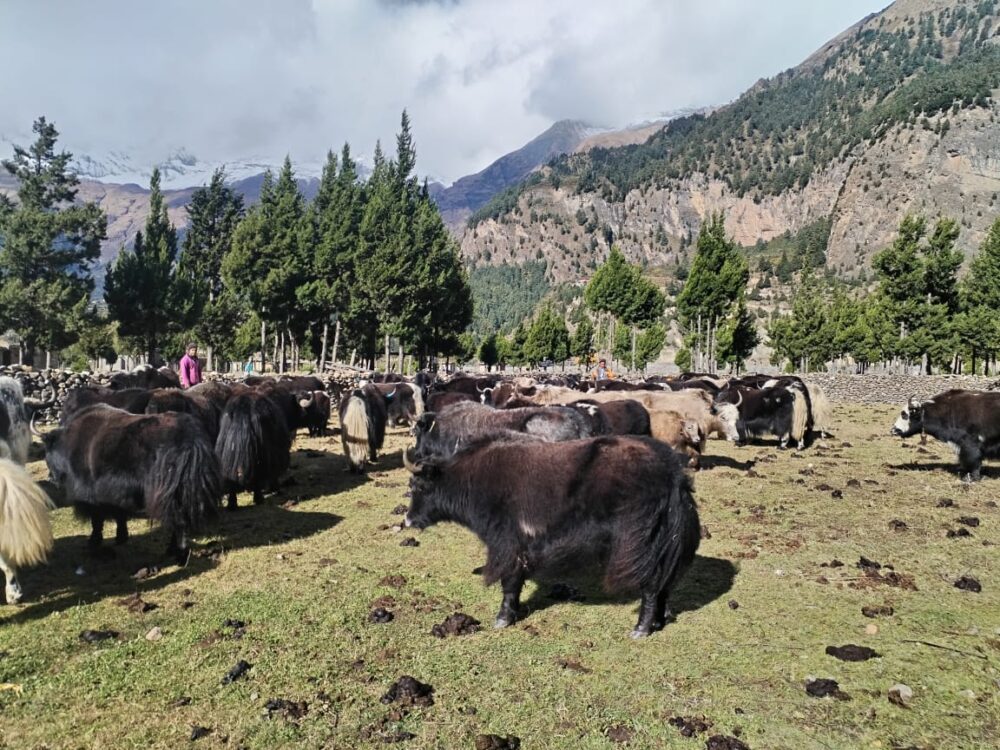
Mustang. Yakchauri reared in the high lakes of the district have been shifted to the valley after heavy snowfall and extreme cold a week ago. The grasslands in the high lake area were completely covered with snow and the water sources were frozen due to snowfall, so the yakchauri here has been shifted to a warmer place in the valley to protect them from snowfall and cold.
Every year, the yakchauri is taken to the high peaks of Mustang in the valley after snowfall in the winter and when the snow melts in the rainy season, the yakchauri is managed by transporting it to the high peaks and pastures. The traditional yakchauri reared in the high hills of five local levels of Mustang is shifted to the basin from October to June.
Sojan Hirachan, secretary of the Himalayan Yak Rearers and Conservation Committee, said that the yaks are kept in the high mountain from April to mid-October with the onset of summer.
Yakchauri in the high lek and pasture are gradually reduced to the valley as the snow in the high lake causes lack of grazing land, difficulty in managing fodder, water and food, and snowfall and cold to the shepherds. The yakchauris are taken to temporary sheds in the high mountains during the rainy season and reared.
Secretary of the committee Hirachan said that the yakchauri rearing is started in the high altitude above four thousand meters of the sea level as the grass grows due to the melting of snow during the rainy season and it is easier for the shepherds to manage yakchouris.
According to the committee’s secretary Hirachan, around 1,000 yakchauri from 10 cowsheds of 10 households at Marche Lake in Thasang rural municipality-2 of Mustang have been lowered down the valley to escape the snowfall and cold. Likewise, around 500 yakchauri of eight households at Mulikharaka Lake where Dhawalagiri Iffel is located in Thasang and around 700 yakchauri belonging to six families at Batase Lake in Thasang-1 and Gharpajhong-2 were reduced to the valley to escape cold due to snowfall, said committee secretary Hirachan.
There are 10 yak sheds in Marche Lake, eight in Mullikharka and six in Batase Lake, said Gautam Sherchan, ward chair of Thasang-2. He said that the ghamti shed was constructed at Marche Lake with the grant assistance of Thasang rural municipality, Veterinary Hospital and Livestock Service Expert Centre. Ward Chair Sherchan said that livestock farmers in Kowang, Sauru, Khanti, Larjung, Naurikot, Nakum, Boksi Khola, Chaktang and Taklung of Thasang Rural Municipality have been involved in yak rearing.
As many as 500 yaks belonging to yakchaur herders Bhupendra Sherchan and Bir Bahadur Gharti of Jomsom in Gharpajhong-4 have been reduced to the lake above Thini village due to snowfall. Sherchan and Gharti’s yaks, which were reared by setting up cowsheds at the high altitude of the sea level, have been lowered from the Namukh lake to the lower reaches of the lake. According to Bhupendra, it is difficult to take care of yaks in winter and there is a problem of grass and drinking water in the high hills. According to him, seven families of Syang, Marpha and Jomsom of Gharpajhong Rural Municipality have been involved in yakchaur farming.
Karma Sangbo Gurung, a local of Tangya, said that around five households have been involved in yakchouri rearing in Upper Mustang, one in Tangya of Loghekar Damodar Kunda Rural Municipality-5 and one in Dyegaun of Ward-4. During the rainy season, yaks at Karang of the high lake were kept at the upper reaches of Thakse Lake after snowfall. Similarly, yak herder Kunsang Rinjin Gurung of Loghekar-4 said that he has brought yaks to the lake near the valley after the snowfall.
Similarly, yak rearing has also taken place in Lomanthang Rural Municipality and Samjung of Upper Mustang. Commercial yakchouri farming, as a traditional culture in the high mountainous region, has been facing crisis due to climate change. Lack of snowfall in a favourable season due to climate change, lack of grass in the grazing areas of the high altitude and the risk of damage to domestic livestock including yak from the attack of wild animals including snow leopard have put yak rearing under crisis.
The climate crisis has added to the yak and yak rearing here. Heavy snowfall, partial snowfall and natural occurrences of no snowfall in some seasons have directly and indirectly affected yak rearing. Farmers in Mustang make curd, ghee and chhurpi from yak milk, which are sold at a high price where Hindus keep the tail of yak in the puja room.
The yakchaur farmers of Gharpajhong and Thasang here extract fresh blood from yakchauri every year in April and August to get double benefits. Since adult yaks are also used as meat here, the price of a single live yak ranges from Rs 100,000 to Rs 150,000.
















प्रतिक्रिया दिनुहोस्