Skip to content

BIN Power Summit: Policy intervention needed to increase investment in energy sector: Senior Vice President Dangi

nabil bank

. Experts have said that policy intervention is needed to increase investment in the energy sector at the South Asia (BIN) Power Summit 2025 held in India. The summit, organized by the Confederation of Indian Industry (CII) in New Delhi, was attended by energy entrepreneurs and government officials who have been active for a long time in the energy sector of Bhutan, India and Nepal.

A 5-member team led by Mohan Kumar Dangi, Senior Vice President of Independent Power Producers’ Association, Nepal (IPPAN) representing the private sector of Nepal participated in the conference.TAG_OPEN_div_34 A team led by Nutan Kumar Sharma, joint secretary at the Ministry of Energy, Water Resources and Irrigation and Deputy Director General of the Department of Power Development, participated in the meeting.

Speaking at the inaugural session of the conference organized by the Confederation of Indian Industry (CII) and the Ministry of Foreign Affairs, Sharma said that Nepal is capable of producing clean energy to meet the electricity demand of South Asia.TAG_OPEN_div_32

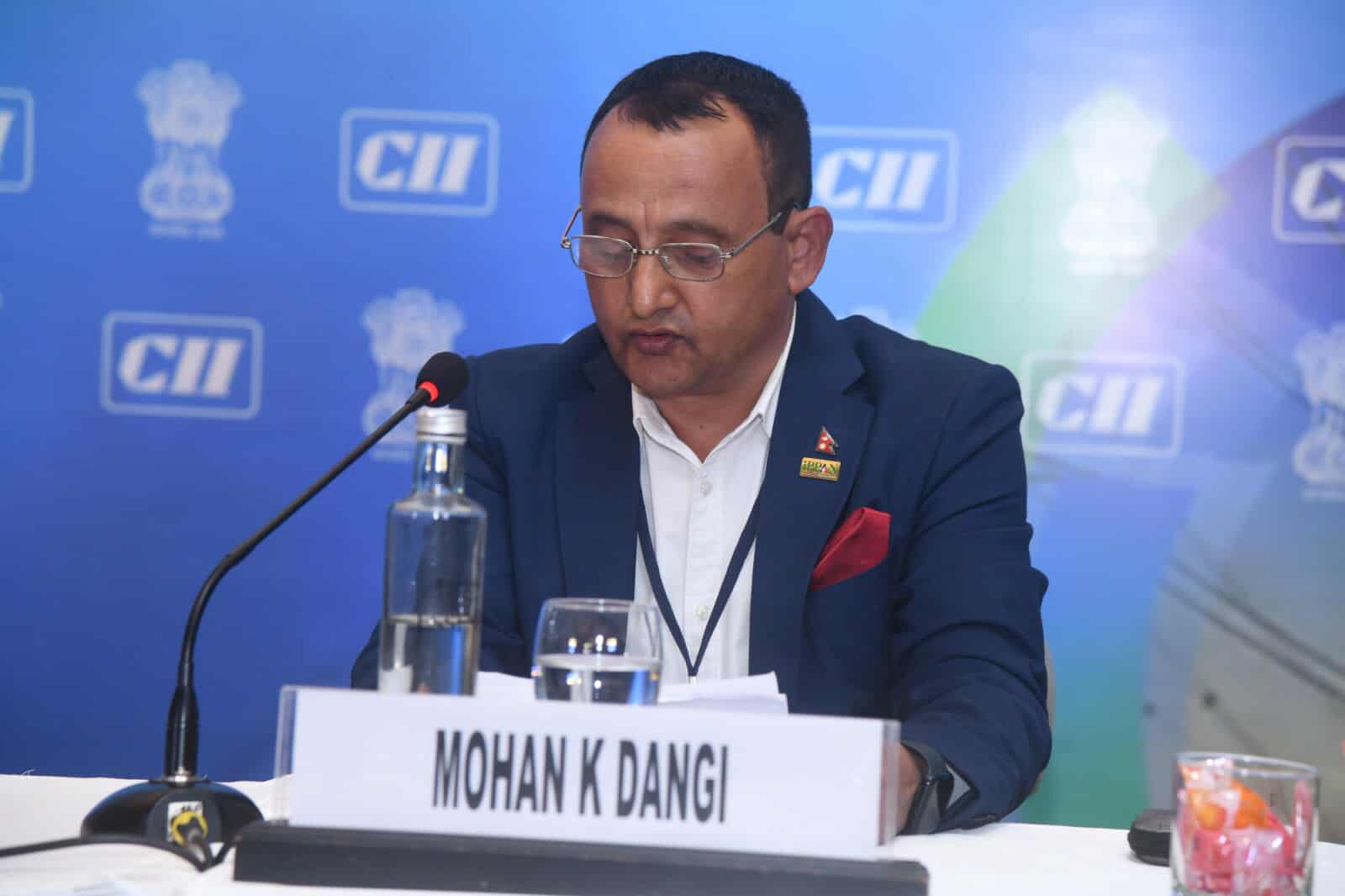
Speaking at the session on ‘Interventions needed to accelerate investment in energy sector’, IPPAN Senior Vice President Mohan Kumar Dangi said that policy interventions are necessary in BIN countries to increase investment in energy sector.TAG_OPEN_div_30 Reminding that the government of Nepal was moving ahead with a target to generate 28,500 megawatts electricity by 2035, Dangi urged the Chinese citizens to invest in B2B as it required an investment of 46.5 billion dollars.

He said that since large investments are required in power generation, distribution, open access and infrastructure development, BIN countries should focus on potential strategies to increase investment in areas that support cross-border electricity trade in the long and short term.TAG_OPEN_div_28 “There is huge demand for clean energy in India and Bangladesh and there is immense potential for hydropower in Nepal, so with the cooperation of BIN countries, Nepali power producers are capable to meet the demand of clean energy of India and Bangladesh,” he said.

According to him, Nepal has the capacity to generate 4,000 MW of electricity, 5,500 MW is under construction under the leadership of the private sector and another 3,000 MW projects are in the final stages of construction.TAG_OPEN_div_26 Dangi said that the private sector is also studying another 20,000 MW hydropower project. Speaking at the session on ‘Strategy to Enhance Energy Cooperation through Cross-Border Power Trade’, IPPAN Vice President Ashish Garg said that there is a need to increase electricity trade as the demand for electricity in the region has been increasing in the last two years.

Subhash Kumar Mishra, Deputy Executive Director of Nepal Electricity Authority (NEA), who participated in the discussion, said that although there are some challenges in the BIN electricity trade, the electricity trade can be accelerated if the plan and specific strategy are made.TAG_OPEN_div_24 He was of the view that there should be proper planning in generation, distribution and transmission to promote open access and electricity trade, for which structural, commercial and regulatory aspects should be prepared for the broader power trading scenario by making policy interventions.

Speaking at the session, IPPAN Vice President Uttam Blon Lama said that although electricity trade used to be done on a long-term basis in the past, now according to the new cross-border power trade guidelines brought by India, inter-country power trade is possible on a daily basis in the day-ahead market.TAG_OPEN_div_22 Currently, Nepal exports more than 1,000 MW of electricity to India and 40 MW to Bangladesh. Lama also said that the electricity tariff being exported to Bangladesh is stable and the import and export of electricity is being done in the Indian market both in a stable and day-ahead manner.

He said that electricity trade is taking place only at the government level in this sector and the private sector is waiting for permission to complete all preparations for electricity trade.TAG_OPEN_div_20 Still, trading in cross-border electricity exchanges is in the initial stage, so there is a need to devise appropriate strategies to increase the penetration of electricity exchanges in the region, Lama said.

In the conference, Abhidnya Malla, former executive committee member of IPPAN participated in a panel discussion on ‘Promotion of Hydropower and Pump Storage: Prospects and Progress so far’ and Sagar Shrestha, Chief Executive Officer, National Grid Company Limited participated in a panel discussion on ‘One Sun One World One Grid Connectivity: Creating Sustainability through Grid Integration’.TAG_OPEN_div_18

Prabhu
sikhar insurance

प्रतिक्रिया दिनुहोस्

global ime
Gili