


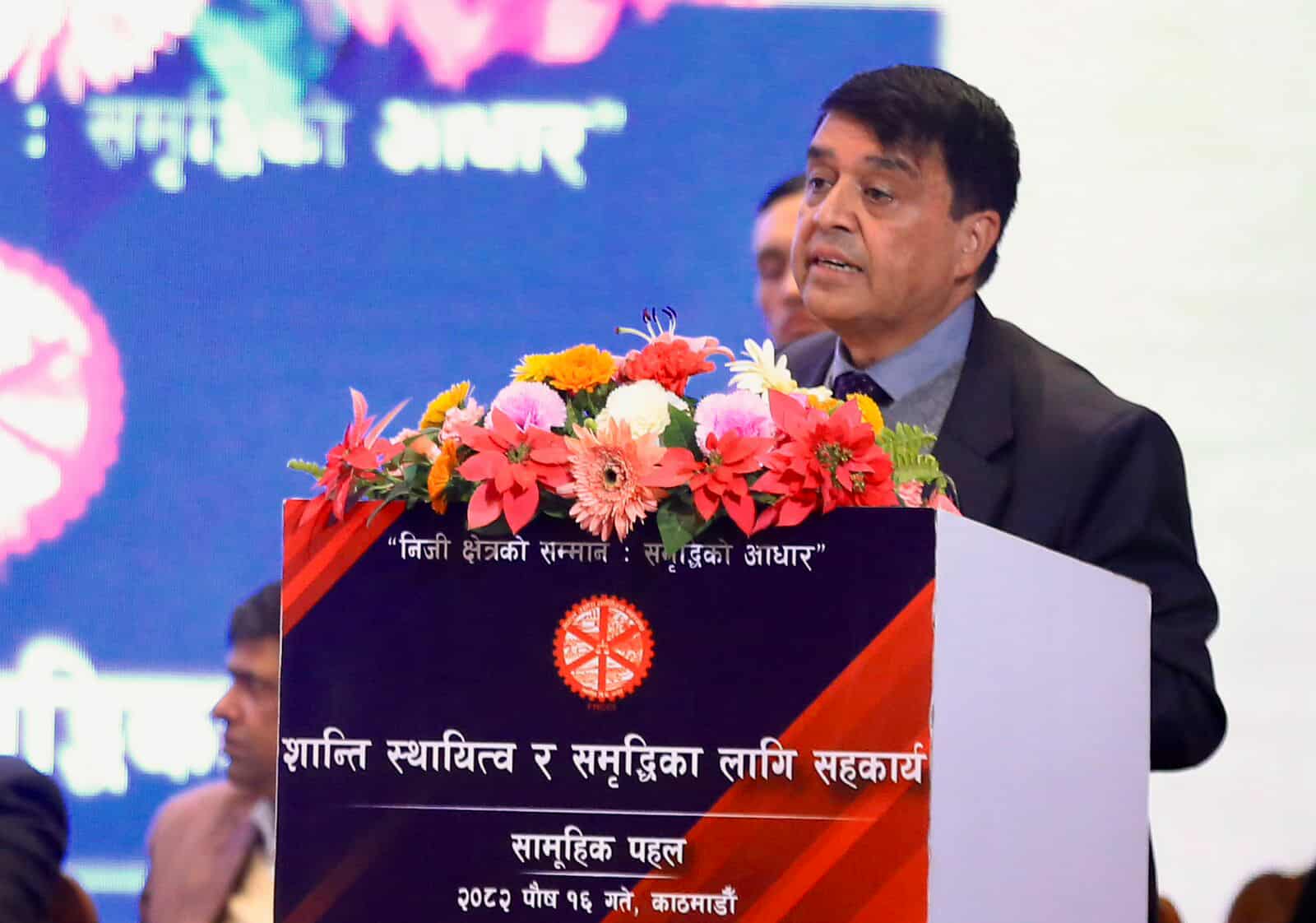
About two months ago, we organized the National Economic Debate Part II program at this place with the aim of urging the government to increase the security and morale of the private sector in the changed situation after the Gen G movement of September 23 and 24. At the programme, we demanded action against those involved in arson and vandalism during the agitation on September 7 and 24.
Likewise, our second request was to implement the Private Sector Protection and Promotion Strategy by the Council of Ministers to boost the morale of the private sector. We had also raised the issue of elections for stability. We also urged the government to resolve the dispute related to the dedicated tankline where the private sector has been affected.
The dispute regarding the dedicated tankline is being resolved at the initiative of the honorable Prime Minister. For this, I would like to thank the Honorable Prime Minister, the Government of Nepal and all the stakeholders. Elections are a method of institutionalizing democracy. The initiative and hard work of all the ministers of the Council of Ministers, including the Right Honorable Prime Minister, and the Government of Nepal for the upcoming elections is commendable. The eagerness shown by all the political parties in the country for participation in the elections has shown that the country is moving ahead for the elections.
I believe that this election environment is an example of the present government’s dedication to democracy. This is also an example of how we are prudent, flexible and committed to peace and stability. But despite all this, we feel that the issue of protecting the private sector for prosperity is still overlooked. There is still no guarantee of an environment in which the private sector can work without any hindrance.
The private sector is still not in a position to invest confidently. It is natural to fear that impunity will continue to flourish if the perpetrators of wrongdoing are not punished. There will be no investment in the country unless there is a smooth policy arrangement for the development of entrepreneurs and entrepreneurship, respect for the private sector, guarantee of uninterrupted business and security of property.
Without investment, there is no employment. Without employment, income levels will not improve. If the income level does not increase, there will be no improvement in human development. Revenue should be increased to make education and health more accessible. In order to increase revenue, there is a need for policies to encourage the private sector to work. For the last one and a half years, the government has been incurring a loss of around one and a half billion rupees. Banks are ready to invest about Rs 11 trillion. The private sector does not want to venture with money. Therefore, the revenue amount is not enough to meet the salary and allowances of the employees.
There has been no investment in infrastructure. The construction of infrastructure by the private sector has also been obstructed in various pretexts. How can employment be possible if there is no infrastructure and factories? How is it possible to imagine employment in the country? The government has been able to provide employment to only 3,500 people a year. There is no opportunity when the private sector is shrinking. Therefore, the youth are forced to go abroad. If Nepali youths can go abroad and work in private business, why not work in private industries and establishments in Nepal? The only problem is that the private sector has not been able to work here. There are policy hurdles.
The procedures are complicated. Business-friendly environment has not been created. Even the general public has a negative feeling towards the private sector. The recent arson and vandalism has added to the frustration. Therefore, the Federation of Nepalese Chambers of Commerce and Industry (FNCCI) felt that collective efforts were necessary for peace, stability and prosperity. And, today, we have invited all the stakeholders of the society here. Through these and similar public programs, we have sought to know your perspective on the private sector, which contributes 81 per cent to the economy and 86 per cent to employment.
We want commitment. If we cannot institutionalize democracy by holding elections for political stability today, if we do not allow the private sector to work safely and with dignity, we will not be able to succeed. If we fail, our failure is not limited to us. This failure will be passed on to our future generations as well. Therefore, we must now think about whether we want to hand over a failed country to the future generation or a prosperous Nepal.
In the last 75 years, there have been more than half a dozen decisive and transformative political movements in Nepal’s politics, but the livelihood of the common people has not improved according to the times. Therefore, the political changes from time to time were also not sustainable. The main reason for the increase in frustration among the people is that their life is not easy. There were not enough jobs, businesses and employment opportunities in the country, and its guarantees were limited to government documents. The main reason for this is that the economic activities of the private sector were not prioritized or the suggestions of the private sector were not heeded.
We believe that one of the forms of this frustration is the youth movement of the Gen G group last August. Mainly in the movement for good governance and building a corruption-free society, there were attacks and arson in many places due to wrong infiltration. The private sector, which was affected by almost all the protests, became the target this time too. According to a study by the Federation of Nepalese Chambers of Commerce and Industry (FNCCI), the agitation caused direct physical loss of around Rs 40 billion while the private sector suffered losses worth Rs 81 billion.
There are many challenges in the area of achieving prosperity through peace and stability. There is no guarantee that the structures of the collapsed private sector can be rebuilt, but they will not be targeted again. I think the morale of the private sector has reached the lowest point in the history of Nepal. This has not only increased the risk of capital flight, but has also raised another doubt whether the country will be on the verge of failure.
Of the eight countries that have changed since 2011, there has been no peace and stability in any other country except Sri Lanka. Keeping this sensitivity in mind, the role of the industrialists and businessmen devoid of political interest has also been realized by the stakeholders, so we have come together today for peace, stability and prosperity with the participation of the government, political parties and young generation in the active participation of the Federation of Nepalese Chambers of Commerce and Industry and entrepreneurs. The positive support and goodwill of every political party, civil society, youth generation and general public is necessary for the development of entrepreneurship with the guarantee of stability and uninterrupted business through elections.
First and foremost, we want the commitment of the government, political parties, the private sector and the Genji Group to be clearly defined and made today. It is our demand that the government of Nepal (Council of Ministers) should approve the industry sector as the sector of primary importance and implement the strategy for the protection and promotion of the private sector in such a way that the employers, service providers, infrastructure builders, the entrepreneurs contributing to revenue collection and wealth building of the country can be allowed to carry out business without any hindrance and respect the fundamental rights related to the right to property. It is the need of the hour to formulate and implement this strategy.
To ensure speedy service and security to the entrepreneurs and entrepreneurs under the private sector protection and promotion strategy, and to provide protection as a free zone of strikes, vandalism and arson. To provide services by setting up a separate hotline and rapid security squad to ensure the security of industries, factories, establishments and private housing.
To take necessary action against those involved in looting and arson of the executive, legislature, judiciary and private property of the private sector and public service establishments through the wrongful infiltration that took place during the demonstrations on September 23 and 24. To implement the Youth Entrepreneurship Development Plan with the necessary facilities for easy business registration, cancellation, concessional loan and market assurance as a major part of the private sector protection and promotion strategy. This will help to increase entrepreneurship in the country and help the youth to show their potential in the country.
The political parties that have ruled the country for more than three decades also need to be serious about maintaining good governance and controlling corruption. We should work for democracy, market economy, peace, stability and prosperity and recognize the industry sector as the sector of primary importance and make commitment to ensure uninterrupted business and business.
We also urge the youth (Gen G) generation to continue advocating for maintaining integrity in the country as per the spirit of the movement for a corruption-free society and good governance. I also urge and propose this generation to collaborate with the Government of Nepal and the Federation of Nepalese Chambers of Commerce and Industry (FNCCI) to run youth entrepreneurship programs.
At the same time, there is a possibility of a repeat of the same kind of destruction by the looters, escaped prisoners, and criminal-minded people who were emboldened by the looting that took place during the protests on September 23 and 24. So, we urge you all to show commitment to help the government to take action against those involved in looting and arson.
I would also like to humbly request the responsible journalists of the country from today’s program. The media is the fourth organ of the state that monitors the executive, judiciary and legislature of the country. That is why it is said that the media is also the judge of the judge. It has also been said that if a doctor is negligent in the course of treatment, a patient may be affected. But a journalist’s fake news can kill hundreds. Billions of rupees can be damaged in property. Thousands of jobs could be lost. Billions of dollars in revenue could be lost. Therefore, I only request that such a huge power of information and such a deep responsibility of journalists should be properly utilized. It is clear to us the damage we have suffered due to the wrong news and misinformation of the past.
I believe that the constitution has guaranteed that there will be no control over the media as it is a responsible body in itself. Therefore, it is our expectation that you should be sensitive to ensure an environment to create employment within the country by promoting social justice, harmony, personal freedom of citizens and private sector investment. We all should remember that the state seeks to make the role of citizens of all professions, professions and sectors more responsible and sensitive at a time when the country is at a critical juncture. We, the private sector, should also be committed to the nation, society and business religion, and we are.
The FNCCI expresses its commitment to fully comply with the good business practices prepared by other organizations and the business responsibilities added over the course of time. In the end, my mind is looking for answers to some questions in this esteemed assembly where people from almost all sections and sectors of the society participate.
Is it a crime for a businessman who invests with loans and money to expect profit by providing services?
If not , why is the private sector always humiliated?
Not only that, but our private property is attacked and arsoned?
Is it wrong for a businessman to take a risk and employ many people?
Is it wrong for us to pay taxes and raise money for the running of the state?
Is it wrong to build infrastructure and provide services to the general public?
Imagine what would happen to the country if the private sector did not invest in the health, education, infrastructure, transport, agriculture, information technology and financial sectors. We, the private sector, have provided employment to about 55 lakh people. Is it possible for the government alone to create those jobs?
Realizing this responsibility towards the state, we appealed to pay the revenue even though the court has given us more time in the adverse situation of the Covid pandemic. Revenue was raised as per the revised target. But the private sector was not spared from blame. It is well known that it is impossible to run the day-to-day affairs of the state without private sector enterprises. Therefore, it is the responsibility of all of us to create an environment where the private sector works with dignity.
Nepal Development Public Limited (NDP) has been established at the initiative of the Federation of Nepalese Chambers of Commerce and Industry (FNCCI) with the objective of creating a large number of jobs in the country by investing in the potential sectors of Nepal, especially big infrastructure and start-ups. We believe that this will increase economic activities by investing Nepal’s capital in the potential areas of Nepal, boost the morale of the general entrepreneurs, give the message that it is possible to invest in big infrastructure projects with domestic capital, create more and more jobs, increase the revenue of the government and overall add a brick to the economic prosperity of the country.
The private sector is the charioteer of prosperity. We have to lead the way to prosperity. Everyone should think that the subject that the world believes in is that the private sector powers the nation. We want the elections to be held on time and there should be stability. An environment should not be created to attack the private sector in the coming days on this or that pretext. Impunity should not be allowed in the country. It is the fundamental right of all to have an unfettered occupation. Therefore, let us all internalize the slogan ‘Private Sector: Charioteer of Prosperity’.
Chairman of the program Chandra Prasad Dhakal












प्रतिक्रिया दिनुहोस्