


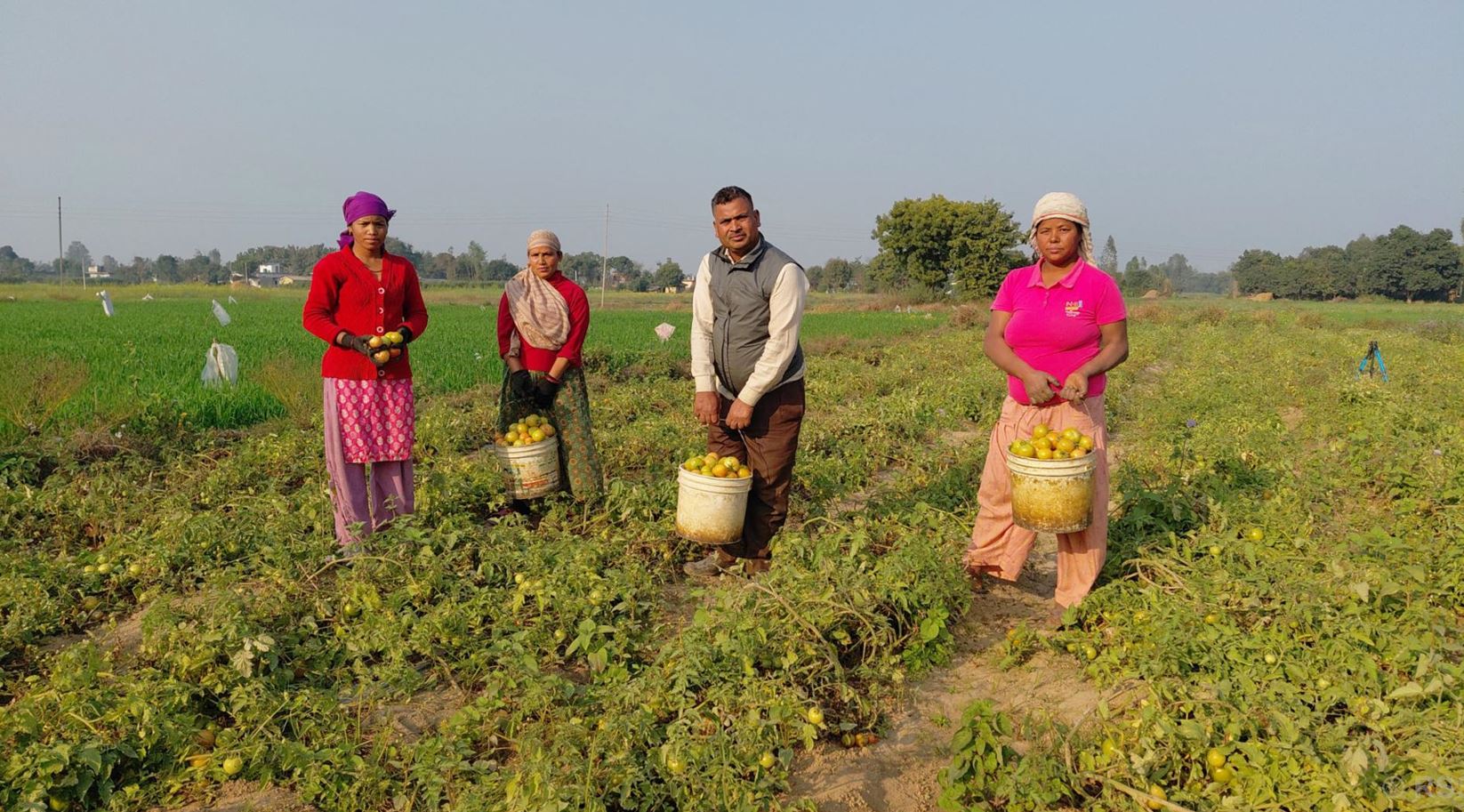
Banke. “My two sons took a loan of Rs 7 lakh and went abroad. It took them two years to repay the loan. I also took a loan of Rs 7 lakh to cultivate tomatoes. I sold tomatoes in two months and repaid all the loans,” said Birendra Prasad Murau, a farmer of Si village of Khajura Rural Municipality-2 in Banke district. ”
Birendra’s statement clearly shows the economic difference between foreign employment and commercial agriculture done in the country. The Murau family, which has been cultivating tomatoes continuously for three generations, has now adopted modern methods and made farming a strong base of income.
Birendra has been commercially cultivating tomatoes in four bighas of land this year. According to him, the initial investment for this has reached around Rs 7 lakh. “We invest in seeds, fertilizer, plastic, irrigation, labor and pesticides,” he said, adding, “If the market is good, the investment will be collected in two to three months.” ”
Birendra, who started picking tomatoes from the third week of November, has so far earned more than Rs 6.500 million by selling about 100 quintals of tomatoes. “More than 1,000 quintals of tomatoes are yet to be harvested,” he said, adding, “If all are sold, it is estimated that the transaction will be around Rs 60 to 7 million this year.” ”
This year, the market price of tomatoes has reached Rs 70 per kg, which has given a big relief to the farmers. “When the price is good, we feel that the hard work of the farmers is worth it,” said Birendra. Modern mulching technology has been used to reduce the cost of production.
According to Birendra, tomato farming is not a new profession. “My father had been cultivating tomatoes since 036 BS. My father ran his family for three generations by cultivating tomatoes in the traditional way,” he said. So I’ve been doing it with modern technology since I started farming. ”
Birendra has been taking full care of farming for the past three years after his father passed away. “I adopted a modern system,” he said, “Then production increased, cost decreased and income became significant.” ”
Last year, Birendra had taken a loan of Rs 5.10 lakh for tomato farming. “I repaid the loan taken in August within two months,” he said. With the profit from tomato farming, he has even bought an auto for the transportation and sale of tomatoes. “Earlier, we had to find a means of rent, now we have our own means. I have bought an auto for sale by transporting tomatoes,” he said.
Tomato farming has not only increased the income of the family, but has also created local jobs. “This farm requires 10 to 20 labourers,” said Birendra, adding, “The daily wage work has benefited the people of the village.” According to him, grants and technical support from the government have made farming easier.
“The concerned body had inspected my farming under the Prime Minister Agriculture Modernization Programme,” he said. He believes that the cost will be further reduced if mulching materials and rotavators are available for ploughing the fields. Birendra said that farmers can become self-reliant if the government grant is properly utilized. “The subsidy should not be misused, it should be used to increase production,” he suggested.
Referring to his sons’ departure abroad, he said emotionally, “They left thinking that nothing could be done in Nepal. But why can’t it? If you do it in your own country, you can grow gold in your own farm. ”
Next year, Birendra set a target to increase the area under tomato farming from four bighas to 10 bighas. “Around 20 people can be employed daily by cultivating 10 bigha of land,” he said. Those who did not believe in asking for a loan in the beginning said that nowadays they do not hesitate to give a loan. “It takes a year to earn Rs 400,000 in foreign countries, but I have earned Rs 5-6 lakh in just 10 days from tomato farming,” he said. ”
According to him, the import of vegetables from India has been decreasing after the government introduced modern farming programme. “We have a joint family of 10-15 people from tomato farming,” said Birendra.
The story of the Murau family, who have been cultivating tomatoes continuously for three generations, has become an inspiring example of economic self-reliance not only in Banke but for farmers and youths across the country. Birendra’s success has given the message that with hard work, planning and the right investment, the future can be secured in the fields.
















प्रतिक्रिया दिनुहोस्