


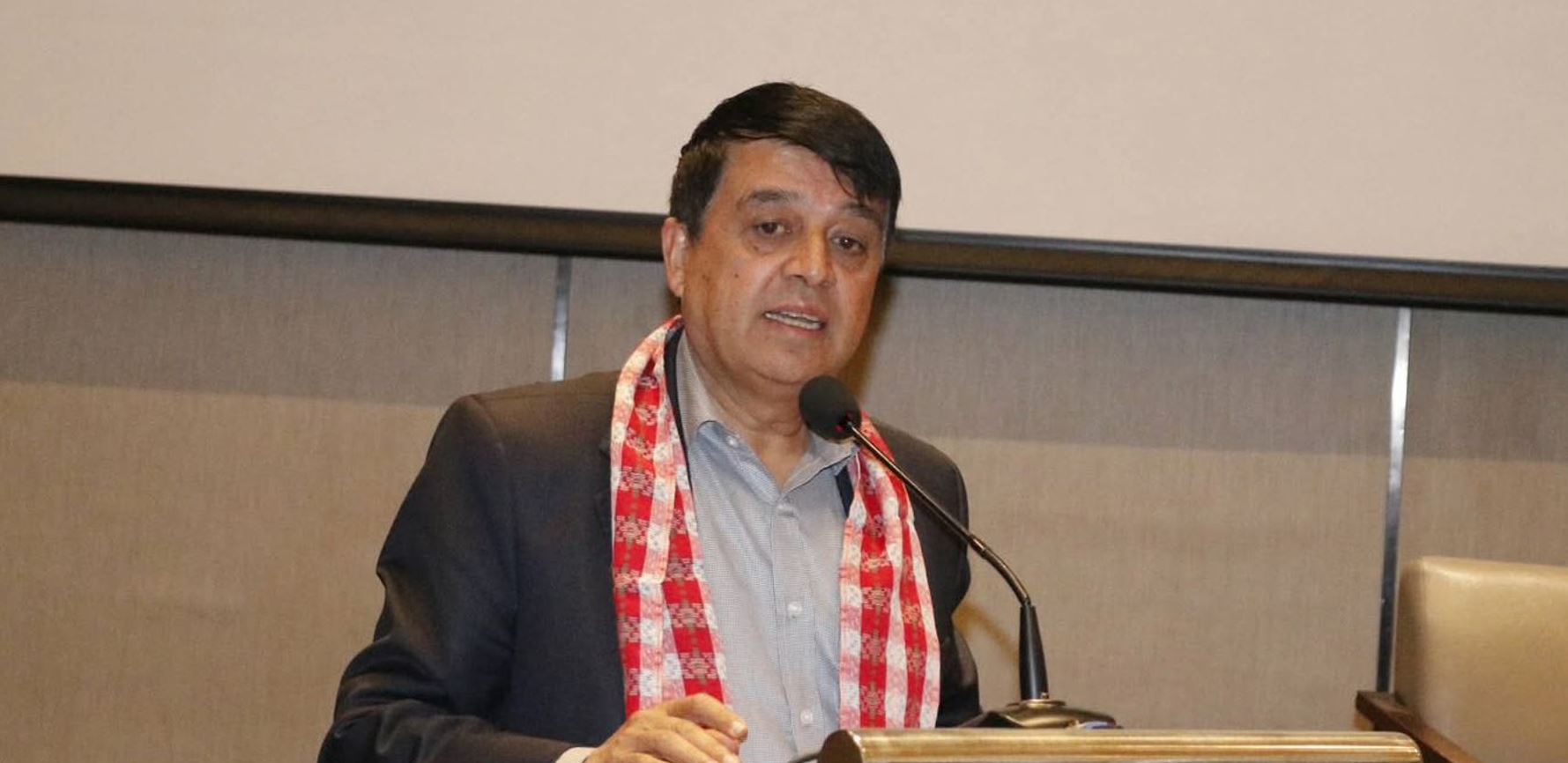
Kathmandu. KATHMANDU: President of the Federation of Nepalese Chambers of Commerce and Industry (FNCCI), Chandra Prasad Dhakal, has stressed the need for political parties to establish their economic agendas.
Speaking at a programme entitled ‘Economic Agenda in the Party’s Manifesto’ organized by Japheez here today, Dhakal said that the tendency to establish established by abusing other political parties should not flourish. He said that economic issues have never been given priority in the manifesto of any political party.
“There is a tradition of political leaders showing bad depictions of other parties. No one is interested in establishing their own agenda,” Dhakal said.
He said that the negative perception of the political parties towards the private sector has also affected them at different times. “The contribution of the private sector to the state has not been discussed by the political leaders and political parties. Why is there no discussion about employment generation and paying taxes?” he asked. They look for popularity while making decisions. Although the state is bound to suffer, the trend of making decisions like making headlines has increased. ’
According to Dhakal, the economy cannot be revived if the state does not promote and protect the private sector.
On the occasion, President of the Federation of Contractors’ Associations of Nepal Rabi Singh suggested the political parties to give priority to infrastructure development in their manifestos. He further said that the parties should prepare manifestos only for the purpose of making manifestos or they should prepare manifestos that will be implemented in practice.
“What all political parties should be aware of is that the Nepali people no longer believe in elections only,” he said. The election will be held in 2082, but more important than the outcome is the development of the country, and that development cannot be limited to the political agenda alone. ’
He also said that the infrastructure sector should not be ruined by doing stunts targeting the outgoing Minister for Physical Infrastructure and Transport Kulman Ghising. He said that although the discussions were held only keeping the political agenda at the centre, the political agenda should be the main priority of the parties.
“Nepali people have also expected the same,” he said. But now there is a lack of serious debate and a clear vision on the economic agenda within the parties. How to reduce corruption in the country today, how to maintain economic good governance – these issues should be the main agenda of the manifesto. ’
According to him, the development of the country is not possible without correctly identifying the development and emergence of capital. According to him, priority should be given to industry, infrastructure and manufacturing sectors that create employment. “Lately, the infrastructure industry and construction entrepreneurs have been portrayed in a negative light, which is not fair. Why can’t construction practices that have been successful around the world be implemented in Nepal? Why have we not been able to learn from the experiences of countries like Japan, Europe and China? There has also been no clear review of how effectively the Nepal Army can play in mega projects. ’
He argued that some legal amendments were made after going for federalism, but they were not sufficient. “Many projects have been stalled, especially due to Section 69 (8) of the Public Procurement Act. Parties must now recognize the real problems of these problems. Merely amending that section is not enough. Now, one act is going to block the other. Political parties should accept the infrastructure industry as the key sector to keep the country’s economy moving. If this mindset is not changed, even the 2082 elections will not be able to give a way out to the country, he added.















प्रतिक्रिया दिनुहोस्