


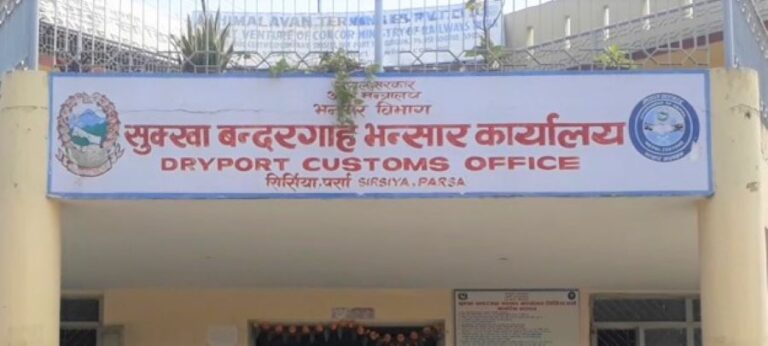
Birgunj. In the first six months of the current fiscal year, 572 railway rakes have brought goods and goods to the dry port under the Birgunj Customs Office.
Kamal Gyawali, chief of Nepal Intermodal Transport Development Committee, Birgunj, said that the number of railway rakes has decreased in the current fiscal year due to the problem of haltage seen in the Indian Railways. In comparison to the last fiscal month, goods and goods were brought through 16 less railway rakes.
In the first six months of the last fiscal year, goods and goods were brought through 588 railway rakes. Cargo is brought to Birgunj by rail from Kolkata, Haldia Port and Visakhapatnam Port. Goods can be brought in 45 containers of 40 feet capacity and 90 containers of 20 feet capacity through railway rakes at a time.
Kamal Gyawali, chief of Nepal Intermodal Transport Development Committee, Birgunj, said that the import of goods through railway rakes has decreased by 16 in the first six months of the current fiscal year compared to the same period of the last fiscal year. In the current fiscal year, 94 rakes were brought through railway rakes, 90 rakes in August, 101 rakes in September, 91 rakes in October, 92 rakes in November and 104 rakes in December.
In the last fiscal year, goods and goods were brought through 99 railway rakes, 102 in August, 110 in September, 79 in October, 90 in November and 108 in December. Sponge iron, chemical fertilizers, gypson, iron, coal, etc. are mainly imported to the dry port.
Abhishek Mishra, operation in-charge of Pristine Valley, which operates and manages a dry port under the Birgunj Customs Office, said that problems seen in the Indian railway system for the past two months are gradually lessening. “The railway service was slightly affected in Bihar state of India until some months back also owing to the elections and festivals”, he said. According to him, it will take eight days to reach the railway rakes from Kolkata to Birgunj and 10 days from Vishakhapatnam.












प्रतिक्रिया दिनुहोस्