


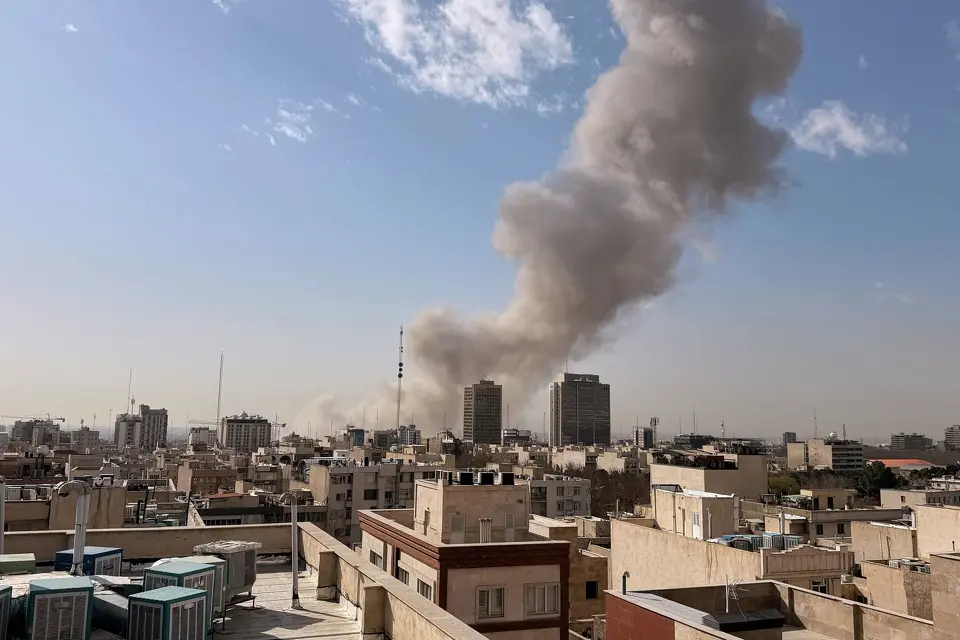
Kathmandu. The Middle East has been plunged into unprecedented tensions after the United States and Israel launched a series of airstrikes on Iran.
Iran’s Supreme Leader Ayatollah Ali Khamenei was killed in the attack. This has intensified the risk of regional war.
The joint U.S.-Israel military operation that began on Saturday morning hit strategic targets in Tehran, including Tehran.
Israel’s military said it deployed 200 fighter jets and attacked more than 500 targets. Missile launchers and senior Iranian officials are said to be among the main targets. Israeli Prime Minister Benjamin Netanyahu warned that action would continue to target thousands more.
Meanwhile, President Trump through his Truth Social network said he had launched a campaign to “eliminate the imminent threats” and said that heavy and precision bombardment would continue when necessary. He called Khamenei “one of the most evil people in history” and declared him dead. Hours later, Iranian state television confirmed Khamenei’s death with a black banner and archival footage. Iran has declared 40 days of national mourning and seven public holidays to mourn Khamenei’s death.
According to Iranian media, Khamenei’s daughter, son-in-law and granddaughter were also killed. The country’s judiciary confirmed that the head of the Revolutionary Guards, Gen. Mohammad Pakpour, and his top security adviser, Ali Shamkhani, were “martyred” in the attack. After Khamenei’s death, President Massoud Pezeskian and two other senior officials will take over the leadership temporarily, state television reported. Reza Pahlavi, the late Shah’s son, described the attack as a step towards the end of the Islamic Republic.
Powerful explosions were still heard in Tehran on Sunday, AFP correspondents said, although the source was not clear. Iran’s judiciary said 108 people had been killed in an attack on a girls’ school in Minab, but AFP could not confirm it independently.
Iran’s Revolutionary Guards have launched the first wave of missile and drone attacks on Israel in response to the US and Israeli action. On Saturday, the US Fifth Fleet in Bahrain and other US bases in the Gulf were also targeted. Israel’s Magen David Adom emergency services said a woman was killed and at least 21 others were injured in the Tel Aviv area. Search and rescue teams have been mobilized across the country.
After Khamenei’s death, the Guards have threatened to launch the “most violent” operation in history. Explosions have been reported across the Gulf region. The United Arab Emirates said two people, including a Pakistani citizen, were killed in Abu Dhabi, while 137 missiles and 209 drones were fired into its territory. Witnesses said there were explosions in Dubai and smoke billowing in the Palm area. Four others were injured.
Explosions were also heard in Riyadh, Manama and Doha, AFP correspondents said. Qatar has said it has intercepted several missiles fired against it. Two people have been killed in an airstrike on a Katab Hezbollah base in Iraq, and the group has threatened to retaliate against the United States. Iran has announced steps to close the strategic Strait of Hormuz, which supplies a large part of the world’s oil and gas.
The development has also caused serious concern to the international community. The UN Security Council has called for an emergency meeting. Iran’s representatives have accused the United States and Israel of carrying out possible war crimes by attacking civilians. UN Secretary-General Antonio Guterres has warned that military action could lead to spiral out of control.
Oman’s foreign minister, who is mediating the Tehran-Washington talks, said he was “disappointed” by the violence. The European Union (EU) has described the situation as “dangerous”. The Gulf states condemned Iran’s attack in a joint statement, while Russia called the US-Israel action a “dangerous adventure” that could lead to regional destruction. Lebanon’s Hezbollah group has called on regional nations and people to stand up to the US and Israel.
Iran, Iraq, Kuwait, Syria, the United Arab Emirates and Israel have partially or completely closed their airspace for civilian flights. A number of international airlines have suspended flights to the Middle East. Russia said it had suspended commercial flights to Iran and Israel until further notice.
The conflict, which began in Tehran, has now directly drawn the Gulf region and world powers, strengthening the possibility of a wider regional conflict.

















प्रतिक्रिया दिनुहोस्