


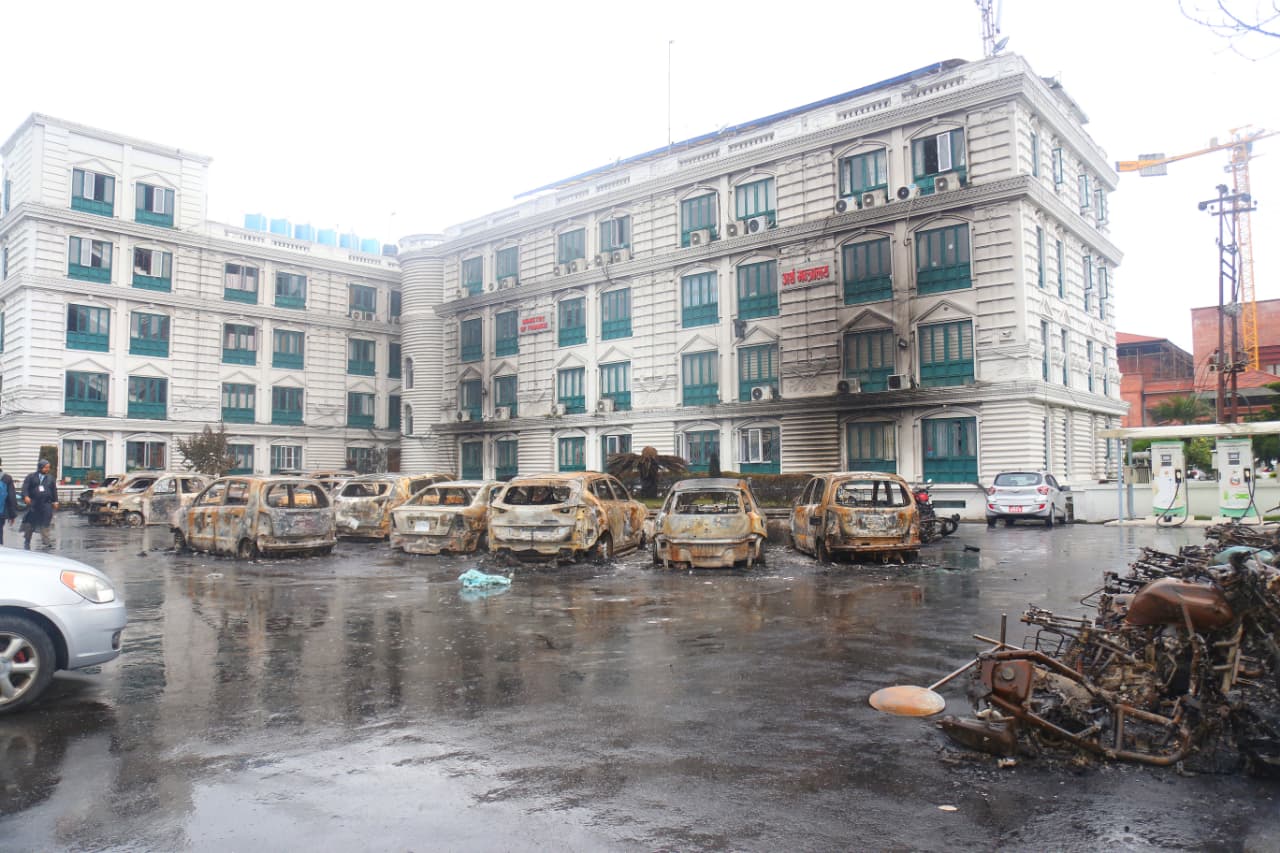
Kathmandu. The government has unveiled a detailed action plan for the reconstruction and remanagement of the earthquakes that took place in different parts of the country on September 9 and 24.
The action plan prepared on the basis of the report of the committee formed under the leadership of Vice-Chairman of the National Planning Commission, Dr Prakash Kumar Shrestha, has incorporated issues ranging from the extent of damage, reconstruction strategy, resource management and revitalization of the private sector. Likewise, an action plan has been prepared in such a way that all three tiers of governments will allocate budget for the reconstruction in the current fiscal year and the next two fiscal years.
The Commission has planned to implement the reconstruction works in a phased manner. It is stated in the action plan that works would be forwarded on the basis of immediate, medium-term and long-term strategies. Similarly, the action plan has given priority to the mobilization of internal resources as the main basis of the reconstruction. All three tiers of government will forward the reconstruction work from their own resources, and the federal government will provide support if necessary. Likewise, a strategy has been adopted to take forward the reconstruction in a coordinated manner in collaboration with the private sector and non-government organizations.
Joint Spokesperson of the National Planning Commission, Dr Dibakar Luitel, said that budget should be allocated accordingly by preparing short-term and long-term plan for the reconstruction of damaged structures. “Some works have already been started from the budget of the current fiscal year. While preparing the budget for the coming fiscal year, discussions are underway to allocate a specific budget for the reconstruction of the damage caused by the Jenji movement. The objective is to get all three tiers of government to give priority to this issue in the budget for the coming fiscal year,” he said.
According to the action plan, the government has laid emphasis on building service-friendly, economical and disaster-resilient infrastructures and has set the goal of minimizing such losses in the future. The federal government will need around Rs 4.34 billion in the current fiscal year and Rs 10.18 billion in the next two fiscal years. Similarly, the provincial government will need around Rs 812.5 million in the current year and Rs 1.46 billion in the next two years. It has been estimated that Rs 1.42 billion will be required for the local level in the current year and Rs 3.21 billion in the next two years.
All three tiers of government have adopted a policy of transferring funds from the current budget for primary maintenance, utilizing existing vehicles and assets and purchasing new ones only if necessary. In addition, a provision of compulsory insurance of all government property has also been proposed.
The government has adopted a policy of tightening expenditure management to raise necessary resources for reconstruction. The policy has been adopted to cut small, fragmented and ineffective projects, the federal government should not take over projects costing less than three crore rupees, and such programs would be handed over to the provinces and local levels.
In addition, some of the programs being run by the federal government, such as micro-enterprise development, people’s housing, and thatch-free programs, will now be removed from the federal level to be run by the local level. The government is also planning to raise support from development partners and Non-Resident Nepalis (NRNs) in the fund. It also states that the state will respect those who provide such assistance.
The private sector has also been severely affected by the agitation. Of the total damages amounting to Rs 33 billion, business establishments have been the most affected. The business sector has suffered a loss of around Rs 27.49 billion while individual households have suffered a loss of Rs 6 billion. The structural analysis shows that about 45 per cent of buildings and houses, 5.5 per cent of vehicles and the rest of other properties have been damaged. Insurance claims worth around Rs 23 billion have been received.
The damage caused by the weakening economy after COVID-19 and external pressure has further weakened the morale of the private sector, it said. The government has proposed various relief and relief programs for the revival of the private sector. The action plan also mentions urging the local levels to waive the map pass fee of damaged buildings and waiving property tax for three years.
Provision has been proposed to provide concessional loan from Nepal Rastra Bank and other financial institutions in case of lack of liquidity in insurance companies and early payment of claims of insured structures. Likewise, the action plan includes providing concessions in the banking sector, converting the current capital loan into installment loan, extending the loan restructuring period till the Ashad 2083 BS and extending the grace period as per the need. Similarly, a provision of providing loans at fixed interest rate for five years has also been proposed, in which only 0.5 percent premium should be added to the base rate.
The state should make arrangements to provide partial relief to the public service recipients in case their vehicles, mobiles, laptops, clothes and other belongings are damaged during the agitation. According to the action plan prepared by the NHRC, up to 25 per cent of the total loss could be provided through the District Administration Office on the basis of police reports.
Although the government has unveiled a detailed action plan, its effective implementation has been challenging. Fiscal discipline, coordination and transparency are needed to complete the reconstruction work of this magnitude at a time when revenue collection is weak, expenditure is increasing in the federal structure and financial pressure is high.
According to government data, the protests caused a total loss of Rs 84.45 billion. Among them, the government and public sectors have been affected the most, while the private sector has also been severely affected. The government structures alone suffered losses worth Rs 44.93 billion while the private sector suffered losses worth Rs 33.54 billion. According to the report, around Rs 5.97 billion has been damaged in the community and other areas.
Within the government structure, the federal government seems to be the most affected. It has caused a loss of around Rs 29.67 billion. After this, the local level suffered a loss of around Rs 9.81 billion while the provincial government suffered a loss of Rs 4.49 billion.
It is estimated that around Rs 36.30 billion will be spent to reconstruct and rehabilitate the structures of the three tiers of government. Of this, around Rs 20 billion will be spent on the reconstruction of the building. Similarly, Rs 6.16 billion will be spent on vehicle purchase and Rs 10.14 billion on other assets.













प्रतिक्रिया दिनुहोस्