

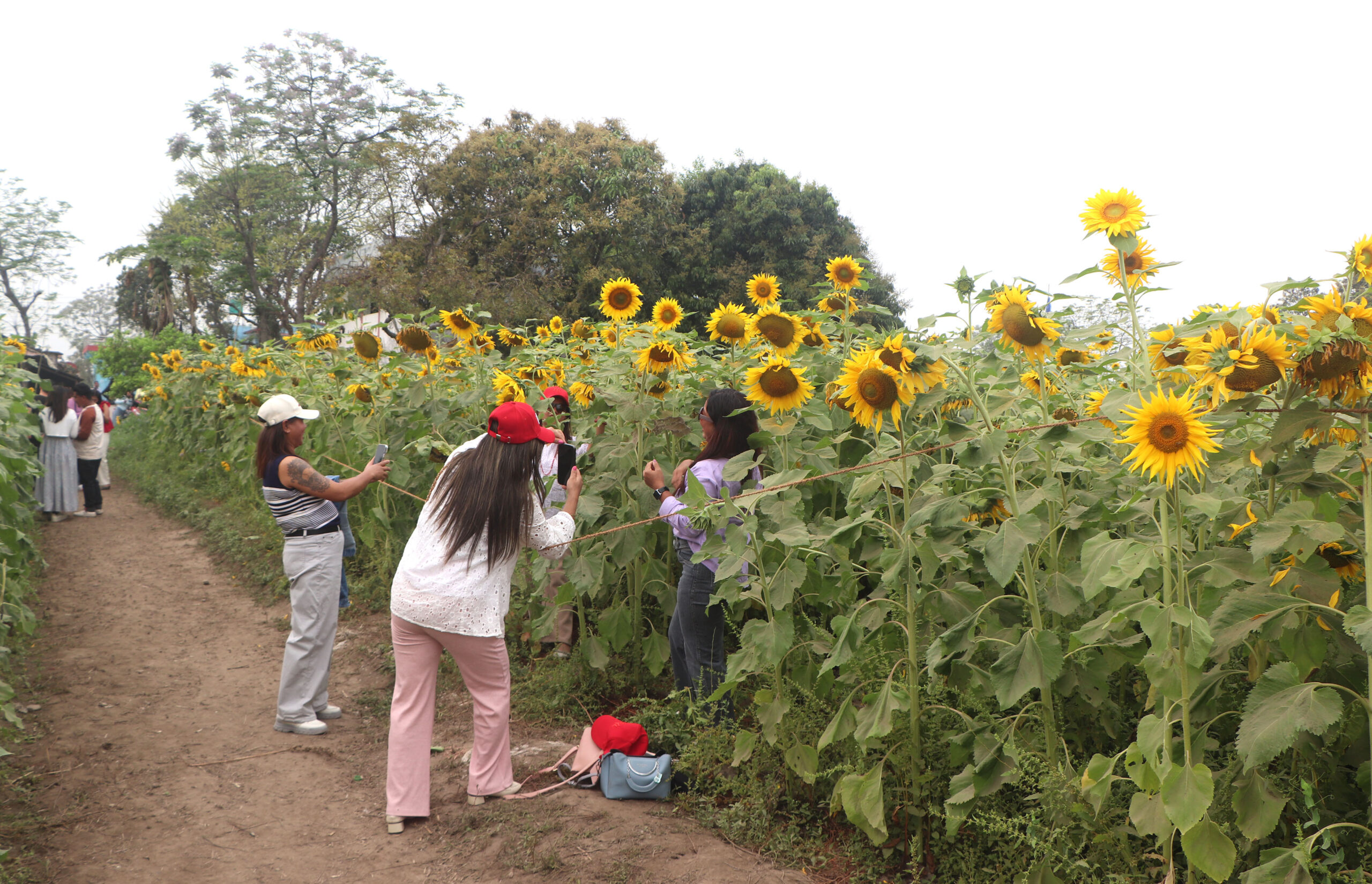
Chitwan. Organic farmer Chandra Prasad Adhikari’s garden at Bharatpur Metropolis-15, Phulbari, has started seeing the sunflower garden with the flowers blooming. The number of people coming to see the sunflowers blooming in about two and a half bighas of land is increasing day by day.
Here some are found making Tiktok, while some are seen studying, observing and some are enjoying taking photos. The view of bees collecting nectar in flowers and roaming around the garden and ‘dummies’ placed to scare away parrots and other birds to protect the crops have made this area more attractive. Sitting on the scaffolding built in the middle of the garden, you can enjoy the sunflower garden spread all around.
Pawan Adhikari and Uljhna Adhikari, who came to observe from Bharatpur-3, said that they found the local environment very pleasant. He also urged others to come and observe the beauty of the flowers and cheer up for some time.
Similarly, Geeta Khadka, Asma Gurung, Jenny Chaudhary, Sanu Chaudhary and Sana Chaudhary said that the garden is very attractive. Those who came from Narayangadh said that although they were planned to come last year, they could not come due to the drying of the flowers. They say that seeing them on TikTok inspired them to come here.
The plantation, which was created with the aim of promoting agro-eco-tourism, has not only made the area vibrant but has also inspired the youth to take up agriculture. At present, around four to five hundred people come here from different places on a daily basis. Due to the limited flowering time, the crowd of visitors is more during this period. “Most of them came to have fun, take pictures and make TikToks. Some have even come to understand farming. Where are the seeds found? “I also have land, I will also plant,” he said. I have taught as much as I can what I know. According to him, youths are also getting attracted towards this farming and there is possibility of agro tourism.
Organic farmer Adhikari said that he has started farming for 36 years without using any chemical fertilizers or pesticides. Organic farming system has also been adopted in some places of the district under his initiative. Along with sunflower, he has also been cultivating carrots and beetroot.
According to him, carrot and beetroot were cultivated here last year and sunflower was planted last year as well. He said that sunflower cultivation has been done again this year. He said that after getting good response from the visitors last year, this year also sunflowers were planted and so far it has been doing well. According to him, a huge investment has been made in plantation, rearing and management to establish this plantation. He brought seeds from the oil crop research program Sarlahi and started sunflower farming here. He said that there is no problem in the market for organic products produced here. The products from here go to the Organic Mart in Kathmandu. Sunflower oil is sold at Rs 800 per liter.
According to him, sunflowers planted in the beginning of November give produce in March. People come to observe the flowers at this time. “Agriculture is linked to tourism during the flowering season”, he said, adding, “In the beginning, I was involved in eco-friendly agriculture and later tourism was also linked to it.” He says that one should not expect high profits in agriculture. “Agriculture is a matter of happiness in itself,” he said. He said that he was also encouraged by the visitors coming for observation.
He said that due to the geographical diversity of Nepal, different types of agricultural systems can be adopted in different places. “The country can be provided with the necessary goods by producing it according to every geography and the rest can be exported,” he said, adding that for this, consultation of agriculture experts and support of policy makers is necessary. Stating that there was good potential of agriculture in Nepal, he suggested adopting different types of agro crops and agricultural methods after knowing and taking advice from experts.













प्रतिक्रिया दिनुहोस्