

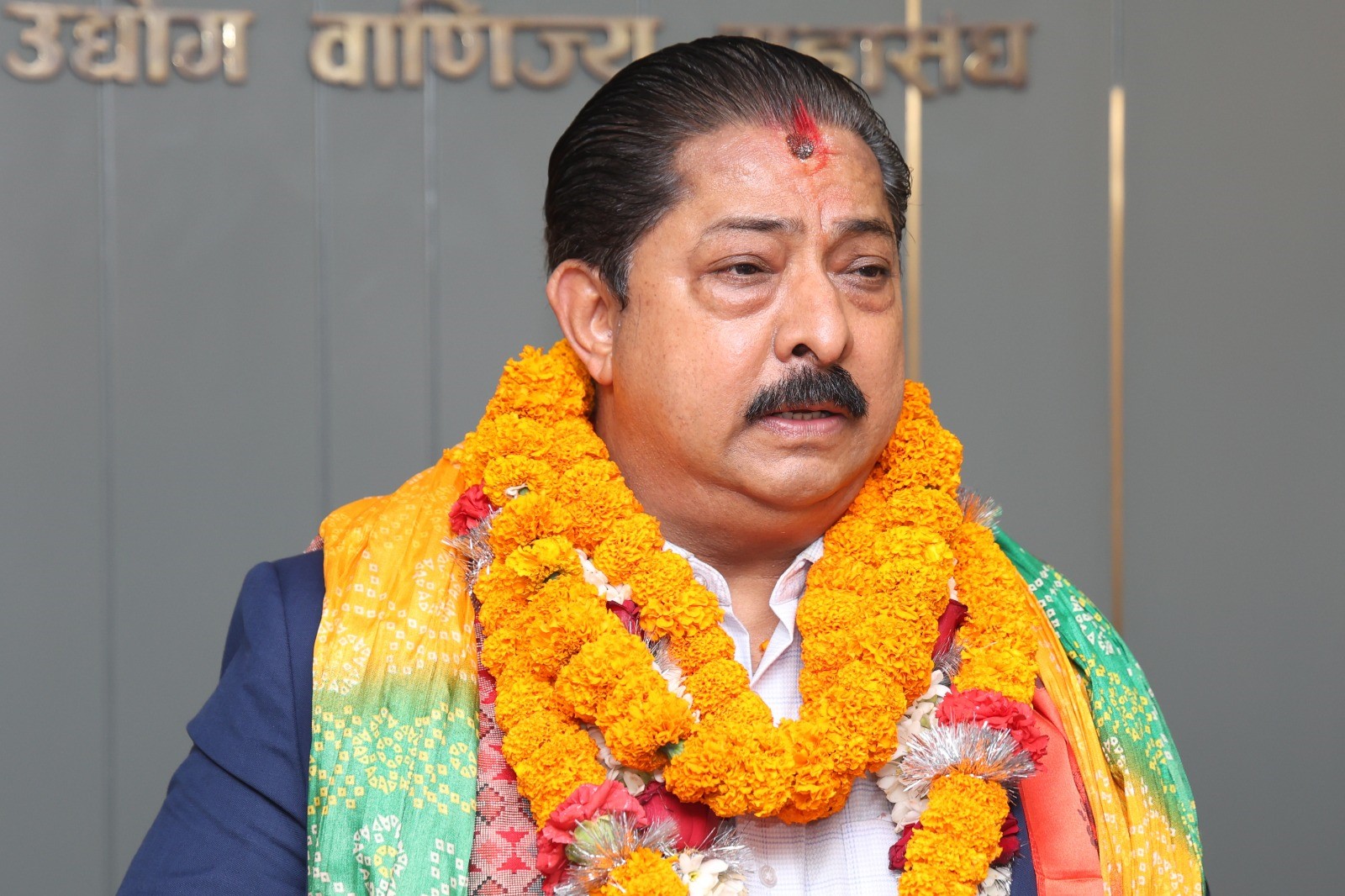
Kathmandu. Anjan Shrestha, president of the Federation of Nepalese Chambers of Commerce and Industry (FNCCI) who was elected from the 60th annual general meeting of the Federation of Nepalese Chambers of Commerce and Industry (FNCCI), has pledged to implement six pillars and 60 initiatives during his tenure.
The FNCCI has decided to implement strategic programmes and action plan to move forward by prioritizing the long-term welfare of the private sector, creating investment-friendly environment and institutional strengthening of the FNCCI.
The “6 Pillars, 60 Initiatives” programme prepared with the objective of making the common voice of the private sector more effective, credible and result-oriented by enhancing the institutional capacity of the FNCCI and related detailed action plan would be implemented with the assumption of office of FNCCI President Shrestha.
The “6 Pillars, 60 Initiatives” program has been prepared by the FNCCI covering the protection of rights and interests of the private sector, promotion of industry and business, protection and expansion of investment, enhancement of effectiveness of policy advocacy, strengthening coordination with member organizations as per the federal structure, modernization of service delivery, development of digital system, promotion of youth entrepreneurship and innovation, expansion of international trade and economic diplomatic relations, among others.
Under the program, a detailed action plan with implementable initiatives, timeline, responsibility determination and expected achievements was prepared under each pillar and it was decided to implement it in a phased manner with the assumption of office of the Chairperson.
Anjan Shrestha
President
Column 1 • Strengthening the services provided by the Federation and expanding the network
01 Detailed Needs Assessment of District, Objective, and Associate Members
02 Strengthening and Professionalization of Federation Secretariat
03 Establishment of separate district and commodity desks to make the services provided by the Federation effective
04 Digital membership portal for service consolidation, mobile app for members and service delivery monitoring system
}
05 Creation of Policy, Professional and Administrative Problems and Grievance Management and Redressal System of 05 Members
06 Effective operation and management of commercial dispute resolution and arbitration system
07 Institutional sustainability of District and Municipal Chambers of Commerce and Industry, Diversification of Income and Coordination Program with Provincial and Local Governments
08 Facilitation and improvement in other administrative services required by members, including certificate of origin
09 Startup and Young Entrepreneur Promotion Program
10. Increase in institutional income and improvement in financial governance of the federation
11. Reforms in Corporate Good Governance including Annual General Meeting of Federation and Member Organizations
Column 2 • Economic Reforms and Good Governance
12. Establishment of Public Policy, Economy, Business and Law Research Branch in the Federation
13. Establishment of a Law Desk in the Federation for the protection of members and regulatory advice
14. Active support for the government’s governance reforms and second phase of economic reforms
15 Policy Recommendations on the Budget, Monetary Policy, and the Economy, and the Private Sector
16 Monthly Economic Summary and Quarterly State of the Economy Report
17. Active involvement in the formulation of laws, rules, bylaws and directives relating to the private sector, economy and business
18 Creation of a private bill led by the Federation
19 Business Confidence Survey and Private Sector Morale Index
Implementation of MoUs with 20 Universities and Research Institutions
21 Initiation of Policy Dialogue Series at the Federation
Column 3 • Competitiveness and growth
22 Made in Nepal and Local Products Promotion Campaign
23 Industrial Zones and Special Economic Zones (SEZ) Initiatives in Partnership with the Government
24 Action Plan to Enhance Competitiveness of Major Sectors of Production
25 Strengthening of FNCCI’s provincial offices for micro, small, medium enterprises, start-ups and business development services
26 Joint dialogue with foreign chambers to enhance the competitiveness of production-oriented industries
}
27 Contract Manufacturing and Assembly Promotion Program
28 Expansion of Regional Value Chains and Cross-Border Production Linkages
29 Export Promotion, Trade Facilitation and Logistics Improvement Program
30 Initiative on Policy Facilitation for Import Substitution for Strategic Goods
31 Digital Transformation and Technology Facilitation for Nepali Enterprises
Column 4 • Development Cooperation and Private Sector Development
32 Development Partnership Branch in the Federation
33 Expansion of bilateral cooperation for the development of the private sector
34 Coordination with Provincial and Local Governments for the Promotion and Expansion of the Private Sector
35 Skill Development and Human Capital Building
36 Women’s entrepreneurship development through bilateral means
37 Overseas Nepalese Investment Facilitation
38 Climate, green finance, and the creation of private sector programs in line with the Sustainable Development Goals (SDGs)
39 Formulation of Alternative Finance Mobilization Strategy for Private Sector
40 Federation of Nepalese Investment and Business Summit
41 Preparedness and Support Programs for Upgradation in Developing Countries
Column 5 • Improving Labour, Skills and Productivity
42 Skill Academy Established as National Level Industry Training Institutes at the Initiative of FNCCI
43 Formulation of a Tripartite Partnership between Industry-Academia-Government
Uniform Occupational Standards Framework for 44 key sectors
45 Skill Development and Re-skill Training
Program Launched
46 Technical and Vocational Education (TEVT) Promotion and Skill Education Initiative
47 National Skills and Demand Survey and Preparation of Vocational Labour Sector Report
48 Creation of a productivity-based wage blueprint
49 Establishment of an Effective Arbitration Centre in the Federation for Labour and Industrial Disputes
50 Skills Utilization, Transfer and Entrepreneurship Program Targeted by Returning Foreign Employment Workers
51 Initiatives and Advocacy for Effective Implementation of Labour Act and Contribution-Based Social Security Reform
Column 6 • Private Sector Promotion and Protection
52 Private Property and Business Rights Charter
53 Anticipatory bail and advocacy for decriminalization of commercial disputes
54 Ease of Doing Business Improvement Program
55 Professional Harassment Monitoring and Creation of Confidential Complaints Mechanism
56 Initiatives for Damasahi, Contract Enforcement and Professional Justice Reform
Expansion and strengthening of sectoral industries through 57 commodity associations
58 Foreign Chambers, Multinational Company Councils and International Partnership Network Building
59 Mass Communication, Media and Public Discourse Strategies
60 Formulation of Business Code of Conduct and Good Governance
Six Pillars • Initiatives for • One Federation











प्रतिक्रिया दिनुहोस्